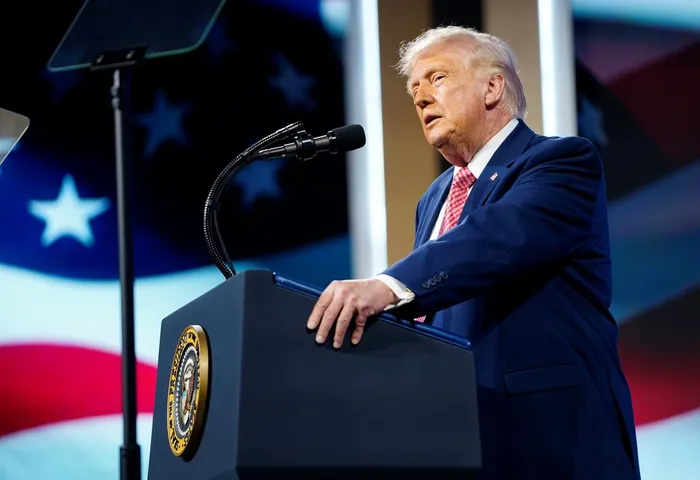
The floor of the Supreme Court is a sea of marble, cold and silent, designed to dwarf the humans who walk upon it. It is a place where history isn’t just studied; it is manufactured. On a Tuesday morning that feels heavier than the ones preceding it, the air inside the chamber carries a specific kind of electricity. Most days, the gallery is filled with law students and tourists. Today, however, a former president—and the current architect of a movement—intends to occupy a seat in the front row. Donald Trump isn’t just coming to watch a legal argument. He is coming to witness the potential dismantling of a 157-year-old promise.
At the heart of the case is a single sentence in the 14th Amendment. It is a sentence that has served as the bedrock of American identity since the dust settled after the Civil War. "All persons born or naturalized in the United States, and subject to the jurisdiction thereof, are citizens of the United States." To many, these words are a heartbeat. To the man sitting in the gallery, they are a loophole.
Consider a hypothetical woman named Elena. She is not a statistic or a line item in a budget. She is twenty-four years old, a nurse in an Ohio neonatal unit, and she has never seen the inside of a passport that wasn't navy blue with a golden eagle on the cover. Elena’s parents crossed a river twenty-five years ago without a visa. She was born in a humid hospital room in El Paso. By the current law of the land, she is as American as any descendant of the Mayflower. But if the arguments echoing through the chamber today hold weight, Elena’s reality begins to fray at the edges.
The legal debate centers on the phrase "subject to the jurisdiction thereof." For over a century, the courts have interpreted this to mean almost everyone physically present on U.S. soil, excluding only the children of foreign diplomats or invading armies. The new argument being championed by the former president is far more restrictive. It suggests that if your parents weren't here legally, they didn't owe "total" allegiance to the United States, and therefore, you—the child—don't inherit the right to belong.
It is a surgical strike on the concept of home.
The presence of a former president in the courtroom changes the physics of the room. It transforms a dry constitutional inquiry into a high-stakes political theater. Trump’s arrival signals that this is no longer a fringe academic theory discussed in the corners of conservative law schools. It is a front-line objective. By physically occupying space in the Supreme Court, he is reminding the justices, and the nation, that the executive branch he seeks to lead again believes the 14th Amendment has been misread for generations.
The stakes are invisible until they aren't.
If birthright citizenship is curtailed, we create a permanent underclass. We invite a ghost population—people born here, raised here, and speaking only English, yet possessing no papers to prove they exist in the eyes of the law. Imagine the logistical nightmare. A child is born in a hospital in Phoenix. Under the proposed shift, the hospital staff wouldn't just record a birth; they would essentially have to act as immigration agents, verifying the status of the parents before a social security number could be issued. The burden of proof shifts from the state to the infant.
This isn't just about immigration. It’s about the definition of a nation. Is America an idea that you join by the sheer luck of your first breath on its soil? Or is it a private club where membership is strictly hereditary?
The 1898 case of United States v. Wong Kim Ark is the ghost haunting the room. Wong Kim Ark was born in San Francisco to Chinese parents. When he returned from a trip to China, he was denied re-entry on the grounds that he wasn't a citizen. The Supreme Court eventually ruled in his favor, cementing the "jus soli" or "right of the soil" principle. To overturn this now would be to reach back through time and undo a thread that has held the social fabric together through world wars and civil rights movements.
The argument for ending birthright citizenship often leans on the idea of "incentives." The claim is that the promise of citizenship for children acts as a magnet for illegal border crossings. But if you talk to those who have made the journey, the stories are rarely about a long-game legal strategy for an unborn child. They are about fleeing a gang in Honduras or a drought in Guatemala. They are about survival in the next ten minutes, not a passport in twenty years.
The tension in the courtroom is a reflection of a deeper anxiety in the American psyche. There is a fear that there isn't enough to go around—enough jobs, enough space, enough "Americanness." When resources feel scarce, the first instinct is to build a fence, and then to check the credentials of everyone already inside the yard.
But look back at Elena in the neonatal unit. She is holding a child whose lungs are struggling to pull in air. She isn't thinking about jurisdictions or constitutional originalism. She is doing the work of a citizen. She pays taxes. She follows the laws. She contributes to the collective health of her community. If the court decides she was never truly "one of us," the loss isn't just hers. It’s the hospital's. It’s the community's. It’s the country's.
We often think of the law as a solid, immovable mountain. In reality, it is more like a river. It shifts. It carves new paths. Sometimes it recedes and leaves the land parched. The men and women in black robes are currently holding the map, and the man in the front row is pointing to a spot where he wants the water to stop flowing.
As the lawyers wrap up their oral arguments and the justices retreat behind the velvet curtains to deliberate, the silence returns to the marble hall. The former president exits to a waiting motorcade, his presence having served as a silent brief filed in the court of public opinion. Outside, the sun hits the columns of the building, casting long, sharp shadows over the steps.
For millions of people, the wait begins. They aren't waiting for a headline or a soundbite. They are waiting to find out if the ground beneath their feet still belongs to them, or if the soil they were born upon has suddenly become foreign territory. The question isn't just what the law says, but what kind of people we become when we decide that a child’s first breath can be a crime.
The marble remains cold. The shadows grow longer. The promise, for now, hangs in the balance.