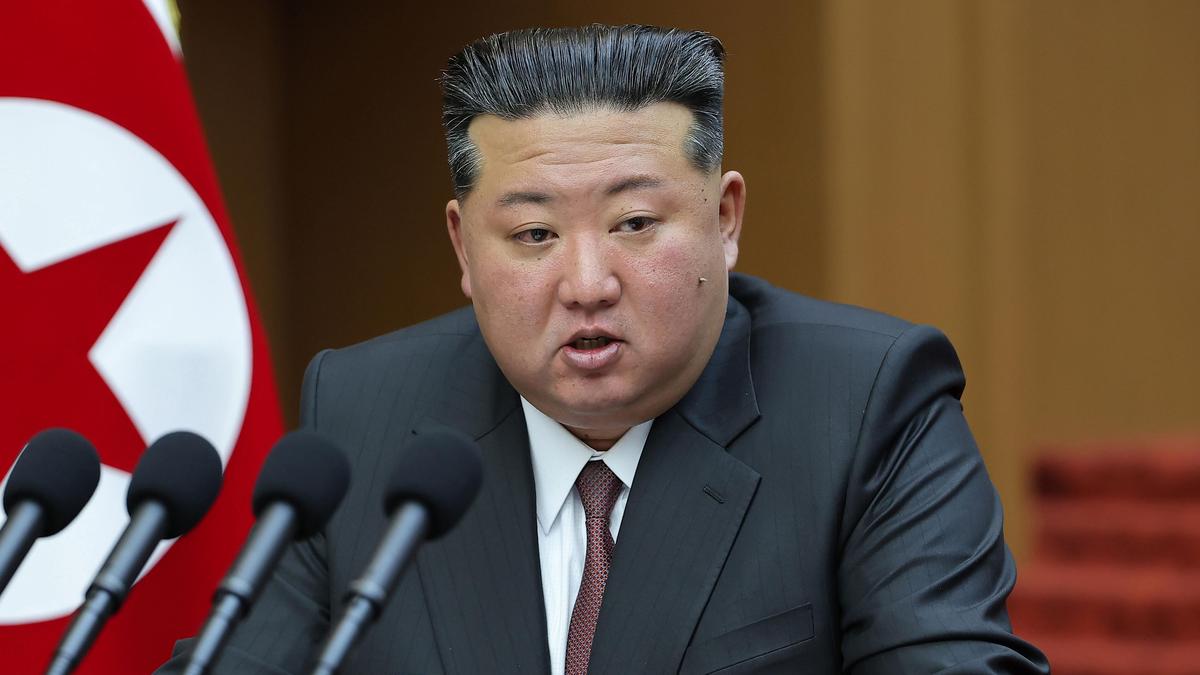
The international press is clutching its collective pearls because Kim Jong Un recently declared South Korea his "most hostile foe" and swore to "irreversibly" cement the North’s nuclear status. The consensus among the usual think-tank pundits? This is a dangerous escalation, a departure from the "reunification" dream, and a sign of a regime nearing its breaking point.
They are wrong. They are missing the signal for the noise.
Kim isn't escalating; he is clarifying. By stripping away the sixty-year-old theater of "peaceful reunification," Pyongyang has executed the most honest pivot in modern geopolitical history. This isn't a tantrum. It’s a sophisticated structural realignment that makes North Korea a more stable, predictable, and dangerous nuclear power than it has ever been.
The Myth of the "Crazy" Dictator
Western media loves the "Madman Theory." It’s a comfortable narrative because it implies that if we just find the right combination of sanctions or "strategic patience," the regime will eventually collapse or come to its senses.
I’ve watched analysts waste decades waiting for a North Korean "Spring" that was never scheduled. The reality is that the Kim dynasty is remarkably rational. They saw what happened to Muammar Gaddafi after he traded his nuclear program for Western "integration." They saw what happened to Ukraine after the Budapest Memorandum.
Kim Jong Un’s move to label the South as a separate, hostile state is a masterclass in risk management. By abandoning the goal of reunification, he removes the legal and ideological obligation to eventually absorb—or be absorbed by—a capitalist neighbor. He is effectively saying, "We aren't a broken half of a whole. We are a nuclear-armed state with a permanent border. Stop treating us like a temporary problem."
Why "Irreversibility" is a Financial Statement
When Kim talks about "irreversibly" cementing nuclear status, he isn't just talking about warheads. He is talking about the economy.
For years, the "Lazy Consensus" held that North Korea used its nukes as bargaining chips. The idea was that they would eventually trade the toys for food and lifted sanctions. This was the premise of the Six-Party Talks and the failed Hanoi Summit.
Kim has officially killed the bargaining chip theory.
By making the nuclear program a permanent, constitutional pillar of the state, he is signaling to his own elite and to foreign investors (mostly in Moscow and Beijing) that the "Nuclear-Economic Parallel Development" (Byungjin) is over. The nukes won.
This is about Path Dependency. Once you’ve sunk billions—and decades of national pride—into a specific infrastructure, the cost of "reversing" it isn't just financial; it’s existential. Kim is telling the world that the cost of denuclearization is now higher than the cost of war.
The South Korean "Identity Crisis"
The pundits are obsessed with how this affects the North. They should be looking at the South.
For decades, South Korean politics has been trapped in a cycle of "Sunshine Policy" liberals vs. "Hardline" conservatives. Both sides shared a fundamental premise: that North Koreans are "brothers" to be saved or reunited with.
Kim just blew that premise up.
If North Korea is officially a foreign, hostile enemy—not a "misguided brother"—the entire legal framework of the Republic of Korea (ROK) Constitution is under fire. Article 3 of the ROK Constitution claims the entire peninsula as South Korean territory. Kim is forcing Seoul into a corner where they must either double down on a fantasy or admit that the North is a sovereign, separate entity.
The Russia-Ukraine Catalyst
You cannot understand Kim’s "hostile" pivot without looking at the 152mm artillery shells currently raining down on Ukrainian positions.
North Korea has transitioned from a pariah state to a vital military industrial hub for the Kremlin. This is the "nuance" the headlines ignore. Kim isn't acting in a vacuum; he is acting as a newly minted partner in a revisionist bloc.
When you have a permanent seat on the UN Security Council (Russia) providing you with satellite technology, oil, and food in exchange for your massive stockpiles of "dumb" munitions, why would you care about Western sanctions?
The "Most Hostile" label for the South is a signal to Putin: "We are committed to the new Cold War. We aren't looking for a way out through Washington anymore."
Dismantling the "Imminent War" Fear-Mongering
Is war more likely because of this rhetoric? Counter-intuitively, the answer is likely no.
The "reunification" rhetoric was always the most dangerous part of the Korean conflict. If you believe the other side is part of your country, you have a "right" to "liberate" them. If you acknowledge the other side is a separate, sovereign state with nukes, you enter the realm of Mutual Assured Destruction (MAD).
Kim’s new stance is actually a move toward a "Cold Peace." It’s an admission that the status quo is permanent. He is building a wall—ideologically and physically—to protect his regime from the "cultural contamination" of K-pop and South Korean wealth.
The real threat isn't a North Korean invasion of the South. Kim knows that would be suicide. The real threat is the proliferation of this model. North Korea is proving that you can be a small, impoverished nation and still force the world to accept you on your own terms if you are willing to be "irreversible" enough.
The Strategy for the West: Give Up the Ghost
The West needs to stop asking "How do we get them to denuclearize?"
That question is a relic of the 1990s. It’s the wrong question. It’s like asking how to get a professional poker player to give back his winnings while he’s still at the table.
The real questions are:
- How do we contain a nuclear North Korea that is now a functional proxy for Russia?
- How do we prevent South Korea (and Japan) from building their own nukes in response to Kim's "irreversibility"?
- How do we manage the collapse of the NPT (Non-Proliferation Treaty) in real-time?
The Hard Truth About Sanctions
Sanctions are a tool of behavior modification. They only work if the target believes there is a "way out"—a set of actions they can take to have the sanctions lifted.
By declaring his nuclear status "irreversible," Kim has rendered sanctions 100% ineffective as a diplomatic lever. They are now merely a tax on his existence. If he has already decided he will never comply, the "pressure" of sanctions is just a static background noise.
I’ve seen governments pour billions into "monitoring" and "enforcing" these restrictions, while the North simply pivots its supply chains to the shadows of the Chinese border and the holds of Russian cargo ships.
Stop Waiting for the "Gorbachev Moment"
There is a persistent fantasy in diplomatic circles that a young, Western-educated Kim Jong Un would eventually become a reformer. They looked at his Swiss schooling and his love for the NBA and thought, "He’s one of us."
They forgot that Kim isn't a teenager looking for a vibe; he’s a CEO of a family business that has survived for 75 years by being more ruthless than its competitors. His recent moves are the ultimate "Founder's Pivot." He is cutting the underperforming "Reunification" division and doubling down on the "Nuclear Deterrence" core product.
It’s brutal. It’s cynical. And from a survivalist standpoint, it’s brilliant.
The "most hostile" rhetoric isn't a prelude to a strike; it’s a "No Trespassing" sign backed by ICBMs. If you’re still waiting for North Korea to collapse or "join the international community," you aren't paying attention. They’ve already joined a different community, and they aren't planning on leaving.
Accept the reality: The Korean War didn't end in 1953, and it isn't going to end with a handshake. It ended the moment the first North Korean nuclear test was successful. Everything since then has just been the world catching up to the facts on the ground.
Don't look for a solution. There isn't one. There is only management. Any politician telling you they can "solve" the North Korea problem is either lying to you or doesn't understand the math of the "irreversible" state.