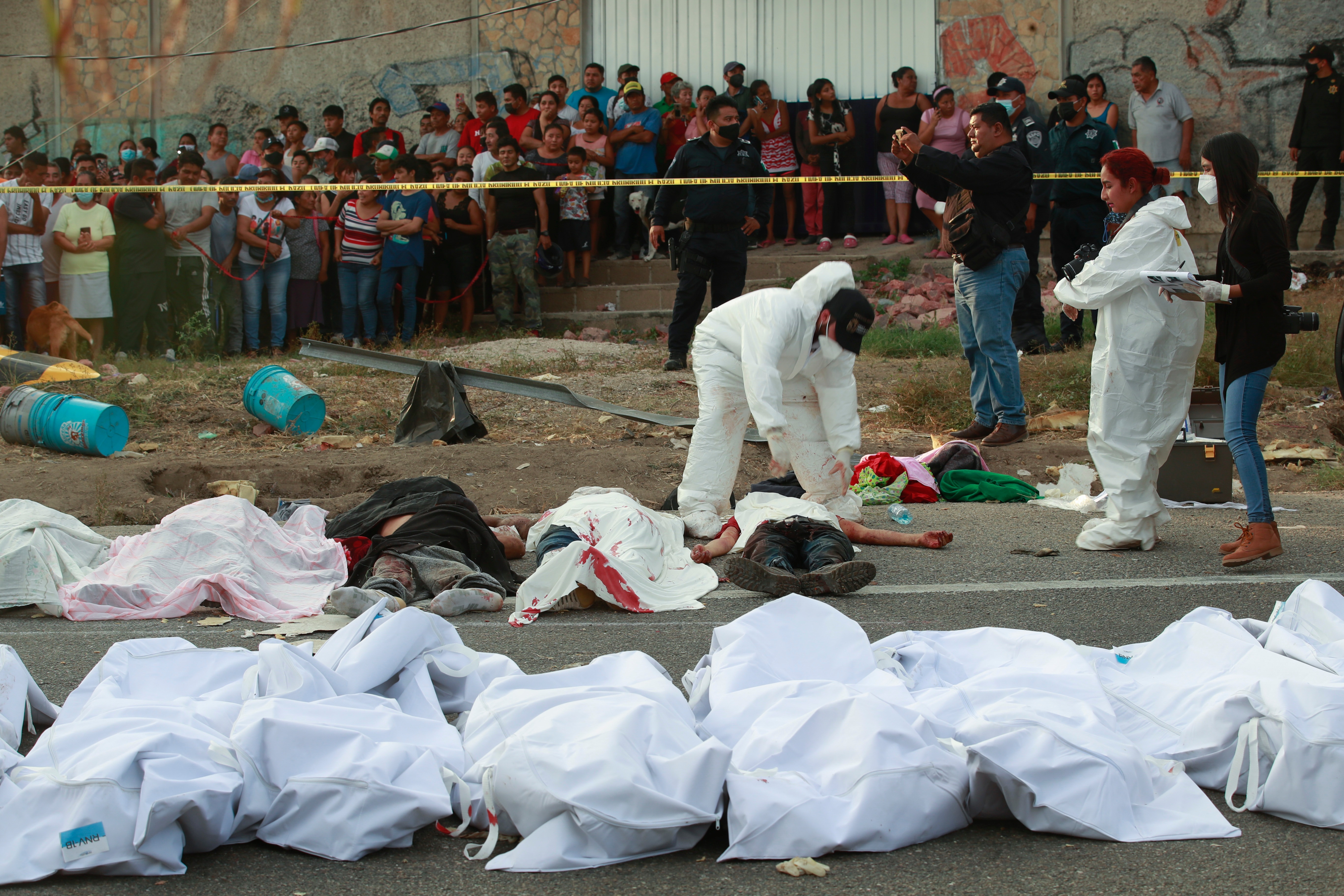
The 2021 trailer crash in Tuxtla Gutiérrez, Chiapas, which resulted in 56 fatalities and over 100 injuries, was not an isolated traffic accident but the catastrophic failure of a high-capacity logistics chain. When a Guatemalan national pleaded guilty in a U.S. federal court to charges related to this event, the legal proceedings pulled back the curtain on a sophisticated, multi-tiered transportation system optimized for volume and speed at the absolute expense of human safety. Analyzing this event requires moving past the emotional weight of the tragedy to examine the mechanics of illicit supply chains, the physical constraints of heavy-vehicle dynamics under human-cargo loads, and the legal frameworks of transnational prosecution.
The Architecture of High-Capacity Human Smuggling
The illicit transportation of migrants through Mexico operates on a hub-and-spoke model. The Tuxtla Gutiérrez event represents the "heavy haul" phase of this model, where smaller groups are consolidated into large-scale industrial assets—specifically modified semi-trucks—to minimize the cost per unit of transport. This system relies on three distinct operational layers:
- Aggregation Nodes: Border-adjacent locations where migrants are held until a "payload" threshold is met.
- The Industrial Transit Layer: The use of heavy commercial vehicles, often modified with false flooring or hidden compartments, to bypass regional checkpoints.
- The Distribution Network: Points in central or northern Mexico where the large shipment is broken down back into smaller, less detectable units for the final border crossing.
The guilty plea in federal court confirms that these operations are managed as professionalized enterprises. The defendant's role was not merely driving; it was the execution of a logistics contract within a hierarchy that includes scouts, "coyotes," and financial intermediaries. The failure in this specific instance occurred in the transit layer, where the mechanical and physical limits of the vehicle were exceeded by the operational demands of the smugglers.
The Physics of a Kinetic Catastrophe
The sheer scale of the casualty count—56 dead—is a direct result of the specific physical environment inside the trailer. Understanding the mechanics of the crash requires looking at the Load Distribution Factor and the Internal Kinetic Environment.
Load Distribution and Center of Gravity
A standard refrigerated trailer is designed to carry static or palletized loads. When 160 individuals are packed into such a space, the load becomes "fluid." Unlike fixed cargo, human passengers shift during acceleration, braking, and cornering. In the Tuxtla Gutiérrez crash, the vehicle was traveling at high speed on a curved descent. The centripetal force caused the human mass to shift toward the outer wall of the trailer, significantly raising the center of gravity and creating a "pendulum effect" that the driver could not correct. This shift exceeded the lateral stability limits of the vehicle, leading to the rollover.
The Internal Kinetic Environment
The high fatality rate is attributed to the lack of internal restraints and the presence of hard structural surfaces. In a collision involving a mass of 160 people, the individuals themselves become the primary source of blunt-force trauma to one another. The kinetic energy $E = \frac{1}{2}mv^2$ of the entire group is concentrated in a confined, unpadded space. The structural failure of the trailer walls upon impact with a pedestrian bridge further exacerbated the trauma, as the container was not designed to maintain its integrity under such high internal pressure and external impact.
The Jurisdictional Strategy: Transnational Legal Accountability
The prosecution of a Guatemalan national in a U.S. federal court for a crash occurring on Mexican soil highlights the strategic use of Extraterritorial Jurisdiction. This legal mechanism is triggered when the illicit activity—even if the tragedy occurs abroad—is part of a conspiracy to violate U.S. immigration laws.
- The Conspiracy Nexus: Prosecutors do not need to prove the driver intended for the crash to happen. They only need to establish that the driver was a willing participant in a conspiracy to transport individuals to the United States.
- The Felony Murder Analogy: While the charges are specific to smuggling and conspiracy, the legal weight mirrors "felony murder" principles, where a death occurring during the commission of a dangerous felony significantly increases the sentencing guidelines.
- Asset and Network Forfeiture: U.S. involvement allows for the deployment of financial intelligence tools to track the payment structures—often involving wire transfers and digital currencies—that facilitate these journeys.
The guilty plea serves as a critical data point for intelligence agencies. It validates the "High-Value Target" (HVT) strategy, which focuses on the facilitators and logistics coordinators rather than just the end-users of the smuggling service. By securing a plea, the government gains leverage to flip the defendant into a cooperating witness, potentially exposing the "upstream" organizers in the Guatemalan and Mexican syndicates.
The Cost Function of Smuggling and Risk Mitigation
From the perspective of the smuggling organization, the loss of 56 lives is a significant "operational loss" but one that is factored into the high-risk, high-reward nature of the business. The economics of this trade are driven by the Demand-Risk Equilibrium:
- Premium Pricing: As enforcement increases, the price per "unit" (migrant) rises.
- Volume Efficiency: To maintain profit margins against high bribe costs and vehicle seizures, smugglers must increase the density of each shipment.
- Risk Transfer: The organization transfers the highest physical and legal risks to the lowest-level operators—the drivers.
The 2021 crash demonstrated that the "Maximum Occupancy" threshold has been pushed beyond the physical limits of the equipment. Smugglers are now opting for higher-density, higher-risk transport because the financial returns on a successful 160-person shipment outweigh the potential loss of a single vehicle and the incarceration of a replaceable driver.
Structural Failures in Border Security Infrastructure
The success of a vehicle carrying 160 people in reaching a major highway in Chiapas points to a failure in Detection Synchronicity. For a shipment of this size to move, multiple security layers must be breached:
- Visual Inspection: A semi-truck carrying nearly triple its safe human capacity often shows visible signs of distress, such as sagging suspension or unusual tire compression.
- Thermal and Acoustic Detection: Modern checkpoints are equipped with sensors designed to detect the heat signatures or heartbeats of concealed persons. The failure to deploy these effectively at key transit chokepoints allows high-capacity trailers to proceed.
- Corruption of the Enforcement Layer: The logistical route from the Guatemalan border to central Mexico is heavily monitored. The passage of a high-volume trailer suggests a "negotiated transit" where local or regional officials are compensated to overlook the shipment.
Without addressing the corruption in the transit corridor, legal victories in U.S. courts remain reactive. The guilty plea is a post-hoc solution to a systemic breakdown in the initial detection phase.
The Strategic Path Forward
Dismantling high-capacity human smuggling requires a shift from "border-at-the-line" thinking to "corridor-based" interdiction. The focus must move from the migrant to the industrial assets used for their transport.
1. Heavy Vehicle Telematics and Monitoring
Governments should mandate advanced telematics for commercial vehicles operating in high-risk transit zones. Vehicles that deviate from standard weight-for-cargo profiles or follow known smuggling routes during off-peak hours should be flagged for mandatory inspection.
2. Financial Interdiction of the "Middle Mile"
The most vulnerable part of the smuggling syndicate is not the border crossing, but the "middle mile" where large sums of money are moved to pay for fuel, bribes, and vehicle maintenance. Targeted sanctions and the monitoring of remitting agents in the Chiapas-Oaxaca corridor can choke the liquidity required to keep these large-scale logistics operations running.
3. Enhancing Multilateral Forensic Intelligence
The Tuxtla Gutiérrez case demonstrates the necessity of shared evidence between Guatemala, Mexico, and the U.S. Establishing a permanent, tri-national task force focused specifically on "Industrial-Scale Smuggling" would allow for real-time tracking of vehicle VIN numbers, driver identities, and known "safe house" coordinates across borders.
The legal resolution of the 2021 crash through the U.S. court system provides a modicum of accountability, but it does not alter the fundamental economic or physical realities that made the crash inevitable. Until the cost of losing a high-capacity asset—both financially and legally—exceeds the profit generated by successful "payloads," the logistics of human smuggling will continue to prioritize volume over life. The focus must now turn to the hardware of the trade: the trucks, the warehouses, and the financial systems that fuel the transit.