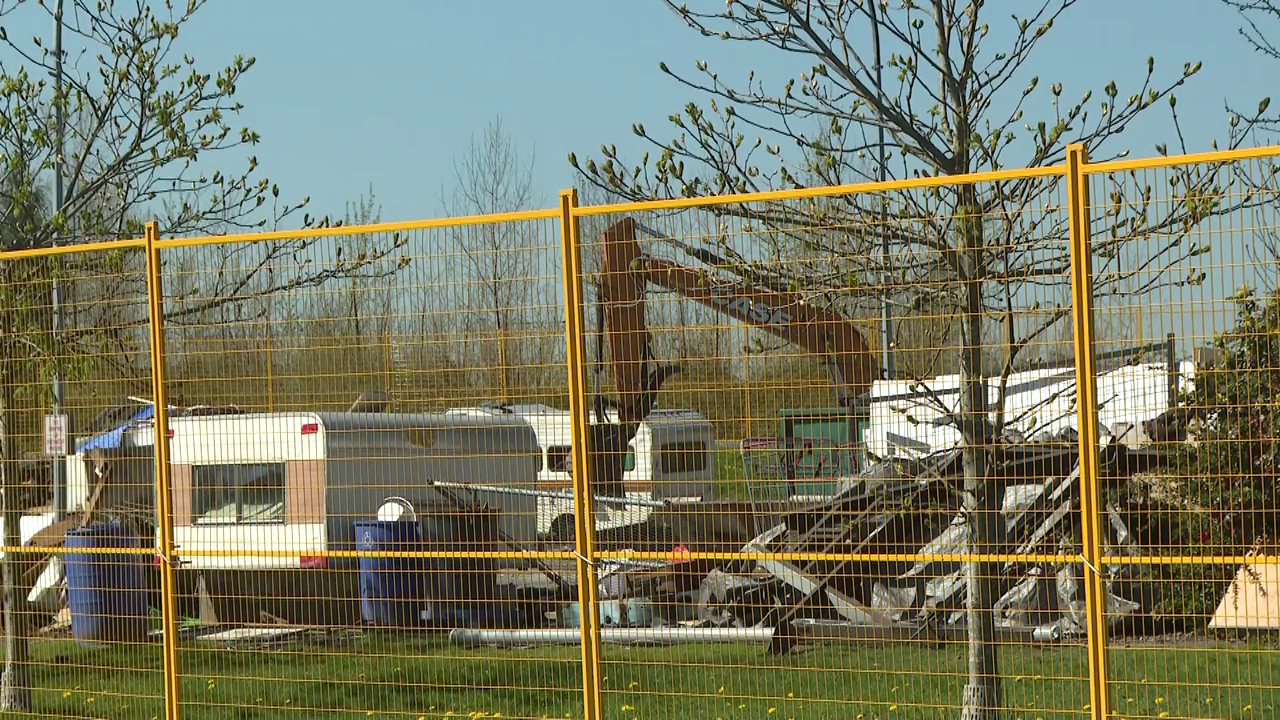
The decampment of the Bradner Road rest stop in Abbotsford by the British Columbia Ministry of Transportation and Infrastructure represents a localized execution of a broader provincial strategy to reclaim critical infrastructure. While public discourse often centers on the tension between housing rights and public order, a rigorous analysis reveals this event as a conflict of jurisdictional mandates: the maintenance of transportation safety versus the systemic failure of the regional housing continuum. The clearance is not a solution to homelessness but a tactical redistribution of the unhoused population, driven by the operational requirements of the Ministry of Transportation rather than the social mandates of BC Housing.
The Jurisdictional Conflict Matrix
To understand why the Abbotsford clearance occurred at this specific juncture, one must examine the intersection of three distinct regulatory domains.
- The Safety Mandate of the Ministry of Transportation: Unlike parks or municipal land, highway rest stops are classified as high-risk environments. The proximity to high-speed traffic (Highway 1) creates a liability profile that precludes long-term habitation. The Ministry operates under a mandate to ensure the "safe and efficient movement of people and goods," a directive that views encampments as physical obstructions and fire hazards.
- The Legal Precedents of Seasonal and Permanent Sheltering: Canadian jurisprudence, specifically rulings such as Abbotsford (City) v. Shantz, has established that individuals have a right to shelter on public land when indoor alternatives are unavailable. However, this right is not absolute. It is balanced against the "intended use" of the land. Rest stops, designed for temporary traveler fatigue management, possess a lower threshold for "legal necessity" of encampment than municipal parks.
- The Operational Capacity of BC Housing: The clearance was contingent not on the completion of permanent housing, but on the availability of "temporary spaces." This distinction is critical. In the Abbotsford context, the clearance was triggered by the opening of 50 new shelter spaces at Lonzo Road, creating the administrative justification required to execute the Trespass Act.
The Cost Function of Encampment Management
The clearance of the Bradner Road site involves a complex allocation of provincial and municipal resources. This "Cost Function" is rarely quantified in standard reporting but dictates the frequency and scale of such interventions.
Direct Operational Expenditures
The immediate costs include the deployment of the RCMP, Ministry contractors, and social service liaisons. Heavy machinery required for debris removal and the remediation of the soil (due to biohazardous waste or fuel spills) represents a significant capital outlay. These costs are often non-recoverable and recurring, as the lack of permanent housing ensures the population will eventually congregate in a new, unmanaged location.
Indirect Systematic Friction
When an encampment is cleared, the immediate result is the fragmentation of the "service network." Outreach workers who have established trust with the Bradner Road residents lose their point of contact. The resulting "displacement churn" increases the administrative burden on emergency rooms and police services as the unhoused population moves into less visible, more dangerous areas (wooded lots or industrial zones) where oversight is impossible.
The Housing Continuum Gap Analysis
The fundamental error in the "clearance-to-shelter" model is the assumption of throughput. In a functioning housing system, individuals move from the street to an emergency shelter, then to supportive housing, and finally to market rentals.
The Abbotsford situation demonstrates a bottleneck at the "Supportive Housing" stage. When the 50 beds at Lonzo Road are filled, they stay filled. Because there is no "exit strategy"—meaning a lack of affordable low-income housing for individuals to transition into—the shelter becomes a stagnant pool rather than a conduit. The Ministry of Transportation clears the rest stop to satisfy its safety mandate, but it does so by pushing the population into a shelter system that is already at 100% capacity or lacks the specific wrap-around services (mental health, addiction recovery) required for this specific demographic.
The Physicality of the Site Remediation
The Bradner Road rest stop clearance involved more than just the removal of tents; it required the physical hardening of the site to prevent re-entry. This is a standard tactical maneuver in urban displacement logistics.
- Infrastructure Hardening: The installation of fencing, concrete barriers (Jersey barriers), and enhanced lighting.
- Ecological Restoration: The removal of invasive structures and the restoration of gravel or paved surfaces to their original engineering specifications.
- Surveillance Integration: Increased patrols by Ministry contractors to ensure the "No Trespassing" signs are enforced immediately upon any new arrival.
This hardening process transforms a public asset (the rest stop) into a restricted zone, effectively reducing the total public space available to the general population to prevent its use by a specific sub-group.
The Mechanism of "Offer of Shelter"
A central point of contention in the Abbotsford clearance is the definition of a "reasonable offer of shelter." Under current provincial guidelines, an offer is deemed valid if it provides a bed and basic amenities. However, this definition fails to account for the "Barriers to Entry" that cause individuals to refuse these offers:
- Asset Liquidation: Shelters often have strict limits on the amount of personal property an individual can bring. For those living at a rest stop with significant belongings, accepting a shelter bed requires the abandonment of their entire estate.
- Pet and Partner Policies: Many emergency shelters remain segregated by gender or prohibit animals. The "logical choice" for an individual may be to remain in a tent with a partner or pet rather than accept a bed in a sterile, congregate setting.
- Safety Perception: In congregate settings, the risk of theft or violence can be higher than in a self-managed encampment where residents have formed their own security protocols.
By ignoring these mechanisms, the provincial government can claim that shelter was "offered and refused," thereby granting the legal authority to use force for removal, even if the "refusal" was a rational calculation based on personal safety or asset preservation.
The Tactical Redistribution Effect
We must categorize the outcome of the Bradner Road clearance not as a "reduction in homelessness" but as a "tactical redistribution."
When 40 to 60 individuals are moved from a centralized, visible location like a highway rest stop, they do not disappear. They undergo a process of "micro-encampment." They move to smaller, more hidden sites within the Abbotsford municipal boundary. This makes the delivery of healthcare and food more expensive and less efficient. The "visibility" of the problem is reduced for the commuting public, but the "intensity" of the crisis for the individual increases as they lose the community support structures formed at the larger site.
Structural Recommendations for Regional Governance
The current reactive model—where the Ministry of Transportation clears land once the "nuisance" threshold is met—is fiscally unsustainable. A proactive strategy requires the decoupling of land management from social service delivery.
The Establishment of "Designated Outdoor Spaces"
Instead of the binary between "illegal encampment" and "indoor shelter," the province should utilize the "Designated Outdoor Space" model. This involves identifying low-risk provincial land where camping is permitted, provided with basic sanitation (toilets, trash collection), and managed by a third-party non-profit. This reduces the remediation costs associated with "wild" encampments and provides a stable location for outreach workers to maintain contact with clients.
Decoupling Trespass Enforcement from Shelter Availability
The legal requirement to have a shelter bed available before clearing an encampment creates a perverse incentive to build low-quality, congregate shelters just to meet the legal threshold for displacement. The province should instead pivot to a "functional zero" mandate for specific high-priority infrastructure zones, where the clearance is offset by the immediate provision of modular, dignified housing units—not just mats on a floor.
Precision Data Tracking of the Displaced
The Ministry of Housing must implement a longitudinal tracking system for individuals displaced during decampments. Without data on where the Bradner Road residents move post-clearance, the province cannot measure the effectiveness of the $250 million "Belonging in BC" homelessness strategy. Success must be measured by "housing retention" rather than "site vacancy."
The Abbotsford clearance serves as a case study in the limitations of departmentalized governance. The Ministry of Transportation succeeded in its mission to clear the Bradner Road rest stop, but in doing so, it simply transferred the logistical and financial burden to the City of Abbotsford and the local healthcare system. Until the provincial government addresses the lack of "deeply affordable" housing (units priced at the provincial shelter rate), these clearances will remain a recurring, high-cost exercise in geographic shuffling.