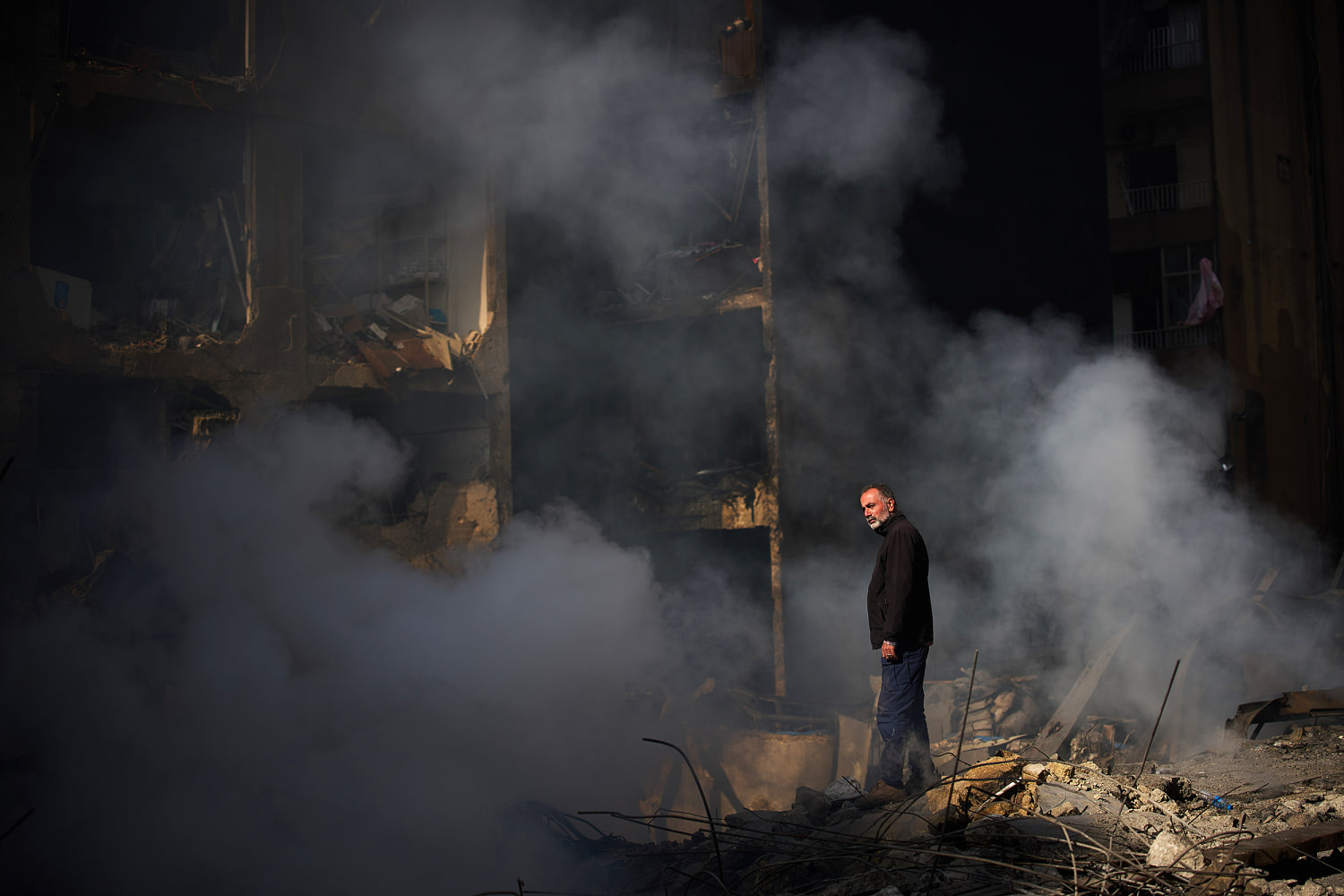
The windows of Beirut do not just break. They scream.
When a precision-guided munition strikes a residential block in the heart of the city, the sound is a physical weight that anchors itself in your chest. It is the sound of concrete turning to powder and the terrifyingly delicate chime of millions of glass shards raining onto the pavement. For a few seconds afterward, there is a vacuum of silence where life used to be. Then the sirens begin.
To the analysts in Washington or the strategists in Tel Aviv, these strikes are data points on a map. They are tactical maneuvers designed to degrade a command structure or send a message to a regional adversary. But if you are standing on a balcony in the Basta neighborhood, watching the sky turn the color of bruised plums from the smoke of a fresh impact, the "message" feels less like diplomacy and more like an ending.
The air in Beirut right now carries the scent of cedar, exhaust, and something metallic—the smell of freshly exposed rebar and ancient dust stirred up from the foundations of a city that has been rebuilt too many times. This latest escalation isn't just a local tragedy. It is the sound of a fragile, invisible thread snapping: the tenuous ceasefire between the United States and Iran that has, until now, kept the Middle East from falling into a total, uncontainable fire.
The Architecture of a Falling Sky
War has a rhythm that the people of Lebanon know by heart. You learn to distinguish the low, rhythmic thrum of a drone from the sharp, predatory whistle of a missile. You learn that the safest place in an apartment isn't the basement—which can become a tomb if the building collapses—but the interior hallway, away from the windows that the shockwave will eventually claim.
Consider a woman named Leyla, a composite of the many who have stayed. She keeps her passport and a single gold bracelet in a small bag by the door. This bag is her life’s insurance policy. When the strikes hit central Beirut—areas previously considered "safe" or at least "off-limits"—Leyla doesn't look at a map of military targets. She looks at the cracks in her ceiling. To her, the geopolitical "threat to the ceasefire" isn't an abstract risk. It is the realization that the rules have changed. The invisible boundaries that once protected the city center have dissolved.
The Israeli military maintains that these strikes are necessary to eliminate high-level targets within Hezbollah’s leadership. From a strategic standpoint, they are moving with a speed and intensity that suggests they believe the window for action is closing. Every crater in Beirut is a physical manifestation of a gamble: that by hitting hard enough now, they can dictate the terms of the peace later.
But gravity works differently in politics than it does in physics. In physics, what goes up must come down. In the Middle East, what goes down—the buildings, the families, the infrastructure—often rises back up as a more radicalized, more desperate force.
The Ghost of a Deal
While the dust settles in Lebanon, the real tremors are being felt thousands of miles away in diplomatic backchannels. For months, a quiet, fragile understanding has existed between the U.S. and Iran. It was never a formal treaty. It was a series of nods and absences. Iran would restrain its proxies from certain red lines; the U.S. would ensure that the regional conflict didn't spiral into a direct confrontation with Tehran.
That understanding was the floor that kept the region from falling into the basement.
Now, that floor is rotting. Each strike on Beirut is a test of Iran’s patience and its "axis of resistance." If Iran stands by while its most powerful partner, Hezbollah, is dismantled in its Mediterranean stronghold, it risks losing its primary deterrent against Israel. If it retaliates directly, it invites a war that could end the current regime.
The U.S. finds itself in the middle of a collapsing bridge. Washington has spent years trying to pivot away from the Middle East to focus on the Pacific, but the region has a way of grabbing hold of those who try to leave. By supporting Israel’s right to defend itself while simultaneously pleading for a ceasefire, the American administration is trying to hold two contradictory truths in its hands.
The result is a paralyzing friction. The "ceasefire" is now a ghost—something people talk about as if it still exists, even as the bombs provide loud evidence to the contrary.
The Arithmetic of Grief
Statistics are the armor we wear to keep from feeling the truth. We read that dozens were killed in a single strike, or that hundreds of thousands have been displaced. We see the numbers on a ticker at the bottom of a news screen and they feel manageable.
They are not.
Displacement isn't just moving from one house to another. It is the loss of the intangible. It is the school photo left on a wall that no longer exists. It is the pharmacy that had the specific medicine for your father’s heart condition, now buried under a mountain of grey rubble. It is the sudden, jarring realization that your neighborhood, your history, and your sense of self can be erased by a coordinate entered into a computer miles away.
In Beirut, the displacement is moving toward the sea and toward the mountains. The city’s parks have become makeshift campgrounds. The luxury hotels, once symbols of Beirut’s "Paris of the Middle East" persona, are now crowded with families who have nowhere else to go.
The economic cost is staggering, but the psychological cost is the real debt that will never be repaid. When a child learns that a ceiling is not a permanent thing, that child grows up with a fundamental distrust of the world. That distrust is the fuel for the next thirty years of conflict. This is the "invisible stake" of the current bombardment. We are not just seeing the destruction of buildings; we are seeing the demolition of the possibility of a normal life for an entire generation.
The Red Lines Are Blurring
For a long time, there were "red lines." Don't hit the airport. Don't hit the downtown commercial district. Don't hit the deep south of Israel. Don't hit the refineries in Iran.
These lines were the grammar of the conflict. They allowed both sides to communicate through violence without speaking.
But in the last few weeks, the grammar has broken down. The lines have been crossed so many times they have been rubbed out. Israel’s shift to targeting central Beirut suggests a total war mentality—a belief that the "old rules" led only to stalemate and that only total dominance can ensure security.
Tehran, meanwhile, watches its investment in Lebanon go up in smoke. The Iranian leadership is currently debating a question with no good answer: Is Hezbollah more valuable as a shield to be used later, or as a sword to be used now? If they wait, the shield might be broken beyond repair. If they use the sword, they might be destroyed in the process.
This is the precipice. This is why the U.S.-Iran ceasefire is "threatened." It’s not that anyone necessarily wants a world war. It’s that the exit ramps are being bombed out one by one.
The Logic of the Crater
There is a cold, mathematical logic to the strikes. If you remove X leader and Y weapons cache, you achieve Z level of security.
But human beings don't live in equations.
When a missile hits a building in a crowded city, it creates a ripple effect that defies math. It creates a vacuum of power that is rarely filled by "moderates." It creates a grievance that becomes a family legacy. It creates a landscape where the only thing that feels real is the next strike.
The tragedy of the current moment is that the "ceasefire" everyone is chasing is being built on top of the very rubble that makes peace impossible. You cannot tell a man whose home has been turned to dust that the "regional stability" is being maintained. To him, the world has already ended.
The diplomats in Geneva and New York will continue to use words like "de-escalation" and "proportionality." They will hold press conferences in front of blue flags and talk about "windows of opportunity."
Back in Beirut, the sun sets through a haze of smoke. The city is dark because the power grid is failing, but the sky is occasionally lit by the orange glow of a new fire. People sit in their darkened living rooms, listening. They are not listening for the news. They are listening for the whistle.
They are waiting to see if the thread holds, or if the sound of breaking glass is all that remains of the world they knew.
The sirens are still wailing. They are the only honest voice left in the city.