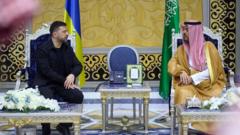
The headlines want you to believe Volodymyr Zelensky’s recent trip to Saudi Arabia was a victory lap for Ukrainian innovation. They paint a picture of a "drone superpower" graciously offering its hard-won technical expertise to the Gulf in exchange for diplomatic leverage.
It is a comforting narrative. It is also a lie.
If you believe Ukraine is visiting Riyadh from a position of industrial strength, you haven't been paying attention to the math of attrition. This isn't a tech transfer; it’s a desperate pitch to find a deep-pocketed venture capitalist for a startup that is running out of runway. The "drone expertise" being marketed isn't a luxury export—it’s a distress signal.
The Myth of the Ukrainian Drone Monopoly
The common consensus suggests Ukraine holds a unique, untouchable lead in FPV (First-Person View) and long-range UAV development. The logic follows that since they are using them every day, they must own the intellectual property of the future.
This ignores the reality of off-the-shelf warfare.
Ukraine’s "expertise" is largely the art of duct-taping Western chips and Chinese frames to Soviet-era mission profiles. It is brilliant improvisation, yes. But improvisation is not a scalable, proprietary product that a nation like Saudi Arabia—which is currently building "The Line" and aiming for Vision 2030—actually needs to buy.
Saudi Arabia doesn't want to learn how to solder a hobbyist drone in a basement in Kyiv. They want the General Atomics level of vertical integration. They want the MQ-9 Reaper's reliability, not the Mavic's expendability.
Riyadh Isn't Buying Drones—They're Buying a Seat at the Peace Table
To understand why this meeting happened, you have to stop looking at the hardware. Look at the balance sheet.
Saudi Arabia, under Crown Prince Mohammed bin Salman, has spent the last five years trying to pivot away from being a mere "oil station" to becoming the world's indispensable mediator. They played the middle in the prisoner swaps. They hosted the Jeddah peace talks.
When Zelensky offers "drone expertise," he isn't selling a weapon system. He is offering a bribe for Saudi Arabia to stay invested in the Ukrainian peace formula. It’s a transaction of relevance. Ukraine provides the "tech" optics so the Saudis can justify their continued engagement with a Western-aligned power without alienating their partners in the BRICS+ expansion.
The "Battle-Proven" Fallacy
Military analysts love the term "battle-proven." They use it to suggest that because a system survived a week in the Donbas, it is objectively superior.
In the real world of defense procurement, "battle-proven" often means "depleted."
I have seen defense contractors burn through billions trying to "ruggedize" consumer tech for the battlefield. What Ukraine has mastered is the high-attrition model. They accept a 90% failure rate because the 10% that get through are cost-effective.
Saudi Arabia’s military doctrine is the polar opposite. Their strategy is built on overwhelming, expensive, high-altitude superiority. They have no interest in a war of attrition where they lose 500 drones a day. The "expertise" Ukraine is offering is fundamentally incompatible with the way the Saudi Royal Air Force operates.
The Silicon Valley of the East is a War Zone
There is a recurring "People Also Ask" theme online: Is Ukraine becoming the new Silicon Valley of defense tech?
The answer is a brutal no.
Silicon Valley relies on stable supply chains, massive capital inflows, and the ability to fail without a cruise missile hitting your R&D lab. Ukraine is operating in a "survivalist" economy.
When you hear about "drone production centers" in Ukraine, you are hearing about decentralized, fragmented workshops. This is great for resisting an invasion. It is terrible for a trade deal with a nation that expects ISO-certified manufacturing standards and a 20-year maintenance contract.
What the Analysts Miss About Electronic Warfare (EW)
The most significant "expertise" Ukraine actually has isn't the drone itself—it’s the signal.
The Russian-Ukrainian front is the most congested electromagnetic environment in human history. Every frequency is jammed. Every GPS coordinate is spoofed.
$S = k \log W$
If we look at the complexity of the signal environment ($S$), the entropy ($W$) created by Russian EW is staggering. Ukraine’s real value is in their frequency-hopping algorithms and their AI-driven terminal guidance that functions without a human link.
But here is the catch: Ukraine cannot sell that code.
That software is their only shield. If that "expertise" leaks to the Saudis, it eventually leaks to the Iranians. If it leaks to the Iranians, the Russian EW suites get patched within a month. Zelensky is selling the shell of the nut while keeping the meat, and the Saudis are smart enough to know they’re getting an empty casing.
The Geopolitical Cost of "Neutral" Expertise
Saudi Arabia is walking a tightrope. They are increasing cooperation with China. They are keeping the taps open for Russia via OPEC+.
By entertaining Zelensky’s drone pitch, Riyadh is performing a "Neutrality Check."
- To Washington: "See? We are still listening to your allies."
- To Moscow: "We are talking to them about tech, not just weapons. Don't worry."
- To the World: "We are the center of the new multipolar order."
Ukraine is the junior partner in this exchange. They are providing the content for the Saudi PR machine.
Stop Asking if the Drones Work
The question isn't whether Ukrainian drones can hit a tank. They clearly can.
The question is: Can Ukraine survive being a technology donor?
Historically, nations that export their most critical defense secrets during an active conflict do so for one reason: they need cash or political cover more than they need the secret.
Imagine a scenario where a startup sells its core patent just to pay the electric bill. That is what "offering drone expertise" looks like in a total war. It’s a liquidation sale disguised as a strategic partnership.
The Reality of the "Offer"
Ukraine’s drone industry is currently a chaotic, beautiful mess of over 200 different companies making slightly different versions of the same thing. There is no standardization. There is no unified export control.
When Zelensky "offers expertise," he is effectively offering to let Saudi Arabia fund the consolidation of this industry. He is looking for a sovereign wealth fund to act as a Series B investor because the Western aid packages are stuck in legislative purgatory.
If you want to understand the trip, stop looking at the drones. Look at the empty silos and the burning refineries.
Ukraine has the talent. They have the data. But they have no time.
Saudi Arabia has nothing but time and money.
This isn't a meeting of equals. This is a fire sale of the only intellectual property Ukraine has left to trade for its life. The "expertise" isn't a product—it's a plea.
The next time you see a headline about "Drone Diplomacy," remember that diplomacy is just the polite word for a desperate negotiation. Ukraine isn't expanding its influence; it is mortgaging its future to keep the lights on today.
Stop praising the "partnership" and start recognizing the desperation.