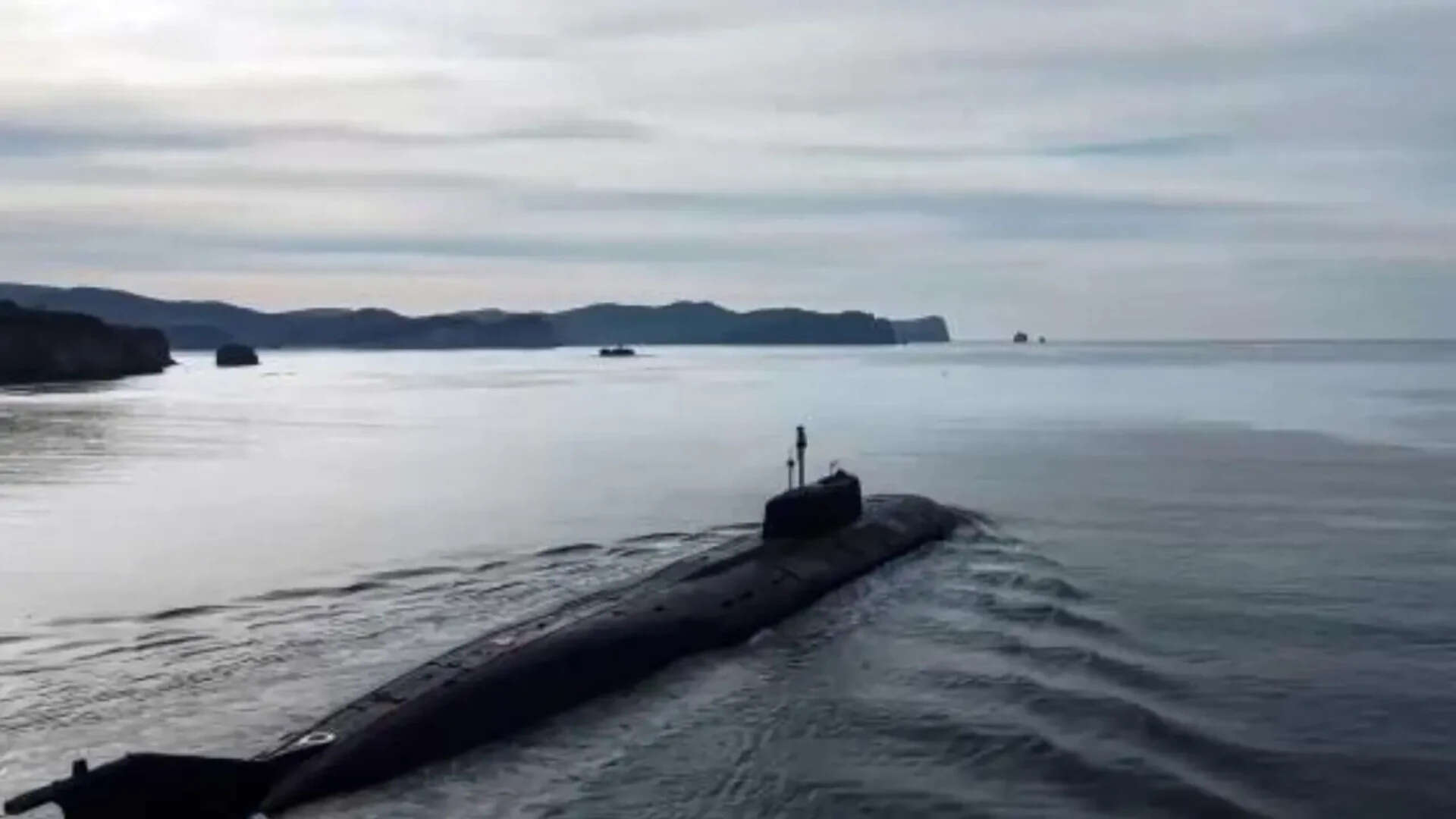
The headlines are screaming again. British tabloids and "defense insiders" are breathlessly reporting on the presence of Russian spy submarines in the North Atlantic. They want you to feel a chill of Cold War nostalgia. They want you to believe that the Royal Navy’s "stern warning" to Vladimir Putin—asserting that "we see your activity"—actually carries weight.
It doesn't. If you enjoyed this article, you might want to look at: this related article.
This isn't a story about Russian aggression. It is a story about Western theater. The narrative being fed to the public—that we are "tracking" these subs as a show of strength—is a desperate attempt to mask the fact that the UK’s anti-submarine warfare (ASW) capabilities are currently held together by duct tape and wishful thinking. If you think a public press release about "seeing" a Russian Kilo-class or Yasen-class submarine is a victory, you don't understand how undersea warfare works.
The Detection Myth
When a government official tells the press they are "tracking" a Russian asset, they are usually admitting a failure, not celebrating a win. For another look on this event, see the latest update from Associated Press.
In the world of high-stakes acoustic signature management, the goal is to never be seen. If a Russian submarine is "detected" in a way that allows the Ministry of Defence (MoD) to brag about it, one of two things is happening:
- The Russians want to be found. This is tactical posturing. They are testing response times, measuring how many Type 23 frigates we have left that can actually put a sonar in the water, and mapping our reaction patterns.
- The detection is old news. By the time a "stern warning" reaches the press, the tactical reality on the seabed has shifted.
The lazy consensus suggests that every time a Russian sub enters the GIUK (Greenland, Iceland, UK) Gap, the Royal Navy is in total control. The reality? We are struggling to maintain a "continuous at-sea" presence for our own deterrent, let alone policing the entire North Atlantic.
The Numbers Do Not Add Up
Let’s talk about the hardware. The Royal Navy is down to a handful of Type 23 frigates optimized for ASW. These ships are old. They are tired. They are being pushed beyond their design lives because the Type 26 replacements are taking years to arrive.
- The Towed Array Gap: An ASW frigate is only as good as its Sonar 2087. We don't have enough hulls to keep these arrays in the water across every critical chokepoint.
- The P-8 Poseidon Problem: We rely heavily on the RAF’s P-8 Poseidon fleet. These are excellent aircraft, but they cannot stay on station forever. Without a persistent surface fleet to hand off the track, "seeing" a Russian sub is a momentary snapshot, not a sustained advantage.
I’ve spoken with former sonar operators who have spent weeks staring at waterfalls, hunting "ghosts" that represent the quietest Russian hulls. They will tell you that the Yasen-M class is a different beast entirely. It’s not your grandfather’s Soviet clunker. These boats are quiet enough to disappear into the ambient noise of the North Atlantic. When the MoD says "we see you," they are often looking at the older, louder decoys, while the real threats are mapping the fiber-optic cables that keep your internet running and your bank transfers clearing.
The Undersea Infrastructure Obsession
The media focuses on the "spy" aspect—the idea of James Bond-style espionage. That’s a distraction. The real target isn't secrets; it’s physics.
The North Atlantic is the central nervous system of global capitalism. Undersea cables carry over 95% of international data. Russia’s GUGI (Main Directorate of Deep-Sea Research) operates specialized mother-ships and midget subs designed specifically for "seabed warfare."
When we issue a "warning" to Putin, we are bringing a knife to a drone fight. Russia has invested heavily in autonomous underwater vehicles (AUVs) and deep-sea interference technology. Our response has been to cut the number of hulls in our fleet and hope that "allies" will fill the gap.
Why the Stern Warning is a Tactical Blunder
In intelligence circles, there is a concept called "revealing your hand." By publicly announcing that we have detected a Russian sub in a specific sector, we provide the Russian naval command with a free data point. They now know exactly what our detection thresholds are in that specific thermal layer.
Why would we do this?
It’s political. It’s about the defense budget. Every time a Russian sub "threatens" our waters, it’s a convenient time to ask for more funding or to justify why we’ve sent our only available carrier to the other side of the world while our home waters are undefended.
The "stern warning" is for the British taxpayer, not for the Kremlin. Putin knows exactly where the Royal Navy’s blind spots are. He doesn't need a press release to find them.
The Fragility of Modern ASW
We have become over-reliant on technology that assumes a permissive environment. We assume our satellites will work, our GPS will be active, and our shore-based processing centers won't be hit by cyber-attacks.
Russian doctrine, however, is built on the assumption of a "dark" environment. Their subs are designed to operate with minimal communication. They are comfortable in the silence. We, meanwhile, have become loud and predictable.
Imagine a scenario where three Russian subs enter the North Atlantic simultaneously.
- Sub A is an old Akula-class boat. It makes just enough noise to be tracked by a Type 23. The Royal Navy makes a big deal about "intercepting" it.
- Sub B is a Yasen-class, sitting dead-still in a deep-water trench, recording the acoustic signatures of every NATO vessel that comes to look for Sub A.
- Sub C is a specialized cable-cutter boat, operating at depths we struggle to monitor, mapping the precise locations of the transatlantic junctions.
The UK celebrates the "detection" of Sub A while Sub C finishes its mission. This isn't a hypothetical; it is the fundamental playbook of modern asymmetric naval warfare.
Stop Asking if We Can See Them
The question "Can we see Russian submarines?" is the wrong question. It’s a binary trap. The real question is: "Can we stop them from doing what they came to do?"
If a Russian sub is sitting 50 miles off the coast of Scotland, "seeing" it does nothing if you don't have the legal or tactical capacity to move it. In international waters, these boats have every right to be there. Our "warnings" are toothless because we have no escalatory ladder that doesn't lead to a nuclear exchange.
We are playing a game of undersea chess where the opponent is willing to sacrifice a pawn to take our queen, and we are bragging about how clearly we can see the pawn.
The Cost of Professionalism
I will admit the downside of this contrarian view: it’s grim. It suggests that the maritime security we take for granted is an illusion maintained by a shrinking number of overworked professionals. The men and women on our frigates and submarines are world-class. They are the best-trained hunters in the world. But you cannot win a war of attrition with 17 frigates and destroyers. You cannot be everywhere at once.
The Ministry of Defence needs to stop the PR spin. Stop telling us that "the message is clear." The only message that matters in the North Atlantic is the sound of a hull moving through the water—or the lack thereof.
If we want to actually secure our waters, we need to stop the theatrical press releases and start building a fleet that can sustain a presence without needing a "stern warning" to make up for a lack of hulls. Until then, every time you see a headline about "detecting" a Russian spy sub, remember: you’re being shown exactly what they want you to see, while the real threat is already underneath you.
Go back to your coffee. The internet is still working. For now.