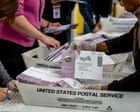
The ground is shifting under your feet if you plan to vote by mail this year. For decades, the trend in American elections leaned toward making voting easier, faster, and more remote. That era just hit a massive judicial wall. Recent signals from the US Supreme Court suggest a seismic shift in how mail-in ballots will be handled, and frankly, it's going to catch a lot of people off guard. If you think the rules from the last election cycle still apply, you’re likely wrong.
We’re seeing a return to a strict, almost literalist interpretation of state election laws. The high court is increasingly signaling that federal judges should stay out of state-level election disputes, even when those disputes involve how your vote is counted. This isn't just "legal jargon." It means the safety net you thought existed for your mail-in ballot is effectively gone.
The end of the pandemic era grace period
During the height of the pandemic, courts were everywhere. They were extending deadlines, waiving witness requirements, and allowing drop boxes in places they’d never been before. It was a chaotic but flexible system designed to keep people safe while they voted. Those days are over. The Supreme Court is now emphasizing that the "emergency" is done, and with it, the judicial appetite for tinkering with state laws.
Justice Brett Kavanaugh and others have repeatedly pointed to the "Purcell principle." It’s a fancy way of saying courts shouldn't change election rules too close to an election because it confuses voters. But here’s the kicker: this principle is now being used to block lower court rulings that tried to make voting easier. When a state legislature passes a restrictive mail-in law, the Supreme Court is now much more likely to let it stand, even if it seems to disenfranchise people, simply because it’s "too close" to the midterms to change it back.
Why your signature matters more than ever
One of the biggest battlegrounds right now is signature matching. In many states, if the squiggle on your ballot envelope doesn't perfectly match the one on your driver’s license from ten years ago, your vote gets tossed. In the past, some courts required states to give you a "cure period"—a chance to fix the mistake.
The current Supreme Court trajectory suggests they won't force states to provide that luxury. If a state law says a mismatched signature is a dead ballot, the federal courts are less likely to intervene. You’re essentially at the mercy of a local election worker’s subjective eye. It’s a high-stakes game of penmanship that shouldn't exist in a modern democracy, but here we are.
The Independent State Legislature theory is the real elephant in the room
You might have heard of the Independent State Legislature (ISL) theory. It’s the most radical idea floating around the marble hallways of the court right now. Proponents argue that the US Constitution gives state legislatures—and only state legislatures—the power to run federal elections.
If the Court fully embraces this, it means state governors can’t veto election laws, and more importantly, state supreme courts can’t strike down election laws that violate state constitutions. Imagine a state legislature passes a law saying mail-in ballots must be received three days before the election. Even if the state’s own constitution says every citizen has a right to vote, the state court might be powerless to stop it. We’re not quite there yet, but the Court has shown a terrifying amount of interest in this theory.
Mail-in ballots are becoming a legal minefield
Let's talk about the actual mechanics. In states like Pennsylvania and Wisconsin, we’ve seen massive fights over "naked ballots"—ballots sent without the inner secrecy envelope. In previous years, you might have gotten a pass. This year? Don’t count on it. The Supreme Court’s current philosophy leans heavily on the idea that if a legislature wrote a rule, no matter how nitpicky, it must be followed to the letter.
- Check for the secrecy envelope.
- Use the exact ink color requested (usually black or blue).
- Don't let your signature stray outside the box.
- Mail it at least two weeks early, regardless of what the "official" deadline says.
The reality is that mail-in voting is no longer the "set it and forget it" option it used to be. It’s now the most scrutinized form of voting in the country.
The data on rejected ballots is sobering
In the 2020 primaries, over 550,000 mail-in ballots were rejected nationwide. That’s a staggering number. Most were rejected because they arrived late or had signature issues. With the Supreme Court effectively giving a green light to stricter state enforcement, that number could easily skyrocket in the midterms.
Take a look at what happened in Texas recently. After new, stricter ID requirements were placed on mail-in applications, rejection rates jumped to nearly 12% in some counties. When those cases reach the Supreme Court, the justices aren't looking at whether the law is "fair." They’re looking at whether the legislature had the power to make it. Spoilers: they almost always say yes.
Don't wait for a federal rescue
The biggest mistake you can make is assuming a federal judge will swoop in at the last minute to extend a deadline or fix a confusing rule. That’s the old way of doing things. The new way is "deference." The Supreme Court is deferring to states, and states are increasingly hostile to mail-in voting.
If you’re going to vote by mail, treat it like a legal filing. Read every single word on that envelope. If your state allows for in-person ballot drop-offs at a board of elections, do that instead of trusting the mail. The postal service is reliable, but the legal deadlines are becoming unforgiving traps.
Go to your Secretary of State's website right now. Verify your registration status. Check the specific ID requirements for mail-in ballots in your zip code, because they probably changed since 2020. If you have any doubt about your signature or the timing, find out where your early voting sites are and show up in person. It’s the only way to be 100% sure your voice isn't silenced by a legal technicality.