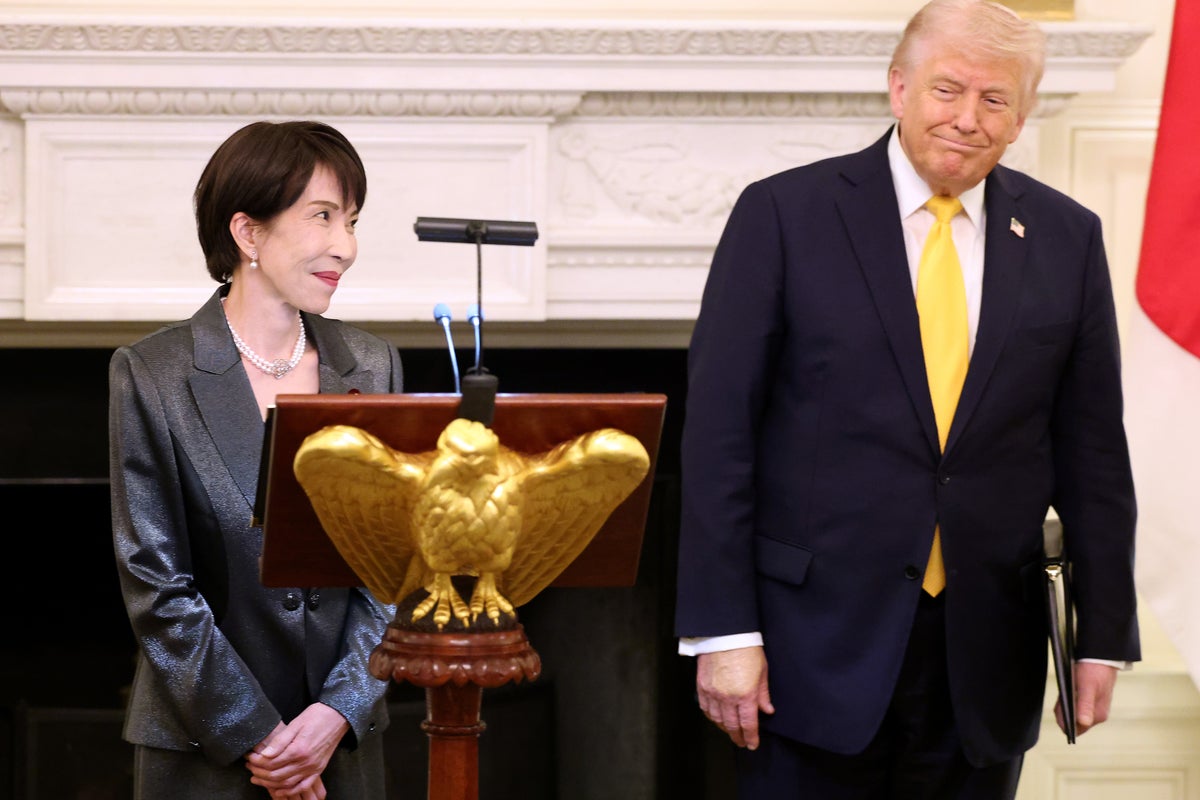
The stability of the Indo-Pacific security architecture relies on a singular, precarious calculation: the ability of the Japanese executive branch to absorb domestic political volatility in exchange for ironclad American security guarantees. When Prime Minister Haruka Shindo characterizes the bilateral relationship as a "best buddy" dynamic following President Trump’s rhetorical invocation of Pearl Harbor, she is not merely engaging in diplomatic pleasantries. She is executing a high-stakes hedging strategy designed to insulate the Treaty of Mutual Cooperation and Security from the transactional volatility of "America First" populism.
The Taxonomy of Rhetorical Friction
Diplomatic incidents of this nature function as stress tests for the bureaucratic "deep state" of both nations. The President’s joke regarding Pearl Harbor—a foundational trauma in the bilateral psyche—serves as a reminder that the alliance is not built on shared historical interpretation, but on immediate, cold-blooded utility. Shindo’s decision to minimize the friction points toward a specific hierarchy of Japanese national interests. For an alternative perspective, check out: this related article.
The Buffer Strategy
By adopting the "best buddy" label, the Shindo administration attempts to personify a complex institutional alliance. This serves three distinct functions:
- Volatility Dampening: Personalizing the relationship creates a "special status" that complicates any sudden U.S. shifts toward protectionism or troop withdrawal.
- Domestic Signaling: It reassures the Japanese electorate that the Prime Minister maintains unique influence over a perceived unpredictable American executive.
- Escalation Avoidance: It denies political oxygen to opposition parties in the Diet who would use the Pearl Harbor comment to argue for "Normalcy"—a euphemism for full-scale Japanese rearmament and a break from the U.S. security umbrella.
The Cost Function of the Security Umbrella
The alliance is often framed through the lens of shared democratic values, but the underlying mechanics are strictly fiscal and territorial. Japan provides the "unsinkable aircraft carrier" for U.S. power projection in exchange for a nuclear deterrent. This exchange is currently undergoing a structural repricing. Related insight on the subject has been shared by Associated Press.
The "Host Nation Support" (HNS) agreements—the payments Japan makes to maintain U.S. bases—represent the primary variable in this cost function. When the U.S. executive utilizes historical grievances or "jokes" to reassert dominance, it is often a precursor to a "Cost Plus 50" negotiation style. Shindo’s rapid pivot to camaraderie is a defensive maneuver to keep negotiations within the realm of strategic partnership rather than a raw real estate transaction.
The Tactical Utility of History
History in this context is a tool of leverage. The mention of Pearl Harbor by a U.S. President is never an accident; it is a recalibration of the moral high ground. It reminds Tokyo of the "Original Sin" that defined the post-war order, effectively signaling that the terms of the alliance are dictated by the victor. Shindo’s refusal to take the bait is a sophisticated rejection of this framing. By claiming "best buddy" status, she attempts to move the relationship from a "Victor-Vanquished" model to a "Peer-Peer" model.
The Triad of Indo-Pacific Deterrence
The "best buddy" rhetoric must be analyzed against the backdrop of three specific regional threats that make the U.S.-Japan alliance non-negotiable for Tokyo.
- The Taiwan Strait Paradox: Japan’s security is inextricably linked to the status quo of Taiwan. Any kinetic conflict there necessitates the use of U.S. bases on Japanese soil (Okinawa), which would likely draw Japan into the conflict.
- The Second-Strike Requirement: As regional actors increase their ballistic missile capabilities, Japan’s "Shield" (Ballistic Missile Defense) requires the U.S. "Spear" (Offensive Strike) to maintain a credible deterrent.
- Supply Chain Decoupling: The integration of the CHIPS Act and Japanese semiconductor equipment manufacturing requires a level of trust that transcends historical grievances.
These factors create a "Lock-In Effect." Even if the U.S. executive branch uses abrasive rhetoric, the Japanese leadership is structurally incentivized to ignore it. The cost of taking offense—resulting in a weakened security commitment—far outweighs the domestic political cost of appearing "soft" on American insensitivity.
Mechanisms of Diplomatic Absorption
How a Prime Minister absorbs an insult without losing domestic legitimacy involves a precise set of administrative maneuvers.
- The Technical Pivot: Moving the public conversation from the joke to specific outcomes, such as joint naval exercises or investment in the Tohoku region.
- The "Special Relationship" Narrative: Cultivating a narrative that the Prime Minister is the only leader capable of "handling" the American President, thereby turning a potential weakness into a unique selling point.
- Institutional Depth: Relying on the Ministry of Foreign Affairs (MOFA) to coordinate with the U.S. State Department and Pentagon behind the scenes to ensure that the "business of the alliance" continues regardless of the "theater of the alliance."
The danger of this strategy is the "Sovereignty Gap." If the Japanese public perceives that the "best buddy" dynamic is one-sided or subservient, it fuels the rise of nationalist movements within Japan that advocate for "Autonomous Defense." This would involve a repeal of Article 9 of the Constitution and a massive increase in defense spending (beyond the current 2% of GDP target), which would fundamentally alter the balance of power in East Asia.
The Geopolitical Arbitrage of Personality
Strategic consultants view the Shindo-Trump interaction as an exercise in "Personality Arbitrage." Shindo is trading a small amount of national pride for a large amount of strategic certainty. In an era where U.S. foreign policy can shift via social media or offhand remarks at rallies, the "best buddy" designation acts as a psychological anchor.
However, this anchor has a limited depth. The structural prose of the alliance—the treaties, the base agreements, and the intelligence-sharing protocols—must eventually be reconciled with the public rhetoric. If the U.S. continues to use historical grievances as a bargaining chip, it risks degrading the "Trust Variable" that allows Japanese leaders to justify the U.S. presence to their own citizens.
The mismatch between the President's humor and the Prime Minister's gravity reveals the inherent asymmetry of the relationship. The U.S. can afford to be flippant because its security is not dependent on Japan. Japan cannot afford to be offended because its security is entirely dependent on the U.S.
Strategic Realignment and the Multi-Polar Path
The Shindo administration’s current trajectory suggests a dual-track approach. While maintaining the "best buddy" facade with the United States, Japan is quietly diversifying its security portfolio. This is evidenced by:
- The Reciprocal Access Agreement (RAA) with Australia: Creating a "quasi-alliance" that does not involve the United States directly.
- The Global Combat Air Programme (GCAP): Partnering with the UK and Italy to develop next-generation fighter jets, reducing reliance on U.S. defense contractors.
- The Quadrilateral Security Dialogue (The Quad): Leveraging India as a democratic counterweight to ensure that the region is not merely a bipolar tug-of-war between Washington and Beijing.
The Pearl Harbor joke, and Shindo’s reaction to it, accelerates this diversification. While the "best buddy" rhetoric provides immediate cover, the underlying strategy is one of gradual "De-risking" from American political volatility.
The immediate strategic play for the Japanese executive is to utilize this "friendship" to secure specific, binding commitments on nuclear extended deterrence and technology transfer before the next U.S. electoral cycle. By framing the relationship as personal, Shindo can bypass traditional bureaucratic bottlenecks to get "handshake deals" that can then be codified by the professional diplomatic corps. The "best buddy" label is not an end state; it is a lubricant for the friction-heavy machinery of international relations.
The alliance remains functional only as long as both parties perceive that the benefits of cooperation exceed the costs of autonomy. For Japan, the "Pearl Harbor" rhetoric increases the perceived cost of the alliance, necessitating a more aggressive pursuit of "Best Buddy" optics to maintain the equilibrium. The final move for Tokyo is to turn these optics into a "Strategic Autonomy Lite," where Japan remains a loyal ally but develops the independent capacity to act if the "best buddy" dynamic ever fails to deliver on its security promises.