The security of the Strait of Hormuz is frequently mischaracterized as a binary state of either "open" or "closed," but for global energy markets and naval planners, the reality is a graduated scale of risk-adjusted costs. The fundamental tension revealed by recent frictions in the Persian Gulf is not merely a localized conflict between state actors; it is a stress test of the post-Cold War maritime security architecture. When the United States signals a pivot toward the Indo-Pacific, the resulting security vacuum in the Middle East forces a re-evaluation of how alliances are structured. This shift moves the mission from a US-led hegemony toward a fragmented, multi-polar "coalition of the interested," where the primary variable is no longer total firepower, but the distribution of political will and operational risk.
The Geographic Bottleneck and Kinetic Reality
The Strait of Hormuz measures approximately 21 miles wide at its narrowest point, with shipping lanes consisting of two-mile-wide channels for inbound and outbound traffic, separated by a two-mile buffer zone. This physical constraint dictates the entire tactical environment. Because the deep-water channels fall within the territorial waters of Iran and Oman, the legal framework of "transit passage" under the United Nations Convention on the Law of the Sea (UNCLOS) is the only thin layer of protection for global commerce.
The kinetic threat profile in this corridor has evolved beyond traditional blue-water naval engagements. Instead, we observe an asymmetric cost-imposition strategy characterized by:
- Swarm Maneuvers: The use of Fast Inshore Attack Craft (FIAC) to overwhelm the targeting cycles of sophisticated destroyers.
- Loitering Munitions and UAVs: Low-cost aerial systems that force defenders to expend high-cost interceptors (e.g., using a $2 million RIM-162 ESSM to down a $20,000 drone).
- Limpet Mine Application: Sub-threshold sabotage that targets insurance premiums rather than hull integrity, effectively "closing" the strait via economic unfeasibility rather than physical blockage.
The efficacy of an alliance in this environment is measured by its ability to provide persistent ISR (Intelligence, Surveillance, and Reconnaissance) across these three vectors simultaneously.
The Cost Function of Maritime Security
Maintaining a "Free and Open" maritime corridor is an exercise in global public goods. Historically, the United States internalized these costs, viewing the stability of the oil market as a prerequisite for domestic economic health. However, as the U.S. transitioned toward energy independence and shifted its strategic focus to the South China Sea, the cost-benefit analysis of unilateral protection changed.
The "Hormuz Crisis" reveals a shift in the burden-sharing equation, which can be expressed as a function of three primary variables:
1. Political Risk Tolerance
Allies are no longer uniform in their response to provocations. European partners often prioritize de-escalation and diplomatic channels to preserve specific agreements (such as the remains of the JCPOA), while regional partners like Saudi Arabia or the UAE view maritime security as an existential requirement for their "Vision 2030" economic transformations. This divergence creates a "hesitation gap" that adversaries exploit to test the limits of collective defense.
2. Technical Interoperability
A coalition is only as strong as its Common Operational Picture (COP). If a British Type 45 destroyer, a French Frigate, and a US Arleigh Burke-class destroyer cannot share real-time sensor data through a unified Link-16 or similar tactical data link, the response to a swarm attack will be fragmented. The crisis has exposed that while NATO standards exist, the "ad-hoc" nature of Middle Eastern coalitions often leads to "islands of excellence" rather than a continuous shield.
3. Economic Exposure vs. Contribution
There is a massive delta between the nations that benefit from the Strait's transit and those that protect it. China, the largest importer of Persian Gulf crude, provides negligible security assets to the region. This creates a "Free Rider" problem. The revelation of recent crises is that the United States is increasingly unwilling to subsidize the energy security of its primary systemic rivals.
The Shift to Distributed Deterrence
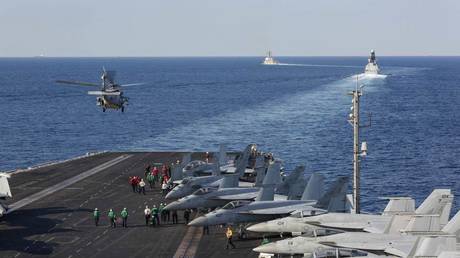
The failure of traditional carrier strike groups to deter sub-threshold "gray zone" activities has led to a pivot toward Task Force 59-style operations. This represents a fundamental change in naval doctrine: moving from a few, expensive, manned platforms to a "mesh network" of uncrewed systems.
In this new model, deterrence is generated through total transparency. By deploying hundreds of Unmanned Surface Vessels (USVs) equipped with AI-driven optical sensors, the alliance changes the adversary's calculus. It becomes impossible to mine a tanker or harass a vessel without high-definition, multi-angle attribution being broadcast to the global community within seconds. This "Transparency as Deterrence" model reduces the need for massive hull counts and places the burden on the adversary to justify their actions in the court of international opinion and law.
Strategic Divergence in Capital Allocation
The crisis has forced a hard look at the "Double Bind" of naval procurement. Allies are currently split between two competing investment philosophies:
- The High-End Conventional Path: Investing in stealth, hypersonics, and massive vertical launch systems (VLS) capacity. This is designed for high-intensity conflict with a peer competitor but is poorly suited for the day-to-day "policing" of the Strait.
- The Constabulary Path: Investing in modular patrol craft, electronic warfare suites, and cyber-defense. While effective in the Persian Gulf, these assets are "sunk costs" in a potential Pacific theater conflict.
The American alliance structure is cracking under the weight of this choice. European allies, facing a land-war threat in Ukraine, are reticent to commit high-end naval assets to the Gulf. This leaves the Strait's security to a patchwork of regional players and the U.S. 5th Fleet, creating a fragile environment where a single miscalculation by a junior commander on a FIAC could trigger a global inflationary spike.
The Institutional Bottleneck of UNCLOS and Rules of Engagement
A significant, often overlooked variable in the Hormuz crisis is the legal ambiguity of "Hostile Intent." In the Strait, Iranian vessels frequently perform "high-speed intercepts" that come within yards of commercial and military ships. Under current Rules of Engagement (ROE), a commander must determine if these maneuvers constitute an imminent threat.
The crisis reveals that there is no unified "Allied ROE." A US captain might have a different threshold for defensive fire than a French or Indian captain. This lack of legal and operational synchronicity means that the "Alliance" does not actually function as a single unit during the critical 120 seconds of a potential engagement. It functions as a collection of individual actors, each checking back with their respective capitals. This latency is a tactical vulnerability that no amount of technology can fully mitigate.
The Strategic Play
The future of maritime security in the Strait of Hormuz will not be found in a return to massive US-led armadas. The data indicates a permanent shift toward a "Regionalized Security Architecture" underpinned by three specific tactical moves:
First, the integration of regional sensors into a unified AI-layer. This removes the "Political Risk" of attribution. If an autonomous system identifies a threat, the data is objective and shared instantly among all stakeholders, preventing any single nation from suppressing the information to avoid conflict.
Second, the decoupling of "Energy Security" from "Naval Hegemony." We are seeing the rise of "Escort-as-a-Service," where nations whose economies are most reliant on the Strait (South Korea, Japan, India) must take the lead in tactical escorts, while the U.S. provides the high-level ISR and "over-the-horizon" strike capabilities. This re-aligns the economic incentives with the physical risks.
Third, a move toward "Hardened Infrastructure" that bypasses the Strait entirely. This includes the expansion of the East-West Pipeline (Abqaiq-Yanbu) and the development of the "Land Bridge" rail projects across the Arabian Peninsula. True security for the Strait of Hormuz is achieved by making it less relevant to the global economy.
The ultimate strategic move for an ally in this environment is not to ask for more US ships, but to invest in the uncrewed, autonomous "digital mesh" that makes clandestine aggression impossible. Deterrence in the 21st century is not about the size of the cannon, but the speed of the sensor-to-shooter loop and the transparency of the theater. The era of the "Global Policeman" is being replaced by the era of the "Global Panopticon," and the Strait of Hormuz is the first laboratory where this theory is being proven.