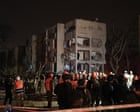
The ballistic missiles that breached the skies over Arad and Dimona on Saturday did more than wound over 100 Israeli civilians. They shattered a long-held doctrine of total aerial hermeticism. For years, the security of the Israeli home front rested on the perceived infallibility of a multi-layered air defense network. That architecture faltered when heavy conventional warheads slipped through the net, striking residential blocks in Arad and schools in Dimona.
An critical assessment of the strikes reveals that the saturation of interceptor envelopes, combined with the deployment of heavy conventional warheads, is actively shifting the operational mathematics of Middle Eastern state-on-state violence. Security establishment inquiries are now underway to determine exactly why the interceptors failed.
The immediate human cost is severe. Shrapnel and structural collapses left dozens fighting for their lives at Soroka Medical Center in Beersheba, including a five-year-old girl and a twelve-year-old boy. Emergency crews in Arad spent the night pulling survivors from pancaked concrete. But while the tactical autopsy focuses on radar acquisition timelines and interceptor inventory, the strategic story is much bigger. This is no longer a shadow war of proxy skirmishes and deniable sabotage. It is a direct, heavy-metal exchange between regional titans where the old thresholds of deterrence no longer apply.
The Mechanical Failure Of Total Interception
To understand why missiles got through, one must understand how modern terminal defense operates. In theory, long-range ballistic projectiles are tracked outside the atmosphere, with interceptors calculated to destroy the threat at its highest or most predictable arc.
When a barrage is synchronized, sensors are forced to prioritize threats in microseconds.
If a single battery is forced to track dozens of incoming objects simultaneously, radar processors can experience track-file saturation. If even two percent of incoming objects slip through due to computing lag or interceptor exhaustion, the result is what occurred in Arad. Preliminary military assessments indicate the projectile that hit Arad carried a conventional warhead weighing hundreds of kilograms. The physical destruction of heavy explosive mass hitting an urban center cannot be mitigated by standard emergency protocols.
The Air Force and Home Front Command are running parallel inquiries. The investigation is not looking for some exotic, unknown weapon. The military has already acknowledged these were standard, heavy conventional ballistic missiles. The failure was not one of imagination, but of pure numbers and mechanical saturation. When a system is built to handle a specific volume of threats, pushing it past that threshold guarantees a leak.
The Proximity To Dimona And The Nuclear Question
While Arad suffered the brunt of the kinetic blast, the psychological epicenter of Saturday's barrage was the nearby city of Dimona. Dimona is home to the Shimon Peres Negev Nuclear Research Center, the cornerstone of the regional nuclear balance.
Iranian state-linked outlets were quick to frame the Dimona strikes as a direct response to previous operations targeting their own enrichment facilities at Natanz and Bushehr. The messaging is not subtle. By dropping heavy ordnance near Dimona, the adversary is telegraphing that the ultimate strategic asset is within range.
The International Atomic Energy Agency monitored the situation closely, stating that no abnormal radiation levels were detected and the facility itself was untouched. The intent of the strike was likely not to trigger a radiological release, which would invite an existential retaliation, but to demonstrate capability. In modern military signaling, putting a conventional crater inside the city limits of a nuclear hub is the ultimate flex. It proves that the distance between a message and a catastrophe is a matter of a few degrees of guidance programming.
Redefining The Doctrine Of Home Front Resilience
For the civilian populations of the Negev desert, Saturday's events mark the end of passive reliance on technology.
Civilian shelters are built to withstand shrapnel and blast waves, not direct impacts from heavy tonnage dropped from the upper atmosphere. In Arad, where emergency services declared a mass casualty incident, responders had to pivot from treating light shrapnel wounds to heavy urban search-and-rescue.
The political fallout is immediate. Prime Minister Benjamin Netanyahu characterized the night as a difficult evening in the campaign for the future, promising to strike back. But the promise of retaliation does little to solve the immediate architectural vulnerability of urban defense. If interception is no longer guaranteed, the state must fundamentally rethink its internal civil defense.
This requires a difficult pivot. Grounding national security on the promise that "nothing gets through" creates a fragile populace. When something inevitably does get through, the psychological shock is magnified. Transitioning to a model of calculated resilience—where the public understands that some impacts are inevitable—is a bitter pill for any administration to swallow.
The Shifting Calculus Of Regional Escalation
The broader geopolitical theater is reacting in real time to the puncture of the southern shield.
- Regional State Players: Bordering nations are tracking the efficacy of the strikes, measuring how their own defensive postures would hold up if caught in the crossfire.
- Superpower Friction: Global powers are weighing whether to press for a immediate de-escalation or allow the kinetic cycle to burn itself out.
- Global Supply Chains: Maritime choke points and energy corridors tighten every time a ballistic arc is tracked over a major Middle Eastern population center.
The tactical reality is that offensive missile technology is currently out-scaling the economic and physical constraints of defensive interception. An interceptor missile costs significantly more to produce and field than the unguided or inertial-guided ballistic tube it is designed to kill. In an attrition engagement, the offense holds the economic high ground.
This asymmetry is the uncomfortable truth behind the smoke over Arad and Dimona. If a regional power is willing to absorb the diplomatic and military consequences of launching direct heavy barrages, traditional defensive shields can be overwhelmed by sheer volume. The military inquiries will likely tighten software parameters and improve radar handshake protocols between batteries. They will squeeze a few more percentage points of efficiency out of the Iron Dome, David’s Sling, and Arrow systems. But they cannot change the fundamental physics of a saturated sky.
The search-and-rescue teams in the south have packed up their heavy hydraulic jacks, and the medical center in Beersheba is stabilizing its patients. The physical craters will be filled, and the rubble will be cleared away. What cannot be patched over is the sudden, jarring realization that the dome over the desert is not a solid ceiling. It is a screen, and screens can tear. Grounding future security policy requires accepting this vulnerability, rather than pretending it can be engineered away.