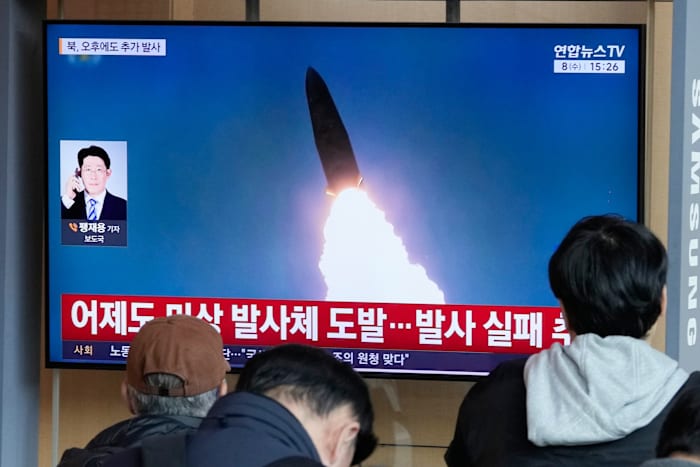
Diplomacy with North Korea isn't just difficult; it's often a choreographed trap. On April 8, 2026, Pyongyang reminded the world of this by launching a series of ballistic missiles into the sea. This didn't happen in a vacuum. It came exactly when South Korea's liberal government was busy patting itself on the back for "meaningful progress" in relations. If you're looking for a textbook example of geopolitical gaslighting, this is it.
The North fired several short-range ballistic missiles from the Wonsan area on Wednesday morning, followed by another that traveled over 700 kilometers later that afternoon. This followed a botched launch near Pyongyang on Tuesday. While South Korean officials were trying to find "frankness" and "courage" in recent statements from Kim Yo Jong, the North’s actual response was to call them "world-startling fools."
The Missile Reality Check
The technical details of these launches matter because they show a regime that isn't interested in talking—it’s interested in targeting. The missiles launched from Wonsan flew roughly 240 kilometers. That distance isn't random. It’s the exact range needed to hit major military hubs and population centers in South Korea.
These aren't the clunky, liquid-fueled rockets of the past. North Korea's recent tests focus on solid-fuel technology. You can store these missiles fueled and ready to go. They don't require a long, visible fueling process that gives satellite intelligence time to react. Basically, they're designed to be launched before an adversary even knows they're out of the hangar.
- Launch 1 (Tuesday): A projectile from the Pyongyang area that likely failed shortly after takeoff.
- Launch 2 (Wednesday Morning): Multiple short-range missiles from Wonsan traveling 240km.
- Launch 3 (Wednesday Afternoon): A single missile flying over 700km, showing a significant range extension.
Why Seoul Keeps Getting it Wrong
The current administration in Seoul, led by President Lee Jae Myung, seems stuck in a loop of optimism that the North simply doesn't share. Earlier this week, Lee expressed regret over civilian drone flights into the North—a gesture intended to lower the temperature.
When Kim Yo Jong, the influential sister of Kim Jong Un, called the move "wise," Seoul’s unification ministry practically tripped over itself to declare a breakthrough. But within 24 hours, Jang Kum Chol, a senior North Korean official, threw cold water on the whole thing. He didn't just disagree; he was insulting. He compared South Korea to "dogs affected by mange" and made it clear that her earlier statement was a warning, not an olive branch.
This disconnect is the core problem. South Korea views diplomacy as a way to prevent war. North Korea views "diplomacy" as a tool to buy time for its nuclear program. Since the 2019 collapse of talks between Kim Jong Un and Donald Trump, the North has shifted its strategy. It no longer seeks a grand bargain. It wants to be recognized as a permanent nuclear power, period.
The Multi-Warhead Threat
What should really keep you up at night isn't the short-range stuff. It's the "wish list" Kim Jong Un is working through. South Korea's spy agency recently warned that a ground test of an upgraded solid-fuel engine indicates the North is close to perfecting a multi-warhead intercontinental ballistic missile (ICBM).
If you have one missile with one warhead, a defense system like THAAD has a decent shot at intercepting it. If you have one missile that releases four or five warheads in different directions, the math changes. It’s about overwhelming the defense. Experts still debate if they've mastered the reentry technology, but the North is failing its way to success at an alarming rate. Every "abnormal" launch, like the one on Tuesday, provides data that makes the next one more lethal.
No More Wishful Thinking
Stop waiting for a "thaw" that isn't coming. The pattern is clear. Pyongyang uses aggressive rhetoric to set the stage, conducts tests to refine its hardware, and then waits for the South or the U.S. to offer concessions just to stop the provocations.
If you're following these developments, don't look at what the politicians say. Look at the flight paths. Look at the fuel types. When a regime calls you an "enemy state" while fueling a missile, believe the missile.
The next steps for the region involve doubling down on the trilateral alliance between Seoul, Washington, and Tokyo. The time for hoping for a change of heart in Pyongyang has passed. Now, it's about containment and ensuring the cost of any "provocation" is too high for the Kim regime to pay. Expect more launches as the North moves toward its goal of a survivable, multi-warhead nuclear triad. Stay skeptical of any headlines claiming a "breakthrough" in the coming weeks.