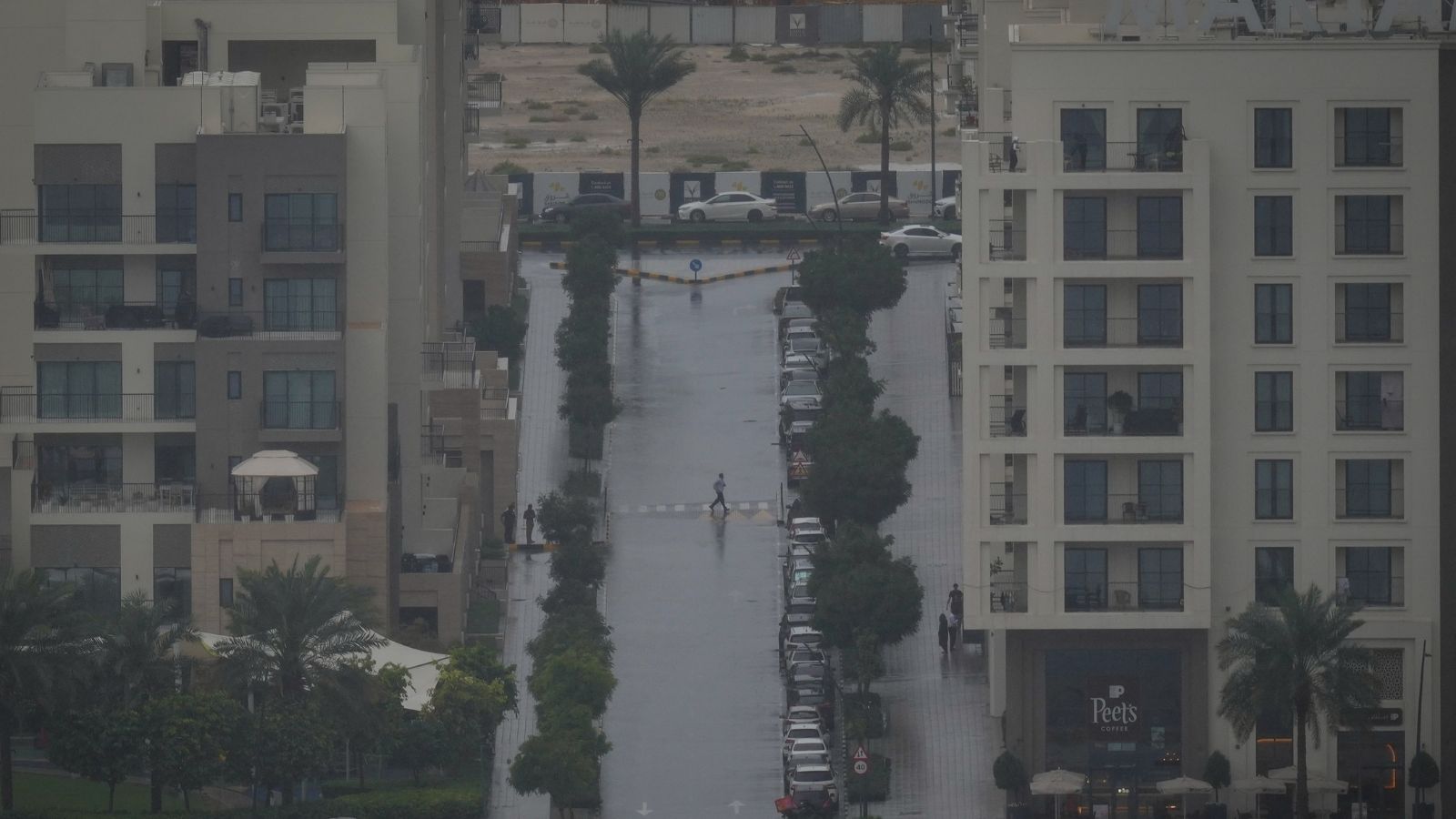
The coffee in Dubai smells of cardamom and ambition. It is a scent that masks the metallic tang of a world on edge. On the twenty-fifth morning of a conflict that many hoped would be a footnote but has instead become a chapter, the sun rose over the Burj Khalifa with its usual indifferent brilliance. But for those watching the radar screens in Riyadh and Kuwait City, the dawn brought a different kind of light.
Iron met fire in the upper atmosphere. Expanding on this theme, you can also read: Why the Green Party Victory in Manchester is a Disaster for Keir Starmer.
We often talk about war in the language of maps and munitions. We track the "25th day" as if it were a score in a game. But statistics are a lie we tell ourselves to stay sane. The reality isn't a number; it is the vibration in a windowpane in a Kuwaiti suburb when an interceptor missiles tears through the sound barrier to meet a drone that was never meant to land safely.
The Calculus of a Quiet Morning
In the plush hotel lobbies of Dubai, the digital tickers hum with news of Saudi and Kuwaiti forces neutralizing threats. To the casual observer, it looks like a success story of modern defense. To the businessman sipping an espresso while checking the Brent crude prices, it is a sigh of relief. Yet, look closer at the hands holding those cups. There is a slight tremor. Experts at The New York Times have also weighed in on this situation.
Security is a ghost. You only notice it when it leaves the room.
For twenty-five days, the regional architecture has been held together by invisible threads of technology and split-second human decisions. When a drone is launched, a sequence of events begins that spans hundreds of miles and involves thousands of variables. It isn't just a military action. It is a stress test for the very idea of the modern Middle East as a global crossroads.
Consider a hypothetical air traffic controller in Kuwait. Let's call him Omar. Omar doesn't see "geopolitics." He sees blips. He sees the commercial flight from London descending toward the runway, filled with families and consultants, and he sees the "unknown" signature blooming on his periphery. The intercept is successful. The "live update" on a news site flashes a single sentence about a drone being downed. But for Omar, the "success" is the fact that the London flight landed without the passengers ever knowing they were part of a kinetic theater.
The Invisible Stakes of the Shield
The interceptors used by Saudi Arabia and Kuwait are masterpieces of engineering, but they are also incredibly expensive ways to buy a few more hours of normalcy. Every time a Patriot missile or a localized defense battery fires, it isn't just destroying a threat; it is defending a narrative.
That narrative is simple: Business continues. The sky is safe. The ports are open.
Dubai thrives on this belief. It is a city built on the audacity of being a sanctuary in a complicated neighborhood. When news breaks that neighboring states are actively intercepting attacks, the stakes aren't just about physical damage. The real target is the collective psyche of the global markets. If the shield holds, the investment stays. If the shield flickers, the capital flies away faster than any drone.
We see this play out in the subtle shifts of the city’s energy. The malls are still full, but the conversations have shifted. People are no longer talking about the next big real estate launch; they are looking at their phones, refreshing feeds, wondering if the "25th day" is the peak or merely the plateau.
A Geography of Anxiety
Distance in the desert is a strange thing. A missile launch hundreds of miles away feels intimate when you share the same coastline. The Gulf is a small pond. A ripple in one corner eventually hits every shore.
Saudi Arabia’s role as the regional heavyweight means its defense systems are the primary umbrella for the neighborhood. When they intercept a drone, they aren't just protecting a refinery or a city square; they are maintaining the atmospheric pressure of the entire peninsula. If that pressure drops, the consequences ripple into the global supply chain, the price of gas in a small town in Ohio, and the insurance premiums of cargo ships navigating the Strait of Hormuz.
The complexity of these attacks—a mix of slow-moving drones and high-speed missiles—is designed to overwhelm. It is a digital-age siege. It tests the endurance of the crews who have been on high alert for nearly a month. Fatigue is the enemy that radar can’t detect.
Imagine the technical teams in the command centers. They have lived in a state of "red alert" for three weeks. They eat their meals in front of monitors. They sleep in snatches. Their world has shrunk to the size of a glowing cursor. For them, the "25th day" isn't a milestone. It is a weight.
The Human Cost of Constant Vigilance
We often ignore the psychological toll of living under a "successful" defense system. There is a specific kind of exhaustion that comes from being told you are safe because something terrible was stopped just in time. It creates a brittle environment.
In the neighborhoods of Kuwait, parents walk their children to school while knowing that, somewhere above the clouds, a sophisticated dance of destruction just took place. They don't see the debris. They don't see the explosion. They only see the blue sky. But they know.
That knowledge changes how a society functions. It makes the "normal" feel precious and fragile, like a piece of ancient glass.
Dubai, meanwhile, remains the glittering exception that proves the rule. It stays focused on the future, on the tech summits and the trade shows, because the alternative is unthinkable. The city’s brilliance is a form of defiance. Every skyscraper is a bet against chaos.
Beyond the Ticker Tape
The news updates tell us what happened. They rarely tell us what it means.
When Saudi Arabia and Kuwait coordinate their defense, it is a signal of a deepening, desperate alignment. The old rivalries and bureaucratic frictions of the past are being burned away by the necessity of the present. This isn't just a military cooperation; it is an evolution of a regional identity. They are learning to breathe in unison because the air has become thin.
The war entering its 25th day marks a transition from a crisis to a condition. We are no longer waiting for it to end; we are learning to live within it. This is the most dangerous phase. When the extraordinary becomes ordinary, we stop looking at the sky. We stop feeling the tremor in the windowpane. We start believing that the interceptors will always work, that the drones will always be caught, and that the cardamom coffee will always be hot.
But the machines are made by men, and the men are tired.
As the sun sets over the Gulf, casting long, golden shadows across the sand, the silence is heavy. It isn't the silence of peace. It is the silence of a held breath. Somewhere out there, in the dark stretches of the desert, the next movement is already beginning, and the radar screens are waiting to catch the first flicker of a light that shouldn't be there.
The dunes do not remember the missiles that fell yesterday. They only wait for the wind to shift the sand, burying the fragments of the day's metal so that, tomorrow, the desert can look as though nothing ever happened.