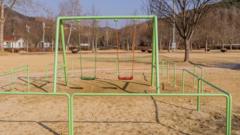
The plastic on a playground slide has a specific, static-filled scent when the sun hits it just right. It is the smell of safety. It is the smell of a Tuesday afternoon in Gyeonggi Province, where the only pressing concern for a child should be whether they can reach the top of the monkey bars or if the ice cream truck is still two blocks away.
Everything about that afternoon in South Korea was normal. The air was crisp. The sounds were a familiar symphony of rhythmic squeaks from swings and the high-pitched chatter of children. Then, the physics of a peaceful neighborhood collided with the mechanics of war.
A four-year-old girl was playing. She was doing what children are designed to do: occupying a world where the ground is stable and the sky is empty of everything but clouds. Then she fell. Not because she tripped, and not because she was pushed. She fell because a piece of metal, traveling at a velocity her mind could not comprehend, tore through the air and struck her head.
It was a bullet.
Specifically, it was a 5.56mm round, the standard diet of an K2 assault rifle. It didn’t belong there. It belonged two kilometers away, at a military shooting range where soldiers were practicing the grim, necessary art of national defense. Yet, through a terrifying failure of trajectory and safety, the bullet traveled beyond the berms, beyond the warnings, and into the soft, unprotected center of a civilian life.
The Invisible Arc of Risk
We often treat military drills as background noise. In a country that exists in a state of perpetual, frozen conflict, the hum of helicopters and the distant thud of artillery become a kind of environmental texture. You stop hearing it. You assume the line between the "training zone" and the "living zone" is an unbreachable wall.
But ballistics don’t respect property lines.
A 5.56mm bullet is a small thing. It weighs about as much as a couple of paperclips. But when propelled by expanding gases at three times the speed of sound, it carries enough kinetic energy to shatter bone and change a family's history forever. When that bullet left the muzzle of a rifle during that routine drill, it entered a state of "stray" existence. It became a blind messenger of chaos.
The military range in question, nestled in the rugged terrain of Gyeonggi, is supposed to be a contained environment. There are backstops. There are angles of fire. There are protocols designed to ensure that the lead stays in the dirt. But when you factor in a ricochet—perhaps a bullet hitting a rock at just the right angle to skip upward like a stone on a lake—the geometry of safety collapses.
Consider the terrifying mathematics of a stray round. A bullet fired at a slight upward angle can travel much further than its intended target. It arches. It climbs into the blue, silent and invisible, before gravity pulls it back down to earth. Usually, these "lost" bullets find their home in a tree trunk or a patch of empty mud. This time, the math ended at a playground.
The Weight of a Small Metal Object
The girl survived. That is the miracle of centimeters. A fraction of an inch in any other direction and the headline would have been a eulogy. Doctors at the local hospital treated the wound—a scalp injury caused by the bullet grazing or striking her—and the physical recovery began.
But the physical wound is only the entry point.
There is a psychological shrapnel that follows an event like this. How do you explain to a four-year-old that the sky is dangerous? How does a parent sit on a park bench again without scanning the ridgeline for the flicker of a camouflage uniform? The trust between a citizenry and its protectors is a fragile thing, built on the assumption that the weapons meant for defense will never be pointed, even accidentally, at the people they are sworn to shield.
The South Korean military immediately suspended drills at the range. They launched investigations. They spoke of "safety checks" and "improved barriers." These are the standard maneuvers of bureaucracy when it meets a crisis. They are necessary, of course. We need better berms. We need higher walls. We need stricter oversight of firing angles.
But the real issue isn't just a lack of sandbags.
It is the creeping encroachment of the military machine into the spaces where we live. As urban sprawl pushes housing developments closer to long-established training grounds, the "buffer zones" are shrinking. The margin for error is evaporating. What used to be a firing range in the middle of nowhere is now a firing range next to a Starbucks and a kindergarten.
The Cost of Readiness
South Korea remains a nation on edge. Conscription is a reality. Drills are a necessity. To live in Seoul or its surrounding provinces is to accept that the machinery of war is always idling in the background. We justify the noise and the inconvenience as the price of peace. We tell ourselves that the soldiers in the hills are the reason we can sleep soundly in our beds.
But that social contract feels different when the lead starts falling in the play area.
When we talk about "military readiness," we usually think of statistics. We think of how many rounds were fired, how many hours were logged, and how many targets were hit. We rarely track the "near misses." We don't have a spreadsheet for the bullets that landed in gardens or the shells that rattled windows without breaking them.
This incident at the playground wasn't just a freak accident. It was a symptom of a system where the "invisible stakes" have become too high. The soldiers behind the rifles are often young men, barely out of their teens, tired and under pressure. The officers overseeing them are checking boxes in a manual. Somewhere in that chain of command, the reality of the surrounding neighborhood—the reality of the seesaws and the slides—slipped from view.
A Geometry of Fear
The investigation will eventually produce a report. It will likely blame a combination of a freak ricochet and a failure to maintain the height of a safety embankment. They will fix the embankment. They will hold a ceremony. They will tell the public that it is safe to return to the park.
But safety is more than the absence of a bullet.
It is the absence of the thought of a bullet. It is the ability to watch your daughter run toward the swings without calculating the distance to the nearest mountain range. For the families in Gyeonggi, that innocence has been punctured. The playground is no longer a sanctuary; it is a coordinate on a map that proved to be within range.
The girl will grow up. The scar on her head will fade into a thin, white line hidden by her hair. She may forget the sound or the shock of the fall. But the community will remember. They will look at the ridgeline every time they hear the distant, rhythmic pop-pop-pop of a training exercise.
They will remember that peace is not just the absence of war, but the assurance that the tools of war stay where they belong. They will remember that on a random Tuesday, the sky wasn't empty.
A bullet is a small thing, but it leaves a hole much larger than its own diameter. It tears through the fabric of the everyday. It reminds us that we are all living within the arc of someone else's trajectory, hoping that the math holds, hoping that the berms are high enough, and hoping that the next time someone pulls a trigger, they remember who exactly they are supposed to be protecting.
The swings are moving now, pushed by the wind, empty and rhythmic.