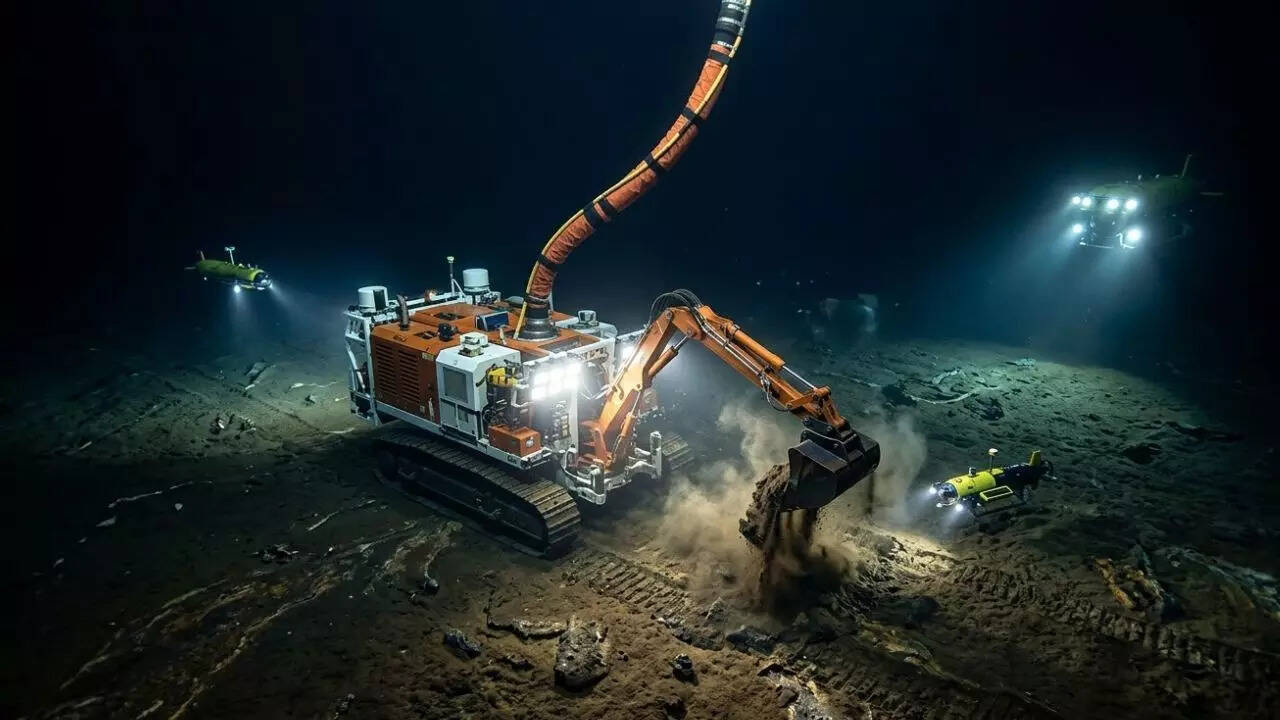
Six kilometers is a distance most of us could jog in thirty minutes. It is a pleasant morning run. But when that distance is measured straight down, through the crushing weight of the Pacific Ocean, it becomes a barrier more formidable than any mountain range on Earth. At six thousand meters, the light died long ago. The pressure is enough to flatten a car into a pancake. It is silent. It is freezing.
And it is where the future of the global economy is currently buried in the mud.
For decades, the world has looked at the periodic table with a sort of casual indifference. We learned about gold and silver because they were shiny. We learned about iron and coal because they built the cities of our grandfathers. But today, the names that matter are far more melodic and infinitely more obscure: terbium, dysprosium, europium, yttrium. These are the rare earth elements. Without them, your smartphone is a glass brick. Without them, the motors in an electric vehicle do not turn, and the turbines of a wind farm do not spin.
For a long time, Japan—a nation that rose to industrial dominance on the back of imported resources—felt a particular kind of vulnerability regarding these minerals. They watched as a single neighbor, China, consolidated nearly 90% of the world's processing capacity. It was a stranglehold. In 2010, after a diplomatic spat, the supply was squeezed. Prices skyrocketed. Panic set in.
Imagine a manufacturer in Nagoya. Let’s call him Hiro. Hiro runs a factory that produces high-precision magnets for EV motors. One morning, he wakes up to find that the raw materials he needs—materials he cannot get anywhere else—have been weaponized. His business, his employees’ livelihoods, and his country’s green energy goals are suddenly subject to the whims of a foreign power’s export office.
That vulnerability creates a specific kind of desperation. It also drives a specific kind of genius.
The Mud Beneath the Waves
In the vast, blue emptiness of the Pacific, roughly 1,200 miles south of Tokyo, lies the Minami-Torishima island. It is a tiny speck of coral and sand. But beneath the surrounding seabed, researchers have discovered something that sounds like a fever dream of a Victorian gold miner. They found mud. Specifically, 16 million tons of rare-earth-rich muck.
This isn't just a "find." It is a geological windfall of such magnitude that it could theoretically supply the entire planet's demand for certain elements for centuries. We are talking about enough yttrium to last 780 years, enough dysprosium for 730 years, and enough terbium to keep the lights on for 420 years.
But there is a catch. There is always a catch. The treasure is at the bottom of a six-kilometer abyss.
Until recently, the idea of mining this was dismissed as science fiction. How do you pull millions of tons of heavy, wet silt from the deepest reaches of the ocean without spending more energy than the minerals are worth? How do you do it without destroying an ecosystem we barely understand?
Consider the engineering required. You cannot simply drop a bucket. You need a continuous system of pipes and pumps capable of defying the physics of the deep. In 2022, a Japanese team successfully trialed a lift system that hauled sediment up from the deep. It wasn't just a technical success; it was a declaration of independence.
The New Oil and the Old Geopolitics
We often hear the phrase "data is the new oil." It’s a catchy line for a tech conference, but it’s wrong. Rare earth elements are the new oil.
In the 20th century, if you didn't have access to the Persian Gulf, your tanks didn't move and your planes didn't fly. In the 21st century, if you don't have terbium, you don't have a high-tech economy. You don't have a defense industry. You don't have a seat at the table where the future is being negotiated.
Japan’s discovery changes the math of the Pacific. It shifts the gravity of power. For years, the narrative was that the "Green Revolution" would be dictated by the nations that controlled the mines in Inner Mongolia or the processing plants in Baotou. Japan is rewriting that script from the bottom of the sea up.
This isn't just about money. It’s about the "invisible stakes" of sovereignty. When a nation depends on a single external source for the bedrock of its technology, it isn't truly sovereign. It is a tenant. Japan is trying to become a landlord.
The Cost of the Deep
Of course, the story isn't purely a triumph of man over nature. There is a deep, lingering anxiety that accompanies any venture into the unknown. The deep sea is one of the last pristine wildernesses on our planet. It is a slow-motion world where life moves at a different pace.
Environmentalists warn that "plumes" of disturbed sediment could choke the life out of the water column. They worry about the noise of the machinery, the light in a world of darkness, and the chemical shifts in the water.
Scientists are caught in a brutal tug-of-war. On one side is the urgent, desperate need to transition away from fossil fuels—a transition that requires these minerals. On the other side is the preservation of the deep-sea floor. It is a classic "lesser of two evils" dilemma. Do we risk the seabed to save the atmosphere?
The researchers on the Japanese vessels know this. They aren't just engineers; they are stewards. Every sample brought to the surface is examined not just for its mineral content, but for its ecological footprint. They are trying to build a "circular" system, where the mud is processed and the remnants are returned in a way that minimizes the scar left behind.
The Human Element in the High-Tech Race
Behind the headlines of "16 million tons" are thousands of individuals working in labs in Tokyo and on pitching decks in the middle of the ocean.
Think of the grad student staring at a monitor, watching a remote-operated vehicle (ROV) claw at the darkness. Think of the policy advisor in the Ministry of Economy, Trade and Industry, mapping out a thirty-year plan to decouple the nation's industry from a volatile supply chain.
These people are operating in a state of quiet intensity. They know that the stakes are more than just the price of a car battery. They are racing against time. Climate change isn't waiting for us to figure out the logistics of deep-sea pumping. The geopolitical clock is ticking even faster.
The "Rare Earth Giant" isn't just a deposit of minerals. It is a symbol of a world in transition. We are moving from the era of extraction on land—where we tore up forests and mountains—to an era where we look to the most extreme environments on the planet to sustain our way of life.
A Silent Revolution
The victory won't be a sudden explosion or a grand ceremony. It will be a slow, steady trickle of grey mud rising through a pipe, six kilometers long. It will be the sound of a factory in Nagoya receiving a shipment that didn't have to clear a foreign customs office that views them as an adversary.
It is a strange thought. The future of our high-speed, high-tech, sun-drenched world is currently sitting in total darkness, under millions of tons of water, waiting to be woken up.
We are standing on the shore, looking out at the horizon, realizing that the ground beneath our feet was never the only place to look for a foundation. Sometimes, to move forward, you have to look down. Deep down.
The ocean has always been a place of mystery and myth. For centuries, we crossed it to find new worlds. Now, we are diving into it to save our own. The mud of Minami-Torishima is not just dirt. It is the grit and the substance of a future that Japan, and perhaps the world, is finally ready to claim.
The silence at six thousand meters is about to get very busy.


