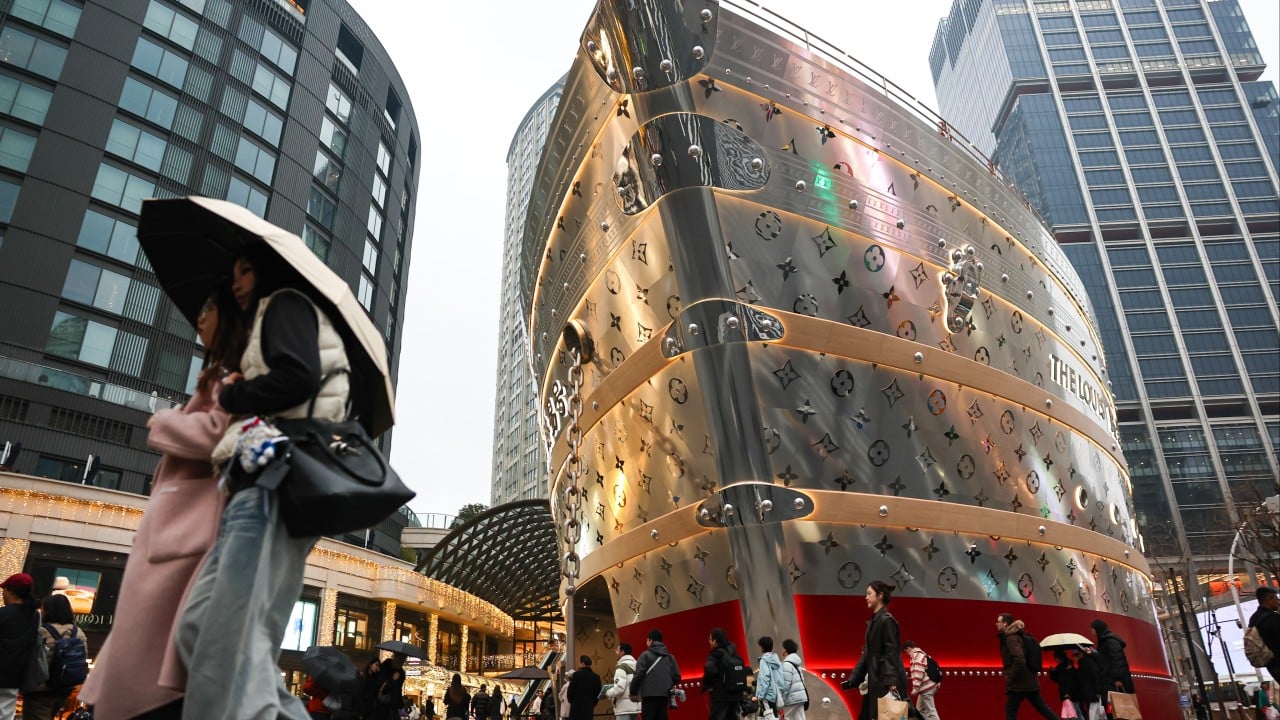
Li Wei stands on the corner of West Nanjing Road in Shanghai, the April rain misting against the glass of a storefront that has come to represent much more than just leather and gold. She isn't a billionaire. She is a thirty-two-year-old marketing director with a mortgage, a penchant for dark roast coffee, and a very specific plan. She has saved for six months. Today, she is buying the bag.
To a casual observer, this is a simple transaction. To the global economy in 2026, it is a heartbeat.
For the last year, the headlines have been grim. You’ve read them. They talk about "headwinds"—that sterile, boardroom word for people being afraid of the future. They mention cooling property markets and a cautious middle class. But if you walk the streets of Shanghai or Chengdu, the reality on the ground feels less like a collapse and more like a metamorphosis. The Chinese consumer hasn't disappeared; they have just become more discerning, more emotional, and infinitely more important to the survival of the world's most storied brands.
The Weight of a Single Purchase
When we talk about luxury spending in 2026, we are really talking about a massive psychological shift. In the early 2010s, luxury was a loud shout. It was about logos that could be seen from a block away, a frantic race to signal status in a country moving at light speed. Now, it is a whisper.
Consider the hypothetical case of Mr. Zhang, a tech entrepreneur in Hangzhou. Five years ago, Zhang would have bought a gold-rimmed timepiece to show his peers he had arrived. Today, he spends that same capital on a bespoke Italian coat with no visible branding. He isn't buying it for them. He is buying it for the way the cashmere feels against his skin during a stressful flight to Singapore.
This shift toward "quiet luxury" or "value-per-wear" is the engine driving the projected growth in 2026. While the volume of mid-tier sales has wobbled, the top end of the market is holding firm. Why? Because in an uncertain world, high-end goods have ceased to be mere fashion. They have become a form of emotional currency. They are the "safe havens" of the wardrobe.
The numbers back this up, even if they lack the soul of the story. Analysts suggest that China’s luxury market will account for a staggering portion of global growth this year. But statistics are just ghosts of human behavior. The real story is the resilience of a culture that views quality as an investment in the self.
The Myth of the Slowdown
The "headwinds" everyone is whispering about—the sluggish real estate sector and the cautious youth unemployment figures—are real. It would be dishonest to ignore them. Yet, the luxury sector is behaving like a different species altogether. It’s a paradox. How can a nation be cautious and spendthrift at the same time?
The answer lies in the "K-shaped" recovery.
Imagine two lines diverging. One goes down—representing the mass market, the fast fashion, the disposable goods. The other goes up. That upper line belongs to the consumers who have realized that if the future is unpredictable, the things they own should at least be permanent.
This isn't just a Chinese phenomenon, but China is where the drama is loudest. European luxury houses are currently betting their entire 2026 fiscal years on Li Wei and Mr. Zhang. If the Chinese consumer breathes, the boutiques in Paris and Milan stay warm. If they hold their breath, the world feels the chill.
The Digital Ghost in the Machine
We often think of luxury as old-world—heavy velvet curtains, hushed tones, white gloves. In China, that world died years ago. Today, the relationship between a brand and a buyer happens in the palm of a hand.
Li Wei didn't just walk into that store on a whim. Her journey started three weeks ago on a social media feed. She saw a short-form video of the bag’s stitching process. She received a personalized message from a digital concierge who knew her birthday and her preference for silver hardware over gold.
The integration of AI and hyper-local data has reached a point where the brand knows what you want before you’ve even admitted it to yourself. This isn't "targeted advertising" in the way we traditionally hate it. It’s more like a digital friendship, albeit one designed to move inventory. In 2026, the technology has become so sophisticated that it feels invisible. It’s no longer about the "synergy" of tech and fashion; it’s about a seamless human experience that happens to be powered by a thousand servers in the desert.
But technology alone can’t close a sale that costs four months of rent. There must be a soul.
The Rebirth of the "VIC"
The Very Important Customer (VIC) programs have become the secret weapon of 2026. Brands are no longer casting wide nets. They are spear-fishing.
Instead of grand, impersonal runway shows, houses are hosting tiny, intimate dinners in private villas in Suzhou. They are flying artisans from Florence to sit with three families and explain the provenance of a specific hide of leather. This is the "human element" that the dry business reports miss. Luxury in China has moved from the mall to the living room.
It is a high-stakes game of loyalty. If a brand loses a VIC in Shanghai, they don't just lose a sale; they lose a node in a powerful social network. In a culture where "mianzi" (face) and community recommendation carry more weight than any billboard, the emotional stakes of customer service are astronomical.
The Global Ripple
What happens in a boutique in Beijing doesn't stay there.
When Chinese luxury spending rises, it fuels the R&D for sustainable materials in Germany. It funds the apprenticeships of young cobblers in Spain. It keeps the lights on in family-owned mills in Scotland. We are interconnected by these threads of desire and commerce.
The skeptics will tell you that the 2026 growth is a fluke, a "dead cat bounce" from previous years of stagnation. They point to the debt cycles and the aging population. They aren't wrong about the risks. But they are missing the fundamental human drive to seek beauty and status in the face of hardship.
History shows us that luxury often thrives when the middle ground disappears. In the 1920s, amidst massive upheaval, the world saw an explosion of Art Deco decadence. In 2026, we are seeing a digital version of that same impulse. People are tired of the "temporary." They are tired of things that break, things that don't last, and things that don't mean anything.
The Long Shadow of the Future
As Li Wei finally walks out of the store, the rain has stopped. She carries a bag that cost more than her first car.
Is it rational? Probably not. Is it a sign of a booming, healthy economy? Not necessarily. But it is a sign of life. It is a sign that despite the "headwinds," there is a deep-seated belief in the value of the tangible.
The global luxury market isn't just watching China because they want the money. They are watching because China is currently the world’s largest laboratory for the future of desire. They are figuring out how to sell a dream to a generation that has seen every nightmare.
The numbers will come out at the end of the quarter. The charts will show a line ticking upward, and the analysts will nod and talk about "year-on-year percentages" and "market penetration." They will miss the point entirely.
They will miss the look on Li Wei’s face as she catches her reflection in a puddle. She isn't looking at the bag. She is looking at the person she thinks she has become by owning it. That is the ghost that haunts every ledger in the luxury industry. That is the invisible force that moves billions of dollars across borders.
The world is not held together by policy or by "robust" economic frameworks. It is held together by the stories we tell ourselves about the things we buy, and right now, the most important story in the world is being written in Mandarin.
Li Wei shifts the strap on her shoulder, turns the corner, and disappears into the crowd, one small, expensive heartbeat in a city that never stops moving.