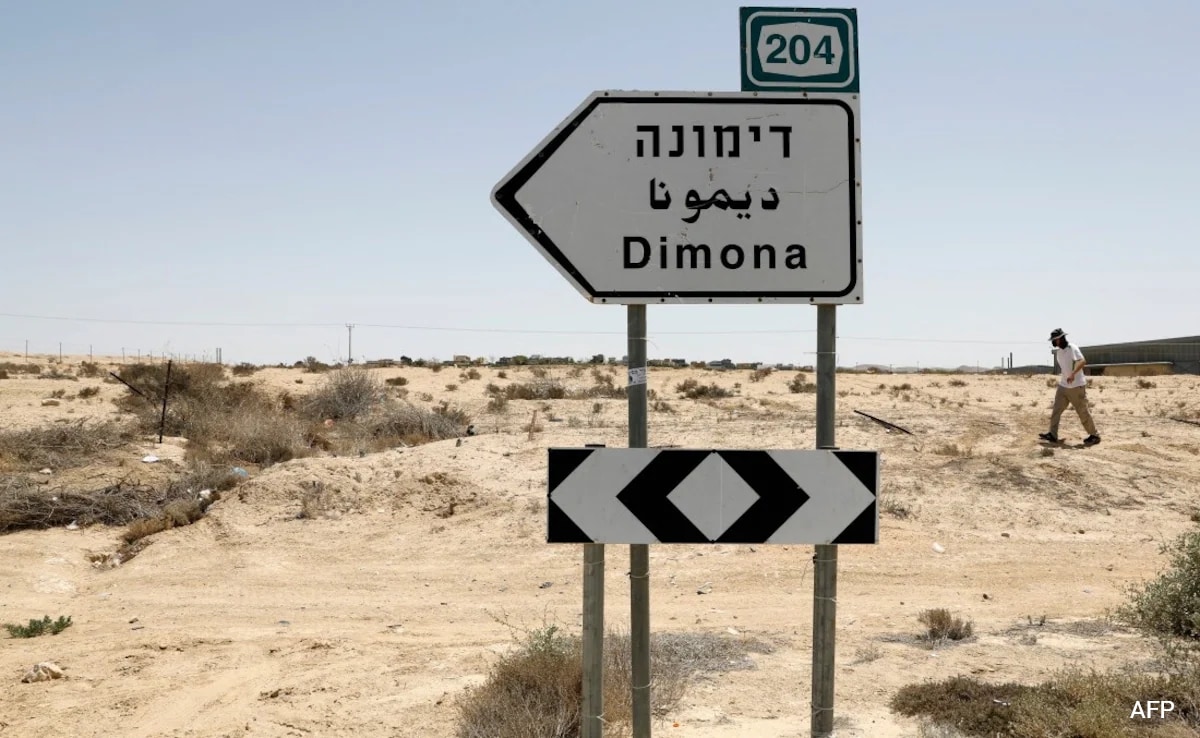
The wind in Dimona does not smell like the Negev desert. Not entirely. If you stand on a street corner near the city center, the dry, dusty heat of southern Israel is sliced through by something sharper. It is the sting of green chilies hitting hot oil. It is the cloying, floral ghost of syrup-soaked jalebis. It is the smell of a home three thousand miles away, preserved in a pressure cooker.
This is Israel’s "Little India." For decades, it has been a quiet sanctuary of concrete apartment blocks and shared courtyards. But recently, the sky above this enclave of spice and tradition turned a terrifying shade of orange. When Iran launched its barrage of missiles and drones, the trajectory put a target on a place that most of the world only knows as a footnote in nuclear strategy. For the people living there, however, the stakes weren’t about geopolitical posturing. They were about the fragile reality of a community that has spent seventy years trying to belong to two worlds at once.
The Architect of a Hidden World
Consider a man like Avram. He is seventy-two, with hands calloused from years of labor and a gait that suggests he is always carrying an invisible weight. In the 1950s and 60s, thousands of Indian Jews—Bene Israel, Cochini, and Baghdadi—boarded planes with the promise of a homeland. They arrived to find a scrub-brush wasteland. The Israeli government, desperate to populate the frontier, dropped them in Dimona.
They were told they were pioneers. In reality, they were a buffer.
Avram remembers the early days. There was no chaat. There were no Bollywood films playing in community centers. There was only the harsh sun and the struggle to prove they were "Jewish enough" for the rabbinate while being "Israeli enough" for their neighbors. They built their own world within the walls of those gray housing units. They planted seeds brought from Maharashtra in the sandy soil. They sang Marathi hymns in synagogues that looked like bunkers.
When the sirens began to wail during the Iranian attack, Avram didn’t run for the public shelter immediately. He stayed in his kitchen for a heartbeat too long, making sure the gas was off under a pot of dal. To an outsider, it seems like madness. To a man whose entire history is defined by the preservation of culture against the odds, that pot of dal is a fort.
A Target Made of Iron and Memory
The world looks at Dimona and sees the Shimon Peres Negev Nuclear Research Center. It is the unspoken heart of Israel’s defense, a facility shrouded in ambiguity and guarded by the most sophisticated air defense systems on the planet. To Tehran, Dimona is a symbol. It is a chess piece.
But missiles are indifferent to symbolism. When the Iron Dome and the Arrow interceptors began their violent dance in the atmosphere, the debris didn't care if it fell on a high-security lab or a balcony where a grandmother was drying turmeric.
The irony is thick enough to choke on. The Indian community in Dimona is one of the most peaceful, least politically volatile groups in the country. They are the people who brought the concept of "Ahimsa"—non-violence—into the rugged, hyper-masculine ethos of early Israel. Yet, because of where they live, they find themselves on the literal frontline of a shadow war between two regional giants.
The explosions overhead were not just loud. They were tectonic. For the younger generation—the ones born in Israel, who speak Hebrew better than Marathi but still crave their mother’s fish curry—the attack was a rupture. It was the moment the "Little India" bubble popped. You can blend in, you can serve in the army, and you can vote in the elections, but the geography of conflict is an inescapable inheritance.
The Geometry of Fear
The technical reality of an aerial assault is often described in cold numbers: 300 projectiles, 99 percent interception rate, flight times of several hours. These statistics are meant to reassure. They fail.
What the statistics miss is the silence between the sirens. In Dimona, that silence was filled with the frantic scrolling of WhatsApp groups. Families in Mumbai and Thane were calling, their voices distorted by the distance and the panic.
"Are you in the room?"
"Is the door locked?"
"Did the Iron Dome catch it?"
Imagine the cognitive dissonance of sitting in a reinforced "Mamad" (security room) while your aunt in India describes the heat wave in Mumbai. You are trapped in a high-tech fortress of the Middle East, while your heart is tethered to a subcontinent that feels like a fever dream.
The defense of Dimona was a miracle of engineering. But for the residents, it felt like a violation of a silent pact. They had moved to the desert to be left alone, to raise children who would be both Indian and Israeli without apology. The Iranian drones represented a world that refused to let them simply be.
The Invisible Stakes
There is a cost to living in a place that the rest of the world views as a target. It isn't just the physical danger. It is the psychological erosion of the "middle ground."
In the wake of the attack, the streets of Dimona returned to a superficial normal. The shops selling silk sarees and imported spices reopened. The smell of frying snacks returned to the air. But something has shifted in the way the neighbors look at the sky.
There is a specific kind of resilience in the Bene Israel community. They have survived for two thousand years in India without facing the kind of systemic persecution that Jews faced in Europe. Their trauma is different. It is a trauma of displacement and the quiet fear of being forgotten. When Iran strikes at Dimona, it isn't just striking at an Israeli city. It is striking at a living museum of a unique human journey.
If Dimona were to be hit—really hit—it wouldn't just be a strategic loss for the IDF. It would be the erasure of a dialect, a specific way of tempering spices, and a bridge between two of the world’s oldest civilizations.
Beyond the Concrete
The "Little India" of the Negev is not a slum, nor is it a luxury enclave. It is a middle-class dream built on a foundation of grit. The apartment blocks are stained by time and the desert wind, but inside, they are vibrant. The walls are covered in pictures of Hindu deities hanging alongside portraits of Jewish sages—a testament to a syncretic history that defies easy categorization.
But the fear of the "big one" lingers. The Iranian threat has turned the residents into amateur ballistic experts. They discuss the difference between a Shahed drone and a ballistic missile over cups of chai. This is the new normal.
The tragedy of the modern age is that we have become used to the spectacle. We watch the streaks of light in the night sky on our phone screens and comment on the "success" of the defense. We forget that under those streaks of light, a woman is holding her breath, praying in a language that is dying out, hoping that the ceiling of her small apartment in the desert holds firm.
The Persistent Echo
Night falls over Dimona. The lights of the nuclear facility twinkle in the distance, a reminder of the power and the peril that defines this coordinate on the map. In the neighborhood, the sound of a Bollywood soundtrack drifts from an open window. It is a song about longing, about a love that spans oceans.
The residents are still there. They are not leaving. They have nowhere else to go that wouldn't feel like a surrender. They will continue to cook their jalebis. They will continue to celebrate their festivals with a fervor that startles their secular Israeli neighbors.
They are the living proof that culture is more durable than carbon fiber or explosives. But they are also a reminder of the fragility of the places we call home. In the end, Dimona is not just a point on a military map. It is a kitchen table. It is a prayer shawl. It is the smell of cardamom rising to meet a sky that, for now, remains empty of fire.
The most dangerous thing about the conflict in the Middle East isn't the weapons. It is the way it turns people into landmarks. We must remember that when the sirens stop, the people are still there, living in the quiet, terrifying gap between the explosions.
Would you like me to explore the specific history of how the Bene Israel community migrated to the Negev, or perhaps analyze the technological specs of the Arrow-3 system that protected Dimona?


