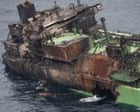
The headlines are screaming about a "damaged" Russian LNG carrier drifting into Libyan waters like it's a floating Chernobyl. They want you to see a geopolitical disaster, an environmental ticking time bomb, and a sign of crumbling Russian infrastructure. They are wrong. What you are actually witnessing is the brutal, efficient reality of the "shadow fleet" and the failure of Western price caps to understand the physics of energy.
If you think this is a story about a broken boat, you’ve been fed a narrative designed for clicks, not for traders. The real story is how the global LNG market has become a high-stakes shell game where the rules of maritime safety are being rewritten by necessity. Meanwhile, you can read similar stories here: Structural Accountability in Utility Governance: The Deconstruction of Southern California Edison Executive Compensation.
The Myth of the "Drifting Disaster"
Most reporting focuses on the "danger" of a damaged hull carrying liquefied natural gas (LNG). Let’s correct the record immediately. LNG is not crude oil. If an LNG tanker breaches, the cargo doesn’t coat the Mediterranean in a black sludge. It evaporates.
$CH_4$ (Methane) at $-162°C$ behaves predictably. In the event of a leak, it undergoes rapid phase transition. It hits the air, turns into a gas, and rises. While it is a potent greenhouse gas, the localized "environmental catastrophe" narrative pushed by mainstream outlets is scientifically illiterate. The risk isn't a spill; it's a fire. But modern membrane containment systems are built with redundancies that make a catastrophic explosion statistically less likely than a standard engine failure on a Greek bulk carrier. To see the bigger picture, check out the detailed analysis by Investopedia.
The "damage" cited in these reports is often a convenient euphemism for "mechanical issues resulting from skipped maintenance." When you operate outside the traditional P&I (Protection and Indemnity) clubs to avoid sanctions, you lose access to top-tier dry docks. That isn't a disaster; it's the cost of doing business in a bifurcated global economy.
The Libyan Detour is a Feature Not a Bug
Why Libya? The lazy consensus says the ship is lost. I've spent enough time in commodity logistics to know that "lost" ships are usually ships waiting for a better price or a cleaner set of papers.
Libya is the Wild West of the Mediterranean. It is a jurisdictional gray zone where ship-to-ship (STS) transfers happen with a wink and a nod. By drifting into these waters, a "damaged" Russian vessel provides the perfect cover for a cargo swap.
- The Distress Signal: A vessel claims mechanical failure or hull stress.
- The Buffer Zone: It moves into waters where international maritime enforcement is spread thin.
- The Shell Game: A "clean" tanker meets the "dirty" tanker. The gas is transferred.
- The Result: The gas is no longer "Russian." It’s "Grade A Mediterranean Blend."
Stop asking why the ship is there. Ask who is waiting to buy the cargo once it’s been laundered. The European Union, despite its posturing, still has a massive appetite for molecules. They just want them to have a different return address.
The Sanctions Paradox
The West’s obsession with price caps and "dark fleet" tracking has created a monster. By forcing Russian energy exports into the shadows, we haven't stopped the flow; we’ve just removed the transparency.
I’ve seen traders ignore 10% risk premiums for 30% margins. That is the fundamental law of energy. When you sanction a critical commodity like natural gas, you don't delete the supply. You simply increase the complexity of the delivery. The "damaged" tanker in Libya is the physical manifestation of this complexity.
The ship isn't a sign that Russia is failing to export; it’s proof that they are willing to use aging, sub-optimal tonnage to keep the revenue flowing. They are treating these vessels as disposable assets. In a world where a single LNG cargo can be worth $50 million to $100 million, losing a $20 million rusted-out hull is just an accounting line item.
The Physical Reality of LNG Logistics
The media loves to talk about "shadow fleets" as if they are a new phenomenon. They aren't. They are as old as the shipping industry itself. What is new is the application of this model to LNG.
Unlike crude oil, which can sit in a rusty tank for months, LNG is a ticking clock. It undergoes "boil-off." Every day that ship sits "damaged" off the coast of Libya, a percentage of its cargo is turning back into gas and being vented or used to power the ship’s engines.
$Boil-off Rate (BOR) = \frac{V_{lost}}{V_{total}} \times 100$
For an older vessel in the shadow fleet, the BOR is significantly higher than a modern vessel. This means the crew isn't just sitting there waiting for a tow; they are watching their profit evaporate into the atmosphere. This creates an immense pressure to offload the cargo by any means necessary—including "emergency" transfers that bypass every safety protocol in the book.
If you want to be worried, don't worry about the Russian flag. Worry about the fact that we have incentivized the world's most volatile cargo to be handled by the world's least scrutinized operators.
The Failure of "People Also Ask" Logic
If you search for this topic, you’ll find questions like "Is the Russian tanker a threat to the environment?" or "Will this stop Russian gas exports?"
These are the wrong questions.
The threat isn't to the environment; it’s to the integrity of the global shipping infrastructure. We are building a parallel maritime economy where safety standards are optional.
Will this stop Russian exports? Absolutely not. For every ship that "breaks down" in Libya, three more make it to India or China via the Northern Sea Route or through clever re-flagging in Gabon or the Cook Islands.
Stop Looking at the Ship, Look at the Insurance
The real indicator of what’s happening isn't the hull; it's the paper. Trace the insurance. Most of these vessels are "self-insured" or backed by opaque Russian or Chinese entities.
This means that if a true collision occurs in the crowded Mediterranean shipping lanes, there is no one to sue. There is no recovery fund. The coastal nations—Italy, Greece, Malta—are the ones holding the bag. The "contrarian" take here is that the Western sanctions, designed to protect the "rules-based order," have effectively stripped the Mediterranean of its primary safety net: the Western insurance market.
We have traded a financial blow to Russia for a systemic risk to the most trafficked waters on earth.
The Harsh Reality of Energy Security
The public wants energy that is green, cheap, and morally pure. You can only ever have two.
Europe chose "green" (by banning their own fracking) and "cheap" (by relying on Russian pipes). Now that they want "morally pure," the price has gone through the roof, and the "cheap" gas is still coming in—it just looks like a broken tanker off the coast of Tripoli.
This isn't a crisis of Russian engineering. It’s a crisis of Western hypocrisy. We pretend the shadow fleet is a rogue element when it is actually the release valve that prevents the global energy market from a total meltdown. If every Russian ship stopped moving tomorrow, the price of heating a home in Berlin would triple. The "damaged" tanker is allowed to exist because, deep down, the market needs that gas.
The Technical Breakdown of the "Hull Damage"
Let's talk about the actual engineering. An LNG carrier is essentially a giant thermos. It has an inner hull, an outer hull, and a massive insulation layer.
- Primary Barrier: Contains the liquid.
- Secondary Barrier: Catches leaks if the primary fails.
- Insulation: Usually perlite or reinforced polyurethane foam.
If a ship is "damaged" enough to be a threat, the temperature sensors in the hull void spaces would be screaming. If those sensors go off, the ship is required by international law to vent the cargo. The fact that this ship is still floating and not a cloud of gas tells you that the "damage" is likely localized to the propulsion or the steering gear, not the containment.
It is a mechanical failure, not a structural collapse. But "Engine trouble on 20-year-old ship" doesn't sell newspapers. "Damaged Russian Tanker Threatens Mediterranean" does.
The Playbook for the Next Decade
Expect more of this. As the fleet ages and the sanctions tighten, the Mediterranean will become a graveyard of aging vessels performing "emergency" maneuvers.
- Expect more "distress calls" that conveniently happen near major transshipment hubs.
- Expect more "mechanical failures" that last exactly long enough for a buyer to be found.
- Expect the "shadow fleet" to grow from a fringe curiosity into the primary mover of global energy.
The industry insiders aren't panicked. They are looking at the AIS (Automatic Identification System) data and laughing at the "damaged" narrative. They know that gas is moving. They know the money is changing hands. And they know that as long as the world needs to keep the lights on, a little bit of "hull damage" won't stand in the way of a billion-dollar trade.
Stop waiting for the explosion. It’s not coming. The real disaster is that we’ve made the world’s energy supply less safe, less transparent, and more expensive—all while patting ourselves on the back for a sanctions regime that Russia is bypassing with a 20-year-old boat and a Libyan GPS coordinate.
Buy the volatility. Ignore the panic. The ship isn't sinking; it's just getting started.