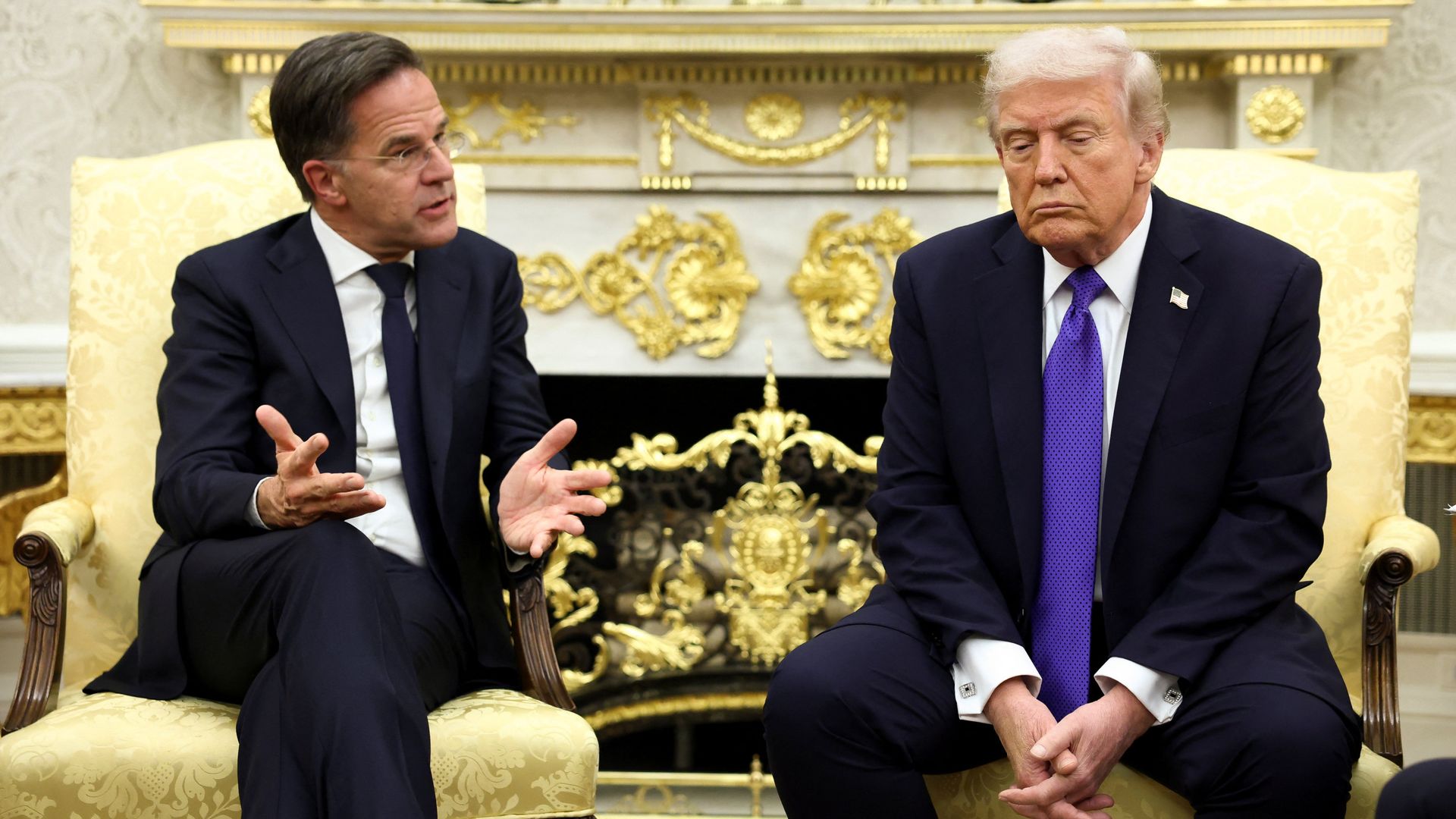
The air inside the room was thick with the kind of tension that usually precedes a divorce or a high-stakes gambling loss. Mark Rutte, the man holding the keys to the world’s most powerful military alliance, sat across from Donald Trump. It wasn't just a meeting of officials; it was a collision of two entirely different worldviews regarding what it costs to keep the lights on in a free world. When the doors finally opened and the cameras flashed, the message from the American side wasn't a handshake. It was a bill.
For decades, NATO has functioned like an elite neighborhood association where one neighbor pays for the gate, the security guards, and the streetlights, while the others promise to chip in for the annual barbecue. Donald Trump has never liked that arrangement. To him, the alliance isn't a sacred democratic bond; it’s a ledger. And right now, he sees the ink as bleeding red.
The Ledger of Broken Promises
Consider a small shop owner in a tough part of town. This owner pays a premium to a security firm every month. One day, he looks around and realizes the shop next door—a massive, profitable department store—is getting the same protection for free because they share a wall. The shop owner is the United States. The department store is Europe.
The grievance isn't new, but the volume is. The North Atlantic Treaty Organization was built on the backbone of Article 5: an attack on one is an attack on all. It is a beautiful, noble sentiment. But sentiment doesn't buy F-35 fighter jets or maintain missile defense systems. The agreement, forged in the fires of the Cold War, suggested that every member should spend at least 2% of their Gross Domestic Product on defense.
For years, many European nations treated that 2% figure as a suggestion. A polite request. Something to be addressed "eventually." When Trump met with Rutte, he didn't bring suggestions. He brought a demand for back pay. He characterized the alliance not as a shield, but as a drain.
The Invisible Soldier in the Room
To understand why this matters, you have to look past the mahogany tables and the tailored suits. You have to look at a hypothetical soldier—let’s call him Elias.
Elias is twenty-two. He’s stationed in a cold, damp forest in Estonia, staring across a border at a Russian military that has become increasingly comfortable with redrawing maps by force. Elias is the human embodiment of the deterrent. If he is attacked, the full might of the American military is supposed to roar to life.
But back in Washington, the man who controls that roar is asking why Elias is there at all if the neighbors aren't paying their fair share. This is the "human element" that gets lost in the headlines about budget percentages. When the President of the United States questions the value of NATO, he isn't just talking about money. He is flickering the lights on the security system while the intruders are at the fence.
The fear in Brussels isn't just about the cash. It’s about the signal. If the United States decides that the cost of being the world's policeman is too high, the vacuum left behind won't stay empty for long.
The Rutte Tightrope
Mark Rutte has a job that few would envy. He has to convince a man who prides himself on being the ultimate "deal-maker" that some deals are worth more than the sum of their parts. Rutte’s strategy has been one of flattery and firm data. He points out that European spending is actually rising. He notes that more countries are hitting that 2% mark than ever before.
But Trump’s rhetoric suggests he isn't interested in "progress." He wants results. He wants a "fair" share, defined by his own terms. During their recent interactions, the atmosphere was described as transactional. There was no talk of "the shared values of Western civilization." There was talk of "delinquency."
Imagine telling your oldest friend that you won't help them move because they didn't pay for their half of the pizza three years ago. It sounds petty until you realize the friend is a millionaire and you’re the one working two jobs to keep the friendship afloat. That is the narrative Trump is selling to his base. He is framing NATO as a "protection racket" where the protector is being ripped off by the protected.
The Geography of Anxiety
Distance changes everything. If you live in Des Moines, Iowa, the defense of a border in Eastern Europe feels like a theoretical math problem. It’s a series of zeros on a federal budget line that could be spent on schools or roads at home.
But if you live in Warsaw or Vilnius, NATO is the only reason you sleep through the night. To these nations, the American grievance feels like a betrayal of a blood oath. They see the 2% not as a fee, but as an insurance premium against total national extinction.
The clash between Trump and the NATO leadership is a clash between the "America First" boardroom and the "Never Again" history books. The "invisible stakes" are the stability of a continent that has, twice in the last century, dragged the entire world into a graveyard.
The Cost of Going It Alone
There is a logical deduction that many avoid because it is uncomfortable: What happens if the ledger never balances?
If the U.S. scales back its commitment, Europe is forced into a frantic, expensive, and potentially chaotic rearmament. Decades of integrated defense would fracture. The "synergy"—to use a word I’ll immediately discard for its coldness—the togetherness of the West would evaporate.
But there is a flip side. Trump’s pressure has acted as a smelling salt for a lethargic Europe. For years, Berlin and Paris relied on the "American Umbrella" as a reason to underfund their own security. They spent that money on social safety nets and infrastructure that Americans don't have. Trump isn't wrong when he says that American taxpayers are indirectly subsidizing the European lifestyle by bearing the brunt of the defense bill.
It is a messy, ugly truth. It’s a truth that Rutte has to acknowledge while trying to keep the alliance from splintering into a dozen different directions.
The Empty Chair
The meeting ended, but the echo remains. Trump's "hit" on NATO wasn't just a tweet or a press release. It was an interrogation of an era. The post-1945 world order is being asked to show its receipts.
We are living through a moment where the "global village" is putting up fences. The leader of the most powerful nation on earth is looking at his allies and seeing debtors. The allies are looking back and seeing an unpredictable landlord who might change the locks.
Behind the statistics and the diplomatic jargon, there is a fundamental question of trust. Can you rely on a partner who keeps a calculator on the nightstand? Can you maintain an alliance when the leader of that alliance views your safety as a line item in a budget negotiation?
The sound of the meeting ending wasn't just the sound of a door closing. It was the sound of an old world cracking. Whether it shatters or hardens into something more sustainable depends entirely on whether the "deal" can ever be more than just money.
Elias is still in the forest. The wind is still cold. And for the first time in eighty years, he isn't quite sure who is coming to help if the lights go out.