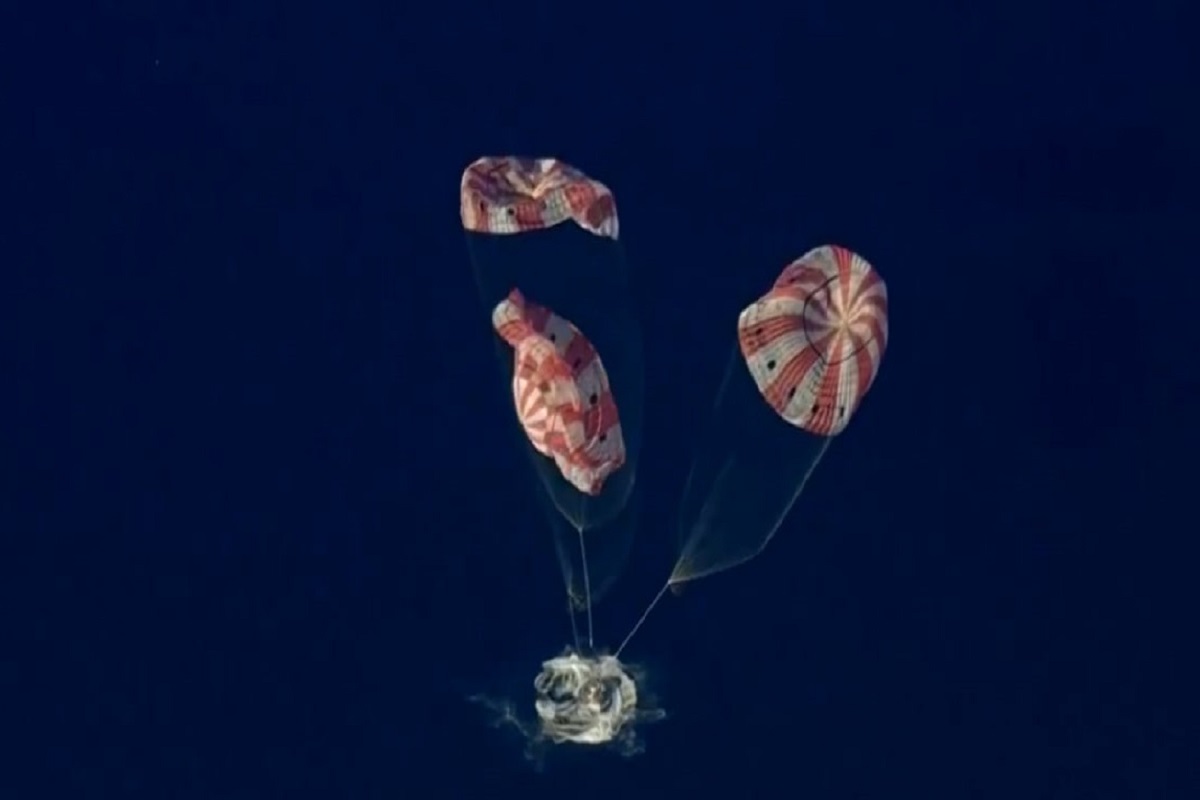
The completion of the Artemis II mission marks a transition from theoretical deep-space transport to the practical validation of human-rated lunar infrastructure. While public discourse focuses on the visual spectacle of reentry, the true success of this mission lies in the empirical performance of the Orion spacecraft’s heat shield and the management of kinetic energy dissipation during atmospheric interface. To understand why this flight establishes a new benchmark for aerospace engineering, one must look past the narrative of "making history" and examine the specific mechanical and thermal variables that define the return from a high-velocity cislunar trajectory.
The Kinematics of Cislunar Reentry
The fundamental challenge of the Artemis II mission was the management of velocity. Unlike Low Earth Orbit (LEO) returns—such as those performed by the International Space Station resupply vehicles—a return from the moon involves significantly higher kinetic energy.
- LEO Velocity: Approximately 7.8 kilometers per second.
- Lunar Return Velocity: Approximately 11 kilometers per second.
Because kinetic energy increases with the square of velocity ($E_k = \frac{1}{2}mv^2$), an Orion capsule returning from the moon must dissipate nearly twice the energy of a standard orbital reentry. This creates a non-linear increase in thermal load. The Artemis II mission utilized a "skip reentry" technique to manage this load. By dipping into the upper atmosphere, "skipping" out briefly to shed heat and velocity, and then performing a final descent, the spacecraft decoupled peak thermal stress from peak deceleration loads. This maneuver allowed NASA to extend the landing range and improve the precision of the splashdown while keeping G-forces within human physiological tolerances.
The Avcoat Ablation Mechanism
The Orion Multi-Purpose Crew Vehicle (MPCV) utilizes a primary thermal protection system (TPS) composed of Avcoat, a phenolic formaldehyde resin with fiberglass in a honeycomb structure. The physics of this system rely on ablation—the process of shedding mass to carry away heat.
The thermal performance of the Artemis II shield can be categorized into three distinct phases:
- Pyrolysis Zone Formation: As the spacecraft hits the atmosphere at 40,000 kilometers per hour, the surface temperature reaches 2,760°C. The resin begins to decompose, creating a charred layer that acts as an insulator.
- Convective Blockage: The gases released during pyrolysis are pushed away from the shield, creating a high-pressure boundary layer that "pushes" the shock wave’s heat away from the capsule's structure.
- Radiative Dissipation: The glowing char layer radiates a significant portion of the heat back into the vacuum of the surrounding plasma.
The data gathered from Artemis II proves that the Avcoat application—specifically the transition from hand-filled cells to a more automated block-bonded process used in this iteration—can withstand the uneven heating profiles generated during a skip maneuver. Previous concerns regarding "spalling" or premature liberation of the heat shield material appear to have been mitigated by these manufacturing refinements.
Life Support System Load and Metabolic Management
While the heat shield protected the exterior, the Environmental Control and Life Support System (ECLSS) had to manage the internal heat generated by four crew members and the onboard electronics. The Orion ECLSS is a departure from the open-loop systems used in the Apollo era.
The efficiency of the Artemis II mission was measured by the Partial Pressure of Oxygen ($ppO_2$) Stability and Carbon Dioxide Removal. Orion utilizes an amine-based swing-bed system for $CO_2$ scrubbing. Unlike lithium hydroxide canisters which are consumable and finite, the swing-bed system regenerates by venting $CO_2$ to space. The mission data indicates that this system maintained $ppO_2$ within a narrow margin of 19% to 23%, even during high-exertion periods.
The second critical variable in the internal environment was the Active Thermal Control System (ATCS). This system uses internal and external loops of propylene glycol to move heat from the cabin to the radiator panels on the Service Module. The successful jettisoning of the Service Module just prior to reentry forced the capsule to rely on its internal thermal mass and Phase Change Material (PCM) heat sinks. This transition is a known bottleneck in spacecraft design; the Artemis II telemetry confirms the PCM successfully stabilized cabin temperatures during the 20-minute communication blackout and high-heat phase.
Communication Blackout and Plasma Attenuation
During the "fireball" phase of reentry, the air around the Orion capsule is ionized into a plasma sheath. This plasma is opaque to radio waves, creating a total communication blackout.
The duration of this blackout is a function of:
- Plasma Density: Directly related to the spacecraft’s velocity and the density of the surrounding air.
- Frequency Modulation: Lower frequencies are blocked more easily than higher frequencies.
During Artemis II, the skip maneuver created two distinct periods of signal loss. The ability of the onboard autonomous systems to execute precise thruster firings during these periods without ground intervention is a testament to the maturation of the Flight Management System (FMS). The capsule’s Guidance, Navigation, and Control (GNC) algorithms had to account for atmospheric density fluctuations that are impossible to predict with 100% accuracy from the ground.
Logistic and Structural Integrity Metrics
The physical state of the capsule post-splashdown provides the most tangible data for the future of the Artemis program. Engineers assess "Micrometeoroid and Orbital Debris" (MMOD) impact craters on the backshell and the structural deformation of the pressure vessel.
The Artemis II backshell consists of 1,300 thermal protection tiles. Unlike the primary heat shield, these tiles are designed to be reusable or easily replaceable. Initial inspections suggest that the strike frequency from orbital debris remained within the predicted 1:1,000 probability of a "Loss of Mission" event. This validates the shielding thickness chosen for the crew module's leeward side.
Furthermore, the recovery operations demonstrated a reduction in the "Time to Hatch Open" metric. For long-duration missions, the physiological state of the crew upon returning to 1G gravity is precarious. The integration between the U.S. Navy and NASA recovery teams during Artemis II showed that the "Front-End" recovery process—extracting the crew before towing the capsule—is now a refined operational standard.
The Economic and Strategic Buffer
The Artemis II mission serves as the strategic validation for the upcoming Artemis III lunar landing. From a project management perspective, this flight was a "risk retirement" exercise.
The successful reentry retires three primary technical risks:
- Thermal Margin Uncertainty: We now have empirical proof that the shield has at least a 25% safety margin above the highest predicted lunar return heat flux.
- Long-Range Skip Navigation: The GNC software successfully executed the skip, proving we can land within 5 kilometers of a recovery ship regardless of where the lunar return trajectory begins.
- Human-Machine Interface (HMI) under Stress: The crew’s ability to monitor systems during the vibration-heavy launch and reentry phases confirms that the cockpit display glass and control layout are optimized for high-G environments.
The bottleneck for the program now shifts from the Crew Module to the Lunar Lander (HLS) and the Gateway station components. With Orion’s return capabilities verified, the "transportation" segment of the lunar economy is effectively solved. The focus must now pivot to the "habitation" and "utility" segments.
The data suggests that the hardware used in Artemis II is capable of supporting missions exceeding the 21-day design limit if power consumption is throttled. This provides a contingency buffer for Artemis III, where any delay in docking with a lunar lander would require the Orion to act as a self-sustained lifeboat in lunar orbit for an extended period. The mission has moved the program from the realm of "proving it can be done" to "optimizing the cost of doing it."
The strategic priority is the acceleration of the Service Module production cycle. While the Crew Module is largely reusable, the European Service Module (ESM) is expended every mission. The cost-per-seat of the Artemis program remains tethered to the manufacturing speed of these expendable components. Streamlining the ESM supply chain is the only way to move from a "once-every-two-years" mission cadence to an annual or semi-annual schedule.
Without this industrial acceleration, the technical success of Artemis II will be overshadowed by a logistical ceiling. The focus must remain on the hardware turnaround and the reduction of the assembly-integration-test (AIT) phase for the Artemis III and IV modules currently in production at Kennedy Space Center. The mission didn't just end with a splashdown; it initiated a mandatory shift toward high-cadence industrial production.