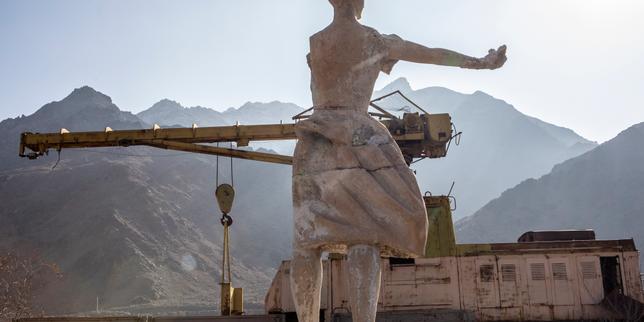
The coffee in the border town of Goris is thick enough to hold a spoon upright. It tastes of cardamom and soot. Across the table, a man named Arakel watches the mist roll off the Zangezur mountains, his fingers tracing the jagged line of a scar on his forearm that he received in a different decade, in a different war. He doesn’t look at the map spread between us. He doesn't need to. He knows where the new fences are being built. He knows which roads, once familiar as the veins on the back of his hand, are now punctuated by the flags of a nation that was, until very recently, a ghost story used to frighten children.
Armenia is a country currently undergoing a radical, painful, and deeply controversial surgery. It is attempting to amputate its past to save its future.
For thirty years, the psychological geography of this place was defined by victory and a frozen status quo. After the first Nagorno-Karabakh war in the early nineties, Armenia held the highland enclave and seven surrounding districts. It was a buffer, a pride, a fortress. Then came 2020. Then came 2023. In a matter of weeks, the fortress didn’t just crumble; it vanished. Over 100,000 ethnic Armenians fled their ancestral homes in Karabakh in a single, desperate exodus, leaving behind churches that had stood since the Middle Ages and cemeteries where their grandparents slept.
Now, the government in Yerevan is doing something that feels, to many, like a betrayal of the soul. They are talking about peace. Not a triumphant peace, but a pragmatic, "at-gunpoint" peace.
The Weight of the Pencil
Prime Minister Nikol Pashinyan is currently redrawing the border. This isn't a metaphor. He is literally handing over four abandoned villages in the Tavush region to Azerbaijan. To a diplomat in Brussels or Washington, this looks like "border delimitation"—a necessary bureaucratic step toward regional stability. It is a line on a digital map, a tick-box in a peace treaty.
But to the people in the village of Voskepar, the pencil used to draw that line feels like a bayonet.
When you move a border in the Caucasus, you aren't just shifting a political jurisdiction. You are moving the front line to a farmer's back porch. You are telling a grandmother that the soldiers she has feared her entire life will now be standing fifty yards from her apricot trees. The fear is visceral. It is a cold weight in the stomach.
"They say we cannot be enemies forever," Arakel says, finally looking down at the map. "And I suppose that is true. Even the wolves and the sheep eventually share the same field when the winter is hard enough. But the sheep does not go to sleep thinking the wolf has become a vegetarian."
The logic from the capital is stark: Armenia is a landlocked nation of three million people, squeezed between an increasingly assertive Azerbaijan and its massive ally, Turkey. Russia, once the guarantor of Armenian security, is preoccupied with its own quagmire in Ukraine and has proven to be a fickle, if not outright indifferent, protector. Armenia is alone. To survive, it must become "normal." It must open its borders, trade with its neighbors, and stop being a "fortress" that no longer has walls.
The Economics of Survival
Peace is often sold as a moral imperative, but in the halls of power in Yerevan, it is being pitched as a mathematical necessity.
Imagine a house where all the doors are nailed shut except for one. You can only buy groceries from one person. You can only invite friends through that one narrow opening. That has been Armenia's reality, with its borders with Turkey and Azerbaijan closed for decades. The "Crossroad of Peace" project is Pashinyan’s attempt to pry those doors open.
The idea is simple. If Armenia allows Azerbaijani and Turkish goods to flow through its territory, and if Armenian goods can reach the markets of Central Asia and Europe via the same routes, the cost of living drops. The economy grows. Wealth becomes a deterrent to war. It is the European Union model applied to a neighborhood that still remembers the smell of gunpowder.
But there is a catch. Azerbaijan wants a specific route—the Zangezur Corridor. They want a path through southern Armenia to their exclave of Nakhchivan that is essentially outside of Armenian sovereign control.
For Armenia, this is the red line. Giving up a corridor means losing the border with Iran, their only other reliable exit to the world. It means slicing the country in half.
The stakes are not just about sovereignty. They are about the very definition of a nation. Is Armenia a historical cause, a sacred land that must be defended at all costs? Or is it a state—a place where people need jobs, schools, and a future that doesn't involve burying their sons every five years?
The Generation of the Gap
In a hip cafe in Yerevan, miles away from the nervous trenches of Tavush, the conversation is different. Here, the youth speak English and code for startups. They watch Netflix and worry about the price of lattes.
"We are tired," says Mariam, a 24-year-old graphic designer. "My father fought. My brother fought. I don't want my children to fight for a piece of land that we can't even live on anymore. If giving up four villages means I don't have to check the news every morning to see if a full-scale invasion has started, then... maybe it’s worth it."
She pauses, her face clouded.
"But then I feel guilty. I feel like I am spitting on the graves of the people who died. It’s a choice between two types of death: a quick death in a war we can't win, or a slow death where we lose our identity piece by piece."
This is the central trauma of the Armenian peace process. It is a negotiation between the heart and the head. The head knows that the military balance of power has shifted decisively toward Baku. The head sees the drones, the oil wealth, and the geopolitical alliances. The head says: Sign the paper. Save what is left.
The heart, however, remembers 1915. The heart remembers the centuries of displacement. To the Armenian heart, "peace" sounds a lot like "surrender," and "delimitation" sounds like "erasure."
The Invisible Actors
We must also talk about the ghost in the room: Russia.
For a century, Armenia was a satellite of Moscow. The Russian 102nd Military Base in Gyumri was the ultimate insurance policy. But that insurance policy turned out to be a scam. When Azerbaijan launched its offensive in 2023, the Russian peacekeepers stood by and watched. They checked their watches. They filed reports. They did nothing.
Now, Armenia is pivoting west. They are inviting European Union monitors to the border. They are buying weapons from France and India. They are trying to find new friends before the old ones finish selling them out.
But geography is a cruel master. You can change your friends, but you cannot change your neighbors. Azerbaijan knows this. They are in no rush. They hold the high ground, literally and figuratively. Every delay in the peace treaty is an opportunity for Baku to demand more—a small hill here, a water source there, a change to the Armenian constitution to remove references to Karabakh independence.
The Mirror of the Enemy
The most difficult part of this narrative is the one we rarely see: the view from the other side.
In Azerbaijan, the narrative is one of "restoration." To them, the last thirty years were an illegal occupation. They see the current peace process as the final reclamation of their sovereign territory. They, too, have a generation that grew up with the bitterness of displacement, living in repurposed railway cars and cramped dormitories after being pushed out of Armenia and Karabakh in the nineties.
When two nations spend three decades defining themselves solely through their hatred of the other, peace feels like an identity crisis. If we are not enemies, who are we?
If the border opens, an Armenian merchant will have to sell a rug to an Azerbaijani truck driver. An Azerbaijani student might have to sit next to an Armenian at a conference in Tbilisi. This requires a level of psychological retooling that no treaty can mandate.
It is easy to sign a piece of paper. It is infinitely harder to erase the map drawn inside the mind.
The Silent Border
Back in Goris, the sun is beginning to set, casting long, bruised shadows across the valley. Arakel stands up and brushes the crumbs from his lap.
"They tell us we are making history," he says, looking toward the dark silhouette of the mountains. "But I think we are just being ground down by it. History is a heavy stone. Eventually, it just crushes everything underneath until only dust is left. And dust doesn't fight. Dust is very peaceful."
He walks away, leaving the map on the table. A gust of wind catches the paper, folding it over itself, blurring the lines between what was, what is, and what might be.
The peace being built in Armenia is not a celebration. It is not the fall of the Berlin Wall. There are no crowds cheering in the streets, no flowers being thrown at tanks. It is a quiet, somber, and deeply fearful pragmatism. It is the sound of a nation holding its breath, hoping that by giving up its dreams, it might finally be allowed to sleep.
The true stake of this "forced march" to peace isn't the location of a fence or the ownership of a village. It is the question of whether a people can survive the loss of their myths. Armenia is looking into a mirror and seeing a stranger. The face in the reflection is scarred, tired, and diminished—but it is still breathing.
And in this corner of the world, for now, breathing is enough.
Would you like me to analyze the specific geopolitical shifts in the South Caucasus that led to this current diplomatic deadlock?


