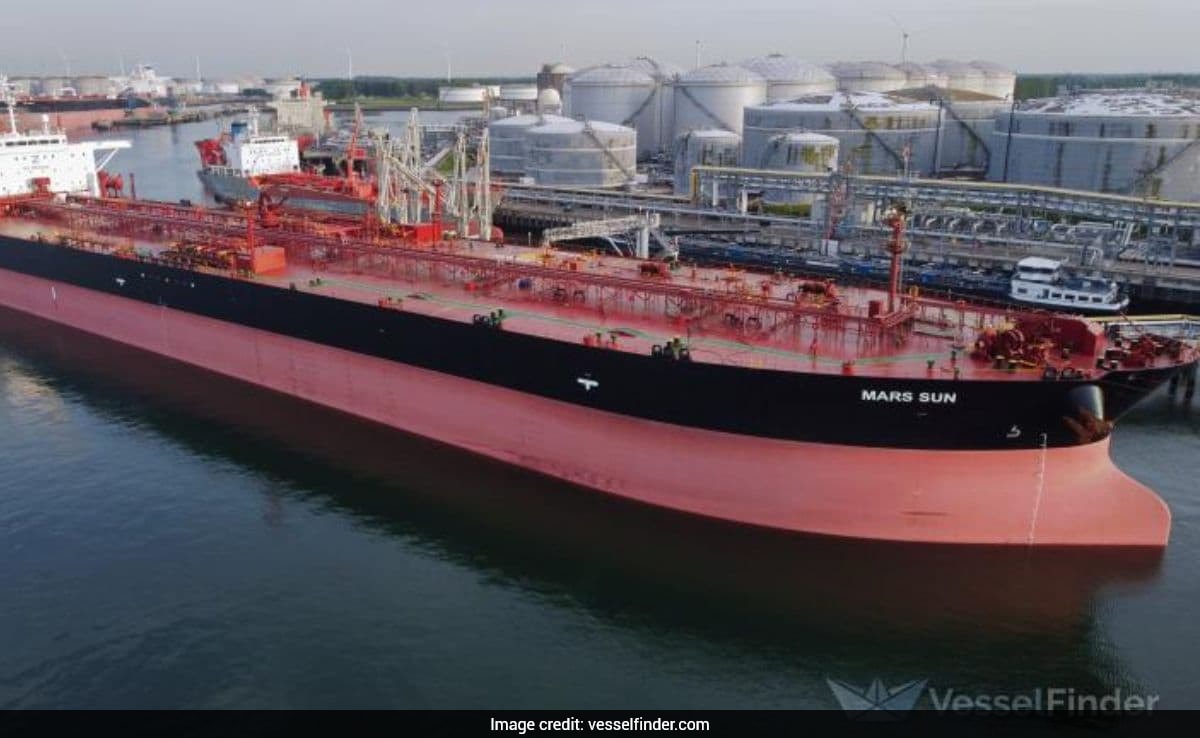
The sea does not care about geopolitics. It only cares about displacement, salt, and the relentless physics of carrying forty thousand tons of volatile energy across an invisible line on a map. When the Aqua Titan cut its engines and prepared to dock at an Indian port this week, it wasn't just bringing crude oil. It was carrying the physical manifestation of a world trying to outrun a shadow.
To look at a satellite tracker of the Indian Ocean right now is to witness a frantic, silent ballet. To the west, the skies over the Levant are streaked with the trails of interceptor missiles. To the north, the Russian heartland is retooling its entire existence to fuel a war that refuses to end. And in the middle, tankers like the Aqua Titan and massive LPG carriers from the United States are racing toward the subcontinent, acting as the life support system for a global economy that is hyperventilating.
We often talk about "energy security" as if it is a ledger of numbers on a spreadsheet. It isn't. It is the smell of diesel on a dock in Gujarat. It is the anxiety of a ship captain watching the horizon for a drone that shouldn't be there. It is the quiet desperation of a nation of 1.4 billion people that must keep the lights on while the traditional pillars of the world order crumble into the surf.
The Ghost in the Machine
The Aqua Titan is a Russian-linked vessel. In the current climate, that makes it a pariah in some waters and a lifeline in others. For months, the "shadow fleet"—a ragtag collection of aging tankers with opaque ownership and questionable insurance—has been the circulatory system for Russian oil. But the Titan represents something more structured. Its arrival in India, alongside American ships carrying liquefied petroleum gas, creates a jarring image of the new neutrality.
Imagine, for a moment, a port official in India. Let's call him Rajesh.
Rajesh stands on the concrete pier, the humid air thick with the scent of brine and industrial exhaust. To his left, a vessel represents the strategic partnership with Washington, fueled by the fracking booms of the Permian Basin. To his right, the Aqua Titan represents a pragmatic, cold-eyed necessity: the need for cheap Russian Ural crude to keep inflation from swallowing the Indian middle class whole.
Rajesh doesn't see a conflict of interest. He sees a schedule. He sees the math of survival.
This is the reality the headlines miss. While diplomats in D.C., Moscow, and Tehran trade threats, the physical world has to keep moving. If the oil stops, the pumps stop. If the pumps stop, the food doesn't move. If the food doesn't move, the government falls. The stakes are not "pivotal" or "paramount"—they are existential.
The Escalation Ladder
The backdrop to these arrivals is a Middle East that feels like a pressurized steam boiler with a welded-shut valve. The US-Israel-Iran triangle has moved past the stage of proxy shadow-boxing. We are now in the era of direct kinetic exchange. When Israel strikes targets in Isfahan, or Iran launches a swarm of Shahed drones toward the Negev, the ripples don't stay in the desert. They vibrate through the hull of every ship in the Arabian Sea.
Shipping insurance premiums have become a fever chart of human fear. A few years ago, the cost to insure a hull for a single voyage through these waters was a predictable line item. Today, it is a volatile gamble. Some companies have simply stopped covering the Red Sea. Others demand "war risk" surcharges that turn a profitable voyage into a break-even slog.
This is why the arrival of the Aqua Titan matters. It proves that despite the threat of escalation, despite the Houthi rebels turning the Bab el-Mandeb into a shooting gallery, the hunger for resources outweighs the fear of fire.
The ships are getting larger. The routes are getting longer. Because the Suez Canal is now a gamble many aren't willing to take, tankers are once again rounding the Cape of Good Hope, a journey that adds weeks and thousands of tons of carbon to the atmosphere. It is a regression. We are using nineteenth-century geography to solve twenty-first-century bottlenecks.
The Invisible LPG Bridge
While the Russian oil grabs the headlines because of the "blood money" narrative, the American LPG ship entering Indian waters tells a quieter, equally vital story. Liquefied Petroleum Gas is the fuel of the home. In millions of Indian households, it is the difference between cooking over a toxic wood fire and having a clean, modern kitchen.
The US has become a global energy powerhouse, not through some grand design, but through the sheer, messy momentum of its private sector. Now, that gas is acting as a strategic counterweight. By flooding the market with American molecules, the US hopes to offer an alternative to the very Russian energy that ships like the Aqua Titan provide.
But India is playing a different game. It is not choosing sides; it is choosing everyone. It is an omnidirectional vacuum for energy. By taking the Russian oil at a discount and the American gas for stability, it is insulating itself from the madness. It is a masterclass in the art of the "and," rather than the "or."
The Engineering of Anxiety
There is a technical brilliance to these ships that we take for granted. An LPG carrier is essentially a giant, floating thermos. It keeps gas at temperatures so cold it turns to liquid, held in massive spherical tanks that look like the eggs of some prehistoric titan. To sail such a vessel through a zone where missiles are a daily occurrence is a feat of nerves as much as engineering.
Think about the crew on the Aqua Titan. They are often forgotten in the grand strategy. They are sailors from Odessa, from Manila, from Mumbai. They live in steel corridors, eating mess-hall food, while the world above them debates whether their cargo is legal, moral, or a target. They watch the radar not just for other ships, but for the "slow-mo" signature of a loitering munition.
If a single one of these ships is hit significantly, the environmental disaster would be catastrophic. But the economic disaster would be worse. The "Just-in-Time" delivery system that governs our world has no margin for error. We live on a knife's edge, supported by a thin line of steel hulls.
The Breaking Point of Neutrality
How long can this dance last?
The United States has, so far, turned a blind eye to much of India’s intake of Russian crude, provided it stays under certain price caps. The goal is to keep the oil flowing (to prevent a global price spike) while limiting the profit Moscow can squeeze out of it. It is a delicate, perhaps impossible, middle ground.
But as the conflict between Israel and Iran heats up, the pressure to "pick a side" will become a crush. If the Strait of Hormuz is ever truly choked off—the ultimate "doomsday" scenario for energy markets—the Aqua Titan and its American counterparts won't just be ships. They will be the most valuable objects on the planet.
We treat the news like a series of disconnected events. A strike in Damascus. A tanker in the Indian Ocean. A gas price hike in Ohio. They are not disconnected. They are the same story. It is the story of a species that has built a civilization far more complex than its ability to get along.
The Silent Arrival
The Aqua Titan finally slides into its berth. The heavy lines are thrown. The winches groan. The connection is made, and the liquid fossil of a million years of biology begins to pump into the vast storage tanks on shore.
A few miles away, the American LPG carrier does the same.
There are no speeches. There are no flags waved. There is only the low hum of the pumps and the shimmering heat haze rising off the deck. For a few days, the lights will stay on. The stoves will burn blue. The tractors will have the fuel to harvest the wheat.
We want to believe that the world is run by the people who give the speeches. We want to believe that the "War LIVE" updates on our phones are the definitive record of our time. But the real history is being written in the draft of these ships, in the depth of their hulls, and in the terrifyingly narrow corridors of water they must navigate to keep the darkness at bay.
The sea remains indifferent. It carries the Russian oil and the American gas with the same cold, rhythmic heave. It waits for the next ship, and the next crisis, while we stand on the shore, hoping the lines hold for one more day.


