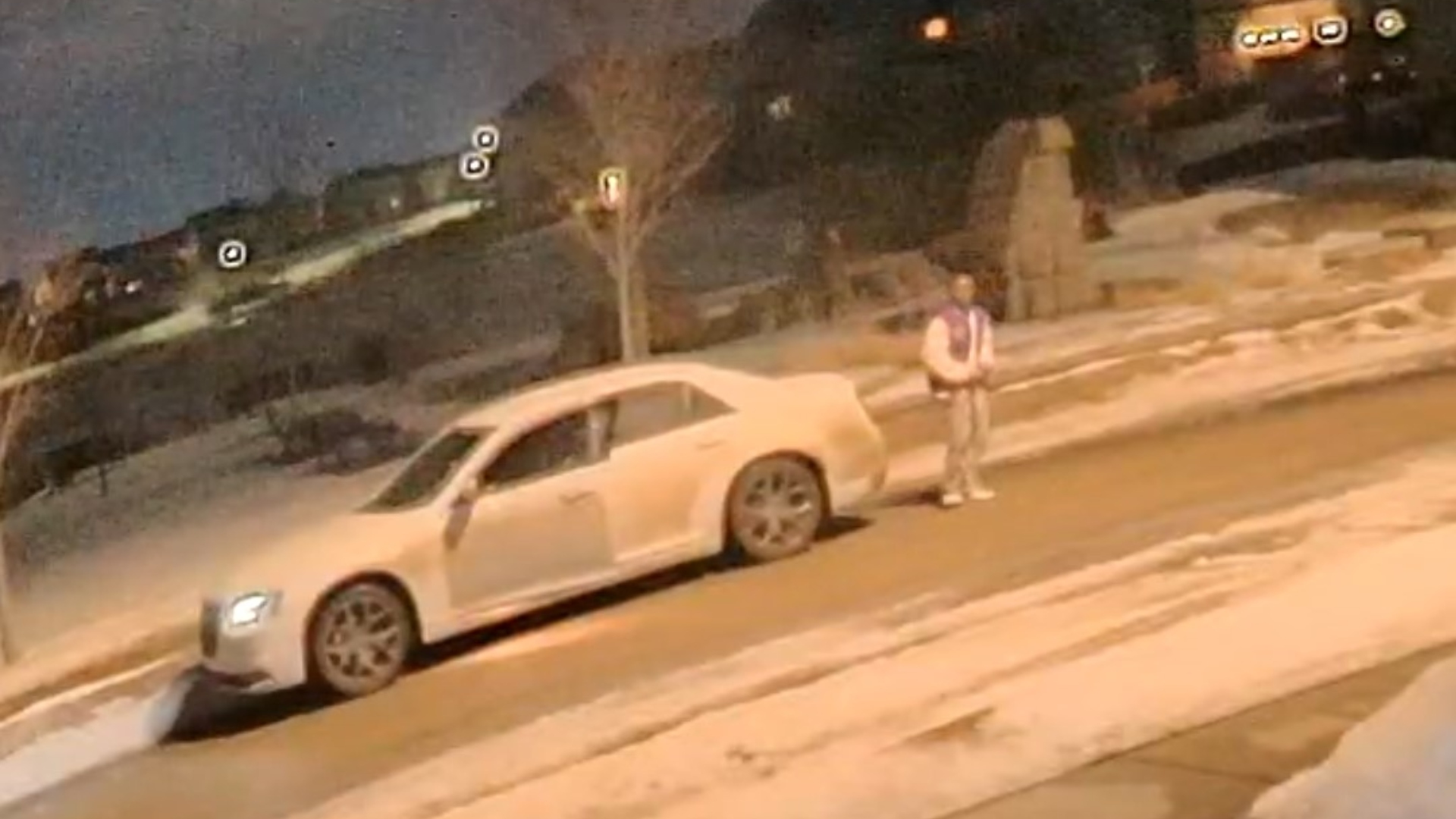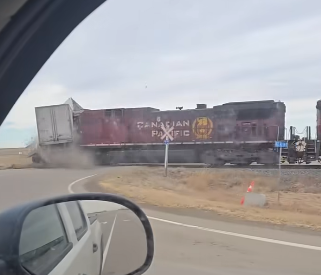
The collision between a freight train and a passenger vehicle near Taber, Alberta, is not an isolated incident of "driver inattention" but a predictable outcome of a failing interface between high-mass rail systems and low-discipline road users. When a locomotive weighing several thousand tons intersects with a two-ton vehicle, the margin for error is zero. To understand why these incidents persist despite modern signaling, one must deconstruct the physics of the encounter, the cognitive load on the driver, and the systemic failure of current enforcement mechanisms.
The Physics of Irreversibility
The primary factor in any rail-roadway intersection is the massive disparity in momentum. Momentum ($p$) is the product of mass ($m$) and velocity ($v$), expressed as $p = mv$. A standard freight train traveling at 100 km/h possesses kinetic energy that requires kilometers of track to dissipate via friction. Unlike a passenger vehicle, a train cannot swerve, and its braking distance is governed by the coefficient of friction between steel wheels and steel rails, which is significantly lower than that of rubber on asphalt.
The Taber incident highlights a critical "Point of No Escape." Once a vehicle enters the fouling envelope—the area where a train’s width extends beyond the tracks—the outcome is dictated entirely by the laws of motion. If a driver misjudges the approach speed of a train, they are effectively entering a high-velocity "kill zone" where the train operator has no mechanical agency to prevent the impact.
The Triad of Intersection Failure
Every grade crossing incident can be categorized into three distinct failure points. Analyzing the Taber collision through this lens reveals where the safety chain snapped.
- Perceptual Distortions (The Size-Speed Illusion): Humans are evolutionarily poor at judging the speed of large objects. A massive locomotive creates a visual illusion where it appears to be moving slower than its actual velocity. This leads drivers to believe they have a "gap" that does not exist.
- Infrastructure Latency: Many rural crossings near Taber rely on passive protection (crossbucks) or active protection (lights and bells) that drivers have become "sensitized" to. When a driver encounters the same signal daily without seeing a train, the perceived risk of the signal diminishes, leading to "automated" driving behavior where the driver fails to actively scan the tracks.
- Mechanical Asymmetry: The structural integrity of a passenger vehicle is designed for car-to-car impacts. In a car-to-train impact, the train acts as a rigid, immovable object. The vehicle’s crumple zones are bypassed as the locomotive’s frame often overrides the car’s chassis, leading to catastrophic cabin intrusion.
Quantifying Driver Trends in Southern Alberta
The Royal Canadian Mounted Police (RCMP) and Canadian Pacific Kansas City (CPKC) often cite "concerning driver trends." From a strategic standpoint, these trends are symptoms of increased cognitive load and distracted driving. The rise in mobile device integration in vehicles creates a "continuous partial attention" state. In rural stretches like the Highway 3 corridor near Taber, the monotony of the drive leads to a drop in situational awareness.
Statistical data from Operation Lifesaver suggests that despite a decrease in total crossings, the rate of incidents per 1,000 crossings remains stubborn. This indicates that better technology on the train side (e.g., LED ditch lights, louder horns) is being offset by increased driver isolation inside sound-insulated, tech-heavy vehicle cabins.
The Economic and Operational Cost Function
A collision near Taber does not just result in property damage; it triggers a cascade of operational failures across the supply chain.
- Network Stasis: A single collision can shut down a primary rail artery for 6 to 12 hours. For a Class 1 railroad, this results in thousands of dollars per hour in lost throughput and idling costs.
- Investigative Overhead: The requirement for federal investigation (Transportation Safety Board) and local law enforcement (RCMP) diverts public resources and delays the resumption of commerce.
- Psychological Attrition: The "Critical Incident Stress" experienced by locomotive engineers often leads to mandatory leaves of absence, thinning the available workforce and increasing operational friction.
Strategic Mitigation and the Failure of Education
The traditional response to the Taber collision is a "safety reminder." From a consulting perspective, reminders are the least effective form of risk mitigation. They rely on human memory and willpower, both of which are fallible.
To actually reduce the frequency of these events, the strategy must shift from "education" to "engineered exclusion."
Grade Separation and its Limitations
The most effective solution is the elimination of the grade crossing entirely through overpasses or underpasses. However, the capital expenditure required for a single grade separation can exceed $20 million. In rural Alberta, the density of crossings makes this economically unfeasible for every secondary road.
Intelligent Transportation Systems (ITS)
A more viable mid-term strategy involves vehicle-to-infrastructure (V2I) communication. If a vehicle’s internal GPS or dash system receives a direct signal from the rail pulse, it can trigger an in-cabin alert that overrides the driver’s audio. This bypasses the "soundproof cabin" problem and forces the driver’s attention back to the immediate environment.
Photo Enforcement and Heavy Sanctions
Data shows that drivers are more likely to respect a crossing if there is a high probability of a financial penalty. Implementing automated camera enforcement at high-risk crossings near Taber would create a "cost-of-violation" high enough to alter behavior patterns.
The Cognitive Bottleneck
The fundamental constraint in rail safety is the human brain's processing speed. When a driver approaches a crossing at 80 km/h, they are covering 22.2 meters per second. If the decision-making process—identifying the signal, checking the tracks, and applying the brakes—takes three seconds, the vehicle has already traveled 66 meters. In many rural configurations, this is the entire length of the "decision sight distance."
If the driver is distracted for even 1.5 seconds by a notification or a passenger, the "safe stop" window closes entirely. The Taber incident is a stark reminder that our current road-rail interface assumes a level of driver focus that no longer exists in the modern era.
Strategic Recommendation for Regional Authorities
Municipalities and rail operators must move beyond the "Safety Awareness" paradigm. The data suggests that awareness campaigns have reached a point of diminishing returns. The strategic play is the implementation of "Nudge Architecture":
- Rumble Strip Installation: Placing aggressive transverse rumble strips 100 meters ahead of every passive crossing to physically jar the driver out of a "highway hypnosis" state.
- Optical Speed Bars: Using painted lines on the road that get progressively closer together as they approach the tracks, creating a visual sensation of increased speed and forcing the driver to naturally slow down.
- Dynamic Signal Timing: Ensuring that active signals provide a consistent "warning time" regardless of train speed, as inconsistent timing leads to drivers "racing the gate."
The Taber collision is a data point in a trend of increasing interface friction. Until the infrastructure physically forces compliance or removes the human element from the decision-making loop, the kinetic energy of the locomotive will continue to find its outlet in the structural failure of the passenger vehicle.
Would you like me to develop a cost-benefit analysis for implementing V2I technology at high-risk rural crossings?