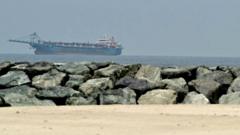
The Japanese government’s hesitation to deploy Self-Defense Forces (SDF) to the Strait of Hormuz is not a failure of bureaucratic willpower, but a calculated response to a multi-dimensional constraint matrix. While international partners often view the Strait as a binary security environment—either open or closed—Tokyo must navigate a triad of legal, diplomatic, and operational frictions that define its "Active Neutrality" posture. The current objective is to ensure energy security without triggering Article 9 constitutional violations or alienating Tehran, a primary energy supplier and long-term diplomatic partner.
The Triple Constraint Framework
Japan’s decision-making process functions within three distinct silos of risk. Understanding why a deployment remains "undecided" requires analyzing how these silos interact to limit executive movement. If you found value in this piece, you should check out: this related article.
1. The Constitutional-Legal Bottleneck
The Japanese Constitution, specifically Article 9, restricts the SDF to "minimum necessary" force for self-defense. Unlike a standard naval power, Japan cannot join a "coalition of the willing" if the mission involves collective self-defense without a direct attack on Japan itself. This creates a legal paradox:
- The Nexus Problem: Protecting a third-party tanker (even if carrying Japanese oil) under fire would require a reinterpretation of "Protection of Japanese Life and Property."
- The Policing vs. War Gap: The SDF can technically operate under "Maritime Police Actions," but this authority is limited to law enforcement. If the threat level escalates to a state-sponsored kinetic strike (e.g., Iranian limpet mines or IRGC seizures), the legal basis for engagement evaporates instantly.
2. The Energy-Diplomacy Dualism
Japan imports approximately 90% of its crude oil from the Middle East, with a significant volume transiting the Strait of Hormuz. However, unlike the United States, Japan maintains a functional, high-level diplomatic channel with Iran. For another perspective on this development, refer to the recent update from BBC News.
- The Cost of Alignment: Joining a U.S.-led "International Maritime Security Construct" (IMSC) would be viewed by Tehran as a hostile alignment.
- The Hedge Strategy: Tokyo’s preference is an independent deployment. By operating outside the IMSC command structure, Japan signals to Iran that its presence is purely defensive and technical, rather than part of a "Maximum Pressure" campaign.
3. Operational Range and Sustainability
The Maritime Self-Defense Force (MSDF) is already overextended in the East and South China Seas. A permanent or long-term presence in the Gulf of Oman or the Strait of Hormuz creates a "Capability Gap" in Japan’s immediate backyard. The cost function of deployment includes not just fuel and personnel, but the degradation of readiness against regional actors like China and North Korea.
The Logic of Independent Information Gathering
The pivot toward "Information Gathering" as a mission objective is a strategic workaround designed to bypass the Triple Constraint. By labeling the mission as "Survey and Research," the Ministry of Defense utilizes a specific clause in the Ministry of Defense Establishment Act that does not require a Cabinet decision for immediate deployment.
This framework provides three tactical advantages:
- Low Political Friction: It avoids the contentious Diet debates required for a full "Security Situation" declaration.
- Strategic Ambiguity: It allows Japan to share intelligence with the U.S. without being formally integrated into U.S. combat operations.
- Escalation Control: If tensions rise, the MSDF can withdraw under the guise of "mission completion" without the optics of a military retreat from a coalition.
The Mechanism of "Safety of Navigation"
When Japanese officials claim that safety of navigation is "actually achieved," they are utilizing a specific metric: the stability of insurance premiums and the frequency of successful transits versus attempted interdictions.
The security of the Strait is not a static state but a dynamic equilibrium influenced by the Interdiction Probability (Pi).
$$Pi = f(K, G, R)$$
Where:
- $K$ = Kinetic capability of regional actors (drones, mines, fast-attack craft).
- $G$ = Geopolitical temperature (sanctions pressure, nuclear deal status).
- $R$ = Presence of credible naval deterrents.
Japan’s assessment suggests that while $K$ and $G$ are volatile, the current $R$ (provided largely by the U.S. 5th Fleet) is sufficient to maintain a "tolerable" level of $Pi$. Therefore, the marginal utility of adding a Japanese destroyer to the mix is outweighed by the diplomatic cost of deployment.
The Bottleneck of Port Access and Logistics
A deployment is not merely a ship in the water; it is a logistical tail. Japan lacks a permanent sovereign base in the immediate vicinity of the Strait. While it utilizes a base in Djibouti for anti-piracy operations, the distance to the Strait of Hormuz introduces significant latency.
- Supply Chain Vulnerability: MSDF vessels would rely on commercial ports in Oman or the UAE for refueling and maintenance.
- Diplomatic Overexposure: Each port call requires a Status of Forces Agreement (SOFA) or equivalent diplomatic clearance, further entangling Japan in regional rivalries.
Risk Assessment of the "Wait and See" Posture
The primary risk of Japan's current indecision is the "Free Rider" perception. If the U.S. perceives Japan as unwilling to protect its own energy lifelines, it may demand concessions in other areas, such as trade or host-nation support for U.S. bases in Okinawa.
Conversely, the "Action Risk" is an accidental kinetic engagement. Should an MSDF vessel be forced to fire upon an Iranian-affiliated craft, Japan’s decades-long "Energy Neutrality" would be incinerated, potentially leading to a total cutoff of Iranian crude and a spike in global Brent prices that would disproportionately hit the Japanese manufacturing sector.
Strategic Recommendation for Maritime Asset Allocation
Japan should formalize a "Bifurcated Deployment Model." This involves:
- Fixed Intelligence Assets: Maintaining the current P-3C Orion surveillance flights to provide high-altitude persistence without the provocative footprint of a surface combatant.
- Staging Capability: Negotiating enhanced logistics access in Salalah, Oman, to reduce the transit time from Djibouti, creating a "latent presence" that can be activated within 48 hours without needing a permanent station.
- Legal Pre-authorization: The Diet should establish a "White List" of non-combatant protection scenarios that allow the MSDF to assist commercial vessels under a "Common Carrier Defense" doctrine, providing clear legal cover before a crisis occurs.
The goal is to transition from a reactive "Wait and See" posture to a "Calibrated Readiness" state. This ensures that when the decision to deploy is finally made, it is an operational formality rather than a constitutional crisis.