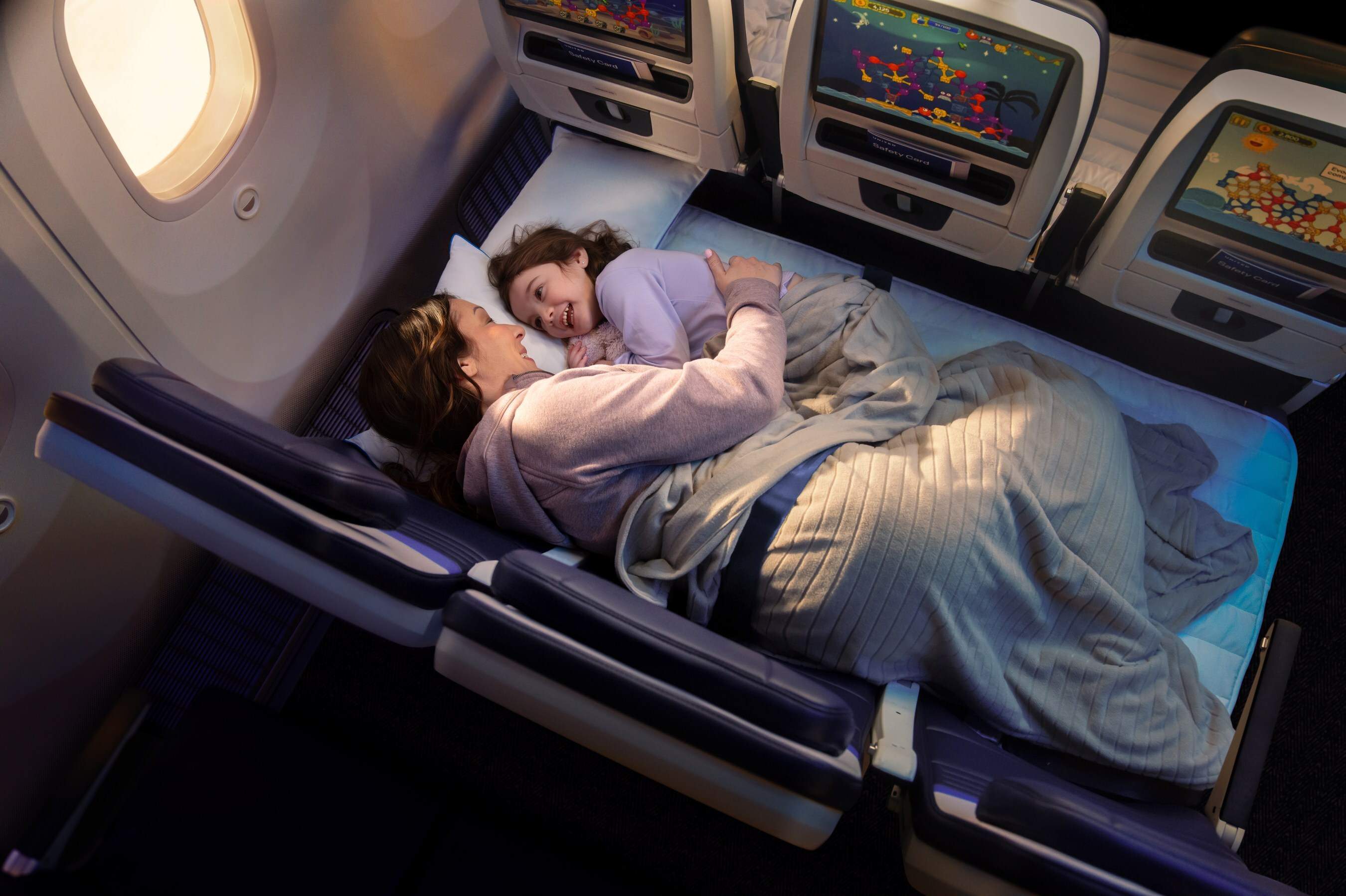
United Airlines is betting that passengers are tired of upright exhaustion and willing to pay a premium to reclaim the horizontal plane. The carrier recently introduced Relax Row, a booking option that allows a single traveler to purchase all three seats in an Economy Plus row. By deploying a specialized mattress pad and a seatbelt extender designed for lateral use, the airline transforms a standard row into a makeshift bed. This is not a new class of service, but rather a clever inventory management play designed to monetize empty middle seats that previously went unassigned.
For decades, the "poor man’s first class"—the stroke of luck where a passenger finds an entire row empty—was a free perk of low-load flights. United is now formalizing this fluke. By turning the triple-seat windfall into a branded product, the airline captures revenue from the very space that used to be the only remaining silver lining of a half-empty cabin.
The Engineering of a Pseudo Bed
The physics of an economy cabin do not naturally lend themselves to sleep. Standard seat pitches and the protruding geometry of armrests usually make lying across three seats an exercise in spinal misalignment. United addresses this with a custom-fitted product. The Relax Row kit includes a thick, cushioned topper that levels the gaps between seat cushions and provides a uniform surface.
Crucially, the safety aspect involves a modified seatbelt. Standard aviation regulations require passengers to be buckled during turbulence, which traditionally meant sitting upright. The Relax Row belt allows a passenger to remain strapped in while prone. This technicality is what separates the product from simply "laying down when the sign is off." It offers the legal and physical infrastructure to stay horizontal for the duration of a long-haul flight.
However, the dimensions remain a hard constraint. A standard Boeing 787 or 777 economy row offers roughly 60 to 65 inches of width across three seats. For any traveler over five-foot-four, "stretching out" remains a relative term. You are still sleeping in a fetal position or with your knees tucked. It is a significant upgrade over a 90-degree recline, but it is a far cry from the six-foot-six lie-flat pods found in Polaris business class.
Monetizing the Void
From a balance sheet perspective, Relax Row is a masterclass in risk mitigation. Airlines hate flying "empty metal." Every unoccupied seat is lost potential revenue. Historically, if a flight was 80% full, those 20% of empty seats were scattered throughout the cabin. By incentivizing the purchase of entire rows, United can consolidate passengers or, more accurately, get one person to pay for the footprint of three.
The pricing strategy is where the investigative eye finds the most friction. United hasn't set a flat fee; instead, the cost of a Relax Row fluctuates based on demand, route, and the original price of the Economy Plus seat. In many cases, the total cost for the three seats plus the "bed" fee approaches the price of a Premium Plus (Premium Economy) ticket.
The traveler then faces a difficult choice. Do they want the superior food, wider seat, and dedicated service of Premium Economy? Or do they value the ability to lie flat—even in a cramped, noisy environment—above all else? United is betting that for the red-eye warrior, the floor-to-ceiling value of sleep outweighs the porcelain plates and extra legroom of the mid-tier cabin.
The Hidden Impact on Cabin Atmosphere
There is a psychological shift that occurs when a cabin is divided into those who can lie down and those who cannot. Economy travel has long been defined by a shared sense of mild discomfort. When you introduce a "luxury" tier within the same physical space, it changes the social dynamic of the aircraft.
Flight attendants now have more hardware to manage. The mattress pads must be distributed, collected, and sanitized. On a packed flight, the sight of one passenger sprawled out while their neighbor in the row behind is jammed into a middle seat creates a visual hierarchy that didn't exist when everyone was equally miserable.
Furthermore, this product essentially eliminates the chance of a "free" empty seat for the budget traveler. As United’s algorithms get better at selling these rows, the likelihood of having an open seat next to you drops to near zero. The airline is effectively "walling off" the remnants of cabin comfort and putting them behind a paywall.
Testing the Durability of Comfort
The hardware itself faces a grueling lifecycle. Aviation grade materials must be fire-retardant, lightweight, and incredibly durable. United’s mattress toppers will be stuffed into overhead bins, dragged across floors, and subjected to the inevitable spills of international travel.
If the pads lose their loft after fifty flights, the "bed" becomes little more than a thin blanket over three hard chairs. The long-term success of Relax Row depends entirely on the maintenance of these kits. If the airline skimps on the cleaning or replacement cycle, the premium experience will quickly degrade into a hygiene nightmare.
There is also the matter of the "middle seat" problem. In a standard row, the middle seat is the least desirable real estate in the sky. By rebranding it as part of a bed, United has successfully turned its worst product into its most profitable "add-on" per square inch. It is a brilliant pivot, but one that requires the passenger to ignore the fact that they are still sitting in a 17-inch wide chair with a plastic tray table and a neighbors' headphones bleeding noise just inches away.
A Selective Rollout
Currently, the option is being tested on select long-haul routes where the "sleep deficit" is highest. Routes from the U.S. to Europe or the South Pacific are the primary laboratories. These are flights where the desperation for rest reaches its peak around hour six.
Industry analysts are watching the "take rate" closely. If travelers prove they are willing to pay $400 to $800 on top of their base fare for a Relax Row, expect other carriers to follow suit immediately. Lufthansa and Air New Zealand have toyed with similar concepts, but United’s scale gives this the potential to become a global standard.
The move signals the final death of "luck" in air travel. Every inch of the cabin is now being mapped, valued, and sold. The days of hoping for an empty row are over; if you want the space, the airline knows exactly what it's worth, and they expect you to pay for it before the boarding door closes.
Check your next long-haul booking for the "Row" upgrade option during seat selection, but bring a tape measure if you're over six feet tall.