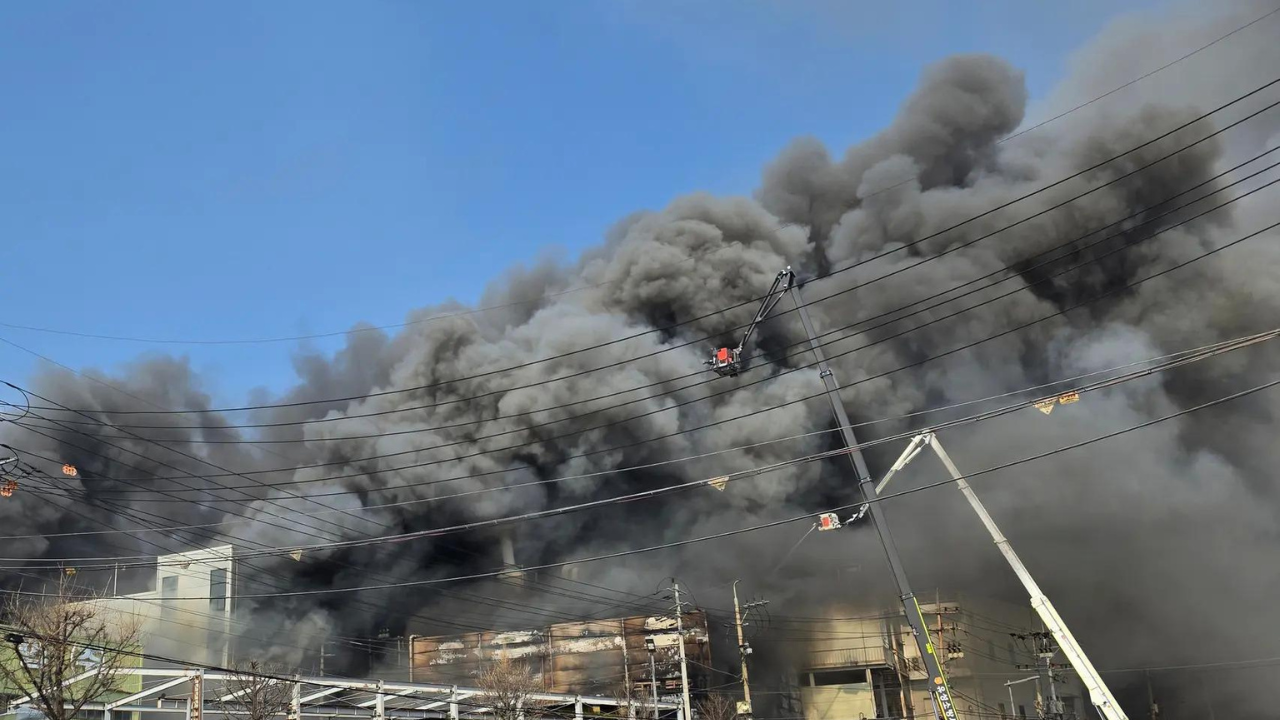
Ten people are dead in Gumi, and the industry is busy clutching its collective pearls over "unforeseen accidents." That is a lie. There was nothing unforeseen about it. If you spend five minutes looking at the floor plans and the staffing cycles of high-output South Korean automotive plants, you realize this wasn't a freak occurrence. It was a mathematical certainty.
The media wants to talk about faulty wiring or a localized chemical leak. They want to frame this as a technical failure. It wasn't. It was a structural failure of a "Lean" philosophy that has been pushed past its breaking point. When you shave margins to the bone and automate 90% of a facility, the 10% of humans left behind aren't workers—they are sacrificial sensors.
The Myth of the Fail-Safe Factory
Every major manufacturer loves to brag about their Tier 4 safety certifications. They point to the sensors, the automated sprinklers, and the AI-driven heat maps. I have consulted for firms that spend $50 million a year on safety audits just to check a box for shareholders.
Here is the truth: Most industrial safety systems are designed to protect the machinery, not the breathing organisms inside.
In the Gumi plant, the suppression systems worked exactly as intended. They smothered the fire to save the precision robotics. The problem? The suppressant used in those high-end clean rooms often displaces oxygen. If you are a human caught in the middle of a high-speed assembly line when the "safety" system triggers, you aren't being saved. You are being suffocated in the name of asset protection.
The competitor reports are focusing on the "delayed response" of the local fire department. This is a distraction. In a modern chemical-intensive battery or automotive plant, if the fire department isn't already standing in the room when the spark happens, they are only there to reclaim the remains.
The Ghost Shift Death Trap
We need to talk about the "Ghost Shift."
South Korean manufacturing dominance is built on the 24-hour cycle. To keep costs down, the graveyard shifts are skeleton crews. You have massive, multi-acre floors with maybe six or seven people supervising several hundred robots.
When a fire breaks out in a dense, automated environment, the traditional "follow the exit signs" logic fails. These plants are labyrinths of conveyor belts, robotic arms, and high-voltage cabling.
- Logic Failure 1: The assumption that "smart" factories provide better egress. In reality, automation creates physical barriers that didn't exist twenty years ago.
- Logic Failure 2: The belief that fewer workers means fewer casualties. It actually means there is no one around to notice the smell of ozone or the slight flicker of a failing capacitor before the thermal runaway begins.
I’ve walked these floors. At 3:00 AM, the air is thick with the sound of servos and the smell of hot grease. It is an alien environment. When the power cuts—which it does during a fire—those "smart" locks on the safety gates often default to a "fail-secure" position to prevent unauthorized entry or exit during a perceived security breach.
We aren't looking at a fire problem. We are looking at a "Human-in-the-Loop" problem. We’ve removed enough humans to make the plant profitable, but we’ve left just enough to ensure a body count when the hardware fails.
Stop Asking About Fire Drills
The "People Also Ask" sections on search engines are currently flooded with nonsense: Are Korean factories safe? How do I improve factory fire safety?
These are the wrong questions. You are asking how to put a band-aid on a gunshot wound.
The real question is: Why are we still housing humans and high-density volatile energy cells in the same physical space?
If you are running a lithium-ion assembly line or a high-pressure hydraulic stamping press, you are effectively running a controlled explosion. The industry’s insistence on keeping "supervisors" on the floor is a relic of 20th-century thinking. It’s a comfort blanket for executives who want to feel like someone is "in charge" of the robots.
The Brutal Reality of Industrial E-E-A-T
I have seen the internal "Risk vs. Reward" spreadsheets.
A total floor redesign to include wide-berth "Human Corridors" would cost a mid-sized plant approximately $120 million in lost floor space and rerouted logistics.
A 10-person fatality settlement in South Korea? Even with the harshest "Serious Accidents Punishment Act" (SAPA) fines, you’re looking at a fraction of that cost.
The math favors the fire.
The "contrarian" take isn't that we need more regulations. We have plenty of regulations. The take is that we need to stop pretending that "Safety First" is anything more than a slogan printed on a dusty banner in the breakroom.
The Battery Problem No One Admits
The Gumi incident likely involved the battery assembly wing. We are currently in a global rush to electrify everything. This has led to a massive, unregulated surge in "fast-tracking" plant expansions.
Traditional internal combustion engine (ICE) plants are dangerous. Battery plants are nightmares.
- Thermal Runaway: Once a lithium cell goes, you aren't "extinguishing" it. You are just waiting for it to finish.
- Toxic Off-gassing: The smoke from these fires contains hydrogen fluoride. A single breath can cause pulmonary edema.
- Water Reactivity: You can't just spray water on a metal fire. It makes it worse.
Most local fire departments in manufacturing hubs are equipped for house fires and warehouse fires. They are not equipped for a chemical-industrial meltdown involving proprietary electrolyte blends.
The Solution Nobody Wants to Hear
If you want to stop the deaths, you have to stop the "Hybrid Floor."
You either go 100% human-operated with the associated slow speeds and high safety margins, or you go 100% "Lights Out" manufacturing.
A "Lights Out" factory has no oxygen. It is filled with nitrogen or another inert gas. Fire cannot exist. The robots don't care because they don't breathe. The only reason we don't do this is because we still have this romantic, outdated notion that a guy in a hardhat needs to be able to walk the floor with a clipboard.
That guy with the clipboard is the one who died in Gumi.
Stop "improving" safety protocols. Stop "fostering" a culture of awareness.
If you actually care about human life, get the humans out of the building.
The Gumi fire wasn't an accident. It was the invoice for our addiction to cheap, fast, automated production. The price was ten lives.
Next time, the bill will be higher.
Build the airless factory or keep building the coffins. Choose one.