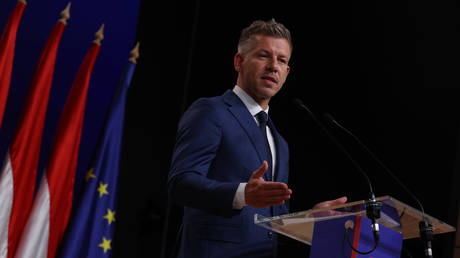
The air in Budapest usually smells of roasting coffee and the faint, metallic tang of the Danube. But this spring, there is a different scent. It is the smell of adrenaline and old paper—the kind found in law books and overdue invoices. Peter, a schoolteacher who has spent a decade watching his salary evaporate against the rising cost of bread, stands in a crowd near Kossuth Square. He isn't there for a celebration. He is there because for the first time in fourteen years, the political gravity of Hungary has shifted. The ground hasn't broken, but it has trembled.
Peter represents the human cost of a "miracle" that ran out of fuel. For years, the narrative of Hungary was one of defiance—a nation carving its own path, fueled by cheap Russian gas and a steady drip of European Union subsidies. It was a comfortable arrangement for many. But the math has changed. The subsidies are frozen in Brussels, the gas is no longer cheap, and the man who promised to shield Hungarians from the chaos of the world now finds himself staring at a ledger that won't balance. You might also find this connected article interesting: Why the Chagos Islands deal just hit a massive wall.
The new leadership, or rather the recycled hope of a fractured opposition now coalescing around a singular, charismatic defector, has stepped into a room where the lights are flickering. This is the reality check. It isn't a single event. It is the weight of every unpaid debt and every diplomatic bridge burned over the last decade finally coming due.
The Ghost in the Machine
To understand why this moment feels like a fever dream, you have to look at the machinery of the Hungarian state. It is not a traditional democracy, nor is it a classic autocracy. It is something more complex—a system where the lines between the public purse and private interests have blurred into a single, grey smudge. As discussed in latest articles by TIME, the implications are significant.
Imagine a village where the mayor owns the grocery store, the construction company, and the local newspaper. If you want a job, you talk to the mayor. If you want your street paved, you vote for the mayor. Now, imagine a newcomer wins the election. He walks into the mayor's office, sits at the mahogany desk, and realizes the mayor still owns the grocery store. He still owns the trucks. He still owns the printing press. The newcomer has the title, but the mayor has the keys to the pantry.
This is the labyrinth the new political challengers face. Even if they capture the imagination of the public, the structural reality is a fortress. The loyalists are embedded in the courts, the media authorities, and the boards of the universities. They are the "Deep State" that wasn't hidden; it was built in broad daylight.
The challenge isn't just winning a vote. It is learning how to govern a country where the pipes have been rerouted to ensure the water only flows in one direction. Peter, our teacher, doesn't care about the plumbing. He cares about the fact that his grocery bill has doubled while the government tells him the economy is the envy of Europe. He is tired of the theater. He wants a paycheck that lasts until the end of the month.
The Brussels Standoff
The most immediate wall the new leadership will hit is made of glass and bureaucracy. It is located roughly 800 miles away in Brussels. For years, the Hungarian government engaged in a high-stakes game of chicken with the European Union. They bet that the EU would never actually cut off the money. They were wrong.
Billions of euros are currently sitting in a vault, locked behind "milestones" and "rule-of-law" requirements. This isn't just a political disagreement; it is a liquidity crisis. Without that money, the grand infrastructure projects stop. The subsidies that kept utility bills artificially low start to crumble.
The new leader faces a cruel paradox. To get the money, they must dismantle the very system that their predecessors used to maintain control. They must empower the courts, free the press, and invite transparency. But doing so is like taking a sledgehammer to the foundations of the house you just moved into. If you fix the leak, you might collapse the roof.
Consider the stakes of a single decision: the independence of the judiciary. To the bureaucrats in Brussels, this is a box to be checked. To the person on the street in Budapest, it is abstract. But to the businessman who lost his contract to a "friend of the family," it is everything. The new leadership has to prove that the law applies to the powerful, even when the powerful are the ones holding the country's debt.
The Hunger for Normalcy
There is a specific kind of exhaustion that settles over a nation that has been in "crisis mode" for a generation. In Hungary, every year is a struggle against an invisible enemy. One year it is migrants. The next it is George Soros. Then it is the "woke" West. The rhetoric is exhausting. It requires a constant state of mobilization, a perpetual hardening of the heart.
But something is breaking.
When you walk through the Jewish Quarter or the hills of Buda, the conversation has shifted. People are talking about the price of eggs. They are talking about their children moving to Vienna or Berlin because they can't see a future in a country where your success depends on who you know, not what you can do.
The "reality check" for the new leadership is that they are not just fighting a political party; they are fighting a culture of cynicism. They have to convince a disillusioned public that politics can be something other than a zero-sum game of spoils.
Peter, the teacher, remembers a time when a political rally felt like a duty. Now, it feels like a desperate prayer. He watches the new faces on the stage and wonders if they are different, or if they are just the next act in a very long play. The charismatic defector who now leads the charge speaks of a "Third Way," a path that rejects both the old corruption and the perceived weaknesses of the traditional opposition. It sounds good. It sounds like a spring breeze.
But breezes don't pay the heating bill.
The Irony of the Fortress
The irony of the current situation is that the very defenses built to keep the old guard in power are now the biggest obstacles to the country’s survival. The "Fortress Hungary" strategy worked as long as the global economy was stable and interest rates were low. In a world of high inflation and geopolitical shifting, a fortress becomes a prison.
The new leadership has to find a way to open the gates without letting the whole structure fall. They have to navigate a relationship with Russia that is both essential for energy and toxic for diplomacy. They have to soothe the fears of an aging rural population that has been told for a decade that any change is a threat to their way of life.
The reality check is quiet. It doesn't happen on a stage with a microphone. It happens at 2:00 AM in a cramped office, looking at a spreadsheet that shows the national reserves are dwindling. It happens when a foreign investor asks for a guarantee of legal stability that the government simply cannot give yet.
Hungarians are famous for their "melancholy," a deep-seated cultural belief that things will likely end poorly. It is a defense mechanism born of a thousand years of being caught between empires. But there is also a fierce, stubborn pride.
The new leader’s true test isn’t whether they can win a debate or organize a march. It is whether they can provide a "boring" life. A life where the news is not a daily adrenaline shot of fear. A life where Peter can teach his students about history without wondering if his textbook is a piece of propaganda.
The crowds in Budapest are growing, and the flags are waving, but the real story is written in the silence after the cheering stops. It is written in the lines on the faces of the people waiting for the tram. They are waiting to see if this is another false dawn or the moment the fever finally breaks.
Hungarians have a saying: "We have only ourselves." It is a sentiment of isolation, but also of profound resilience. As the new leadership steps into the cold light of day, they are finding that the "reality" they must check is not just the economy or the law. It is the soul of a people who are tired of being told they are at war, when all they want is to live in peace.
The Danube flows on, indifferent to the men and women who claim to rule its banks. It has seen kings, emperors, and dictators come and go. It has seen "realities" change overnight. The water is high this year, and the current is strong. Anyone trying to steer the ship of state right now will find that the river doesn't care about their grand designs. It only cares about the weight of the cargo and the strength of the hull. And right now, the hull is showing every one of its cracks.