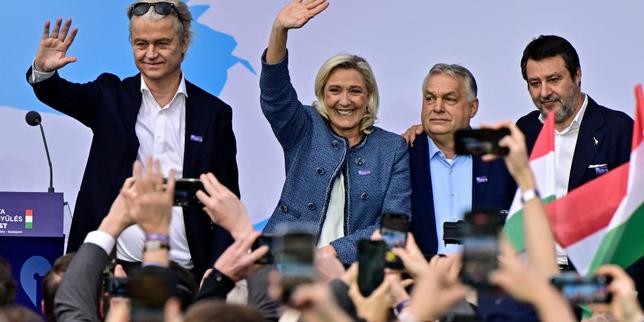
Viktor Orban's sixteen-year grip on Hungary didn't just slip on Sunday; it shattered. For years, the National Rally (RN) in France looked at Budapest as a crystal ball, a glimpse into a future where "illiberal democracy" wasn't just a fringe theory but a functioning state model. With Peter Magyar's decisive victory, that crystal ball has officially cracked.
The timing couldn't be worse for Marine Le Pen and Jordan Bardella. As they eye the 2027 Elysée run, their most vocal ally in the European trenches has been evicted by his own people. This isn't just about losing a friend at the dinner table in Brussels. It’s about the collapse of a blueprint that the RN spent a decade trying to "Frenchify."
The end of the Hungarian laboratory
For the French far-right, Orban wasn't just a politician. He was a pioneer. He showed them how to capture a state from within—neutralizing the judiciary, reshaping the media, and painting every critic as a puppet of a foreign elite. When Le Pen visited Budapest, she wasn't just there for a photo op. She was studying the manual.
Orban's defeat proves that the "populist wave" isn't a permanent tide. It’s a cycle, and cycles end. The RN has long argued that their brand of nationalism is the inevitable future of Europe. But Magyar—a former Orban insider who turned the table on his old boss—just proved that voters eventually get tired of the "enemy within" narrative when the economy stagnates and corruption becomes too obvious to ignore.
A power vacuum in Brussels
In the European Parliament, the loss is even more tangible. The "Patriots for Europe" group, chaired by Jordan Bardella, just lost its primary state-level sponsor. Orban provided something the RN couldn't: the veto power of a sovereign nation.
When the RN wanted to gum up the works in Brussels on migration or green regulations, they didn't have to do it alone. They had a Trojan horse inside the European Council. Orban was the one who could walk into a room of heads of state and stop the clock. Without him, the RN's influence in the EU is relegated back to the sidelines of the parliament floor. They’re loud, sure, but they’ve lost their executive muscle.
The Peter Magyar factor is a warning for Le Pen
The most chilling part of Sunday's results for the RN isn't just that Orban lost. It’s how he lost. He wasn't beaten by a "Brussels liberal" or a leftist coalition. He was taken down by Peter Magyar, a man who talks like a conservative, shares some of the same values, but promises to actually fix the plumbing.
This is the "Magyar Trap." In France, the RN thrives on the idea that it's the only alternative to a disconnected centrist elite. But what happens if a credible, center-right challenger emerges—someone who doesn't carry the baggage of the Le Pen name but speaks the language of order and sovereignty? Magyar showed that you can beat a populist by being a more competent version of one. That’s a lesson that should make Bardella very nervous.
Sovereignty without a paycheck
Orban’s fall also highlights the RN’s biggest vulnerability: the economy. Hungary's stagnation and the freezing of EU funds were the anchors that eventually dragged Orban down. The RN likes to talk about "economic sovereignty," but Orban's experience shows that you can't pay the bills with nationalist rhetoric forever.
Voters in Hungary basically decided that "protecting the nation" didn't mean much if they couldn't afford groceries. If the RN continues to focus on identity politics while ignoring the granular reality of purchasing power, they're setting themselves up for the same rejection.
Why the shield is gone
For years, Orban served as a lightning rod. When the EU wanted to crack down on "right-wing extremism," they focused on Budapest. That gave the RN cover to "normalize" themselves in France. They could say, "We aren't as radical as Orban," while simultaneously cheering his policies.
With Orban gone, that shield is toast. The spotlight in Brussels will shift directly to the RN and their allies in Italy and the Netherlands. They are now the primary targets for an emboldened European Commission that just saw its biggest headache disappear.
If you're watching the polls for 2027, don't just look at Paris. Look at the wreckage in Budapest. The RN just lost their most "prestigious" ally, but more importantly, they lost the argument that their rise is inevitable.
The next step for the RN isn't just to find a new friend in Brussels. It's to figure out how to survive a world where the "Orban model" is no longer a winner. They need to prove they can govern without descending into the cronyism that killed the Fidesz regime. If they can't, Sunday's results in Hungary aren't just a news story—they're a preview of their own finale.