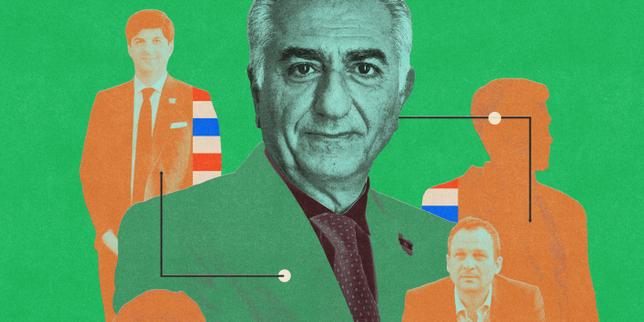
The coffee in a Parisian brasserie has a specific, metallic bitterness that feels like history. It is the drink of revolutionaries, of the displaced, and of men who spend decades waiting for a phone call that might never come. Across from the gilded gates of the Élysée or tucked away in the quiet corners of the 16th arrondissement, a man named Reza Pahlavi is drinking that coffee. He is not just a tourist. He is a ghost of a crown, weaving a web through the heart of the French Republic.
To the casual observer in the street, he is a tall, impeccably dressed gentleman of a certain age. To the French intelligence services and the halls of the Quai d’Orsay, he is a geopolitical chess piece that has been on the board for forty-five years. He is the son of the last Shah of Iran, and lately, his presence in France has shifted from a quiet retirement into a calculated, high-stakes diplomatic campaign.
The Weight of a Name
Imagine standing in a room where every person looks at you and sees a map of a country they lost. That is the daily reality for the Crown Prince. When he walks into a private meeting with French parliamentarians or sits down with influential intellectuals like Bernard-Henri Lévy, he isn't just representing himself. He carries the baggage of the 1979 Revolution, the opulence of the Peacock Throne, and the visceral longing of a diaspora that has been scattered like seeds in a gale.
His strategy in France is subtle. It does not involve the loud, brassy proclamations of militant opposition groups. Instead, it is a campaign of proximity. France has always been the laboratory of Iranian change. It was from Neauphle-le-Château that Ayatollah Khomeini orchestrated the downfall of Pahlavi’s father. There is a poetic, perhaps even haunting, irony in the son now using the same soil to dismantle what the Ayatollah built.
The stakes are invisible but absolute. In the corridors of the National Assembly, the conversation isn't about restoring a monarchy in the sense of capes and crowns. It is about "secular democracy." Pahlavi has learned the language of the Republic. He speaks of human rights, of the bravery of the "Woman, Life, Freedom" movement, and of a transition that avoids the bloody chaos of a power vacuum. He is selling a bridge.
The Network of the Shadows
How does an exiled royal build influence in a country that famously guillotined its own king? You do it through the "Réseau"—the network.
In recent months, Pahlavi’s French itinerary has become dense. He isn't just meeting with the old guard. He is engaging with the French media machine, appearing on major news cycles to frame the Iranian regime not as a stable regional power, but as a crumbling edifice. His message to the French government is simple: Stop betting on the status quo. The status quo is dying.
This isn't merely a series of handshakes. It is a logistical ballet. There are the wealthy Iranian expats in Paris who provide the financial backbone. There are the French thinkers who see in Pahlavi a "third way"—an alternative to both the current theocracy and the more radical, often controversial opposition groups like the MEK. Pahlavi’s strength in France lies in his perceived moderation. He presents as the elder statesman, the unifying figure who claims he doesn't want the throne, but merely to hold the door open for the Iranian people to choose their own future.
The Friction of Reality
But the velvet chairs of Paris are a long way from the streets of Tehran. This is where the narrative hits the jagged edge of reality. While Pahlavi weaves his web among the French elite, the critics are never far behind. They whisper about the Pahlavi legacy—the SAVAK secret police of his father’s era, the wealth of the family, the long years of absence.
He knows this. You can see it in the way he handles difficult questions during interviews at the French Press Club. There is a practiced patience there. He isn't fighting for his father’s reputation anymore; he is fighting for his own relevance. He is betting that the desperation of the Iranian people for change will eventually outweigh their historical grievances with his bloodline.
Consider the logistical nightmare of his security detail. Every time he moves through Paris, there is a shadow of tension. The French authorities must balance their diplomatic relationship with the current Islamic Republic against the protection of a man who represents its ultimate destruction. It is a tightrope walk over a pit of fire. If France leans too far toward Pahlavi, they risk trade deals and regional security. If they ignore him, they might find themselves on the wrong side of history when the inevitable happens.
The Human Toll of the Long Game
There is a profound loneliness in being a symbol. To many Iranians in the French diaspora, Pahlavi is a vessel for their nostalgia. They bring him photos of a Tehran that no longer exists—of women in miniskirts on Vali-e-Asr Street, of a booming middle class, of a time before the morality police. He has to hold that nostalgia while simultaneously trying to project a modern, forward-looking vision.
One evening, in a quiet neighborhood, he might meet with a young student who fled Shiraz only months ago. The student doesn't care about the 1970s. The student cares about the bullets fired in the street last November. The gap between these two worlds—the nostalgic exile and the traumatized refugee—is the space Pahlavi must bridge if his network in France is to mean anything.
He uses his French connections to advocate for more "maximum pressure" on the Iranian leadership, but he also pushes for "maximum support" for the protesters. It is a dual-track diplomacy. He is asking France to lead the European charge in designating the Revolutionary Guard as a terrorist organization. This isn't just politics; it’s an attempt to cut the oxygen to the machine that keeps him in exile.
The Silence of the Afternoon
The sun sets over the Seine, casting long shadows that stretch toward the Place de la Concorde. Pahlavi’s work continues behind closed doors. The dinners, the memos, the quiet briefings with advisors who parse every word from the French Foreign Ministry.
It is easy to dismiss an exiled royal as a relic. It is much harder to dismiss a man who has become a focal point for a global movement. Whether he is a king-in-waiting or simply a high-level lobbyist for a dream, his presence in France has changed the atmospheric pressure of the Iranian debate in Europe.
He is no longer just waiting. He is building.
The true test of his French network won't be found in the headlines of today. It will be found in the moment the regime in Tehran falters. When that day comes, the phone in that Parisian brasserie will finally ring. The question is no longer if he will pick it up, but if the people on the other end will still recognize the voice of the man who spent forty years preparing for the call.
In the end, the web he weaves is made of both silk and steel. It is a delicate construction of diplomatic niceties and the hard, cold reality of power politics. As he leaves the cafe and steps into the cool evening air, the shadow he casts on the pavement is long, reaching far beyond the borders of France, across the Mediterranean, over the mountains, to a home he hasn't seen since he was a boy. He walks with the gait of a man who knows that in the game of history, the person who stays at the table the longest often wins.
The waiters begin to stack the chairs. The lights of the city flicker on. The exile disappears into the crowd, just another face in Paris, carrying the weight of an empire in his coat pocket.