The air in Washington is often thick with the scent of old paper and ambition, but on this particular morning, it carried the weight of a tectonic shift. We have spent decades watching the Middle East through a very specific lens—one of American intervention, endless summits, and the slow, grinding gears of Western diplomacy. We got used to the idea that if the world’s most volatile region was going to move, it would be because a President in the Oval Office picked up a phone.
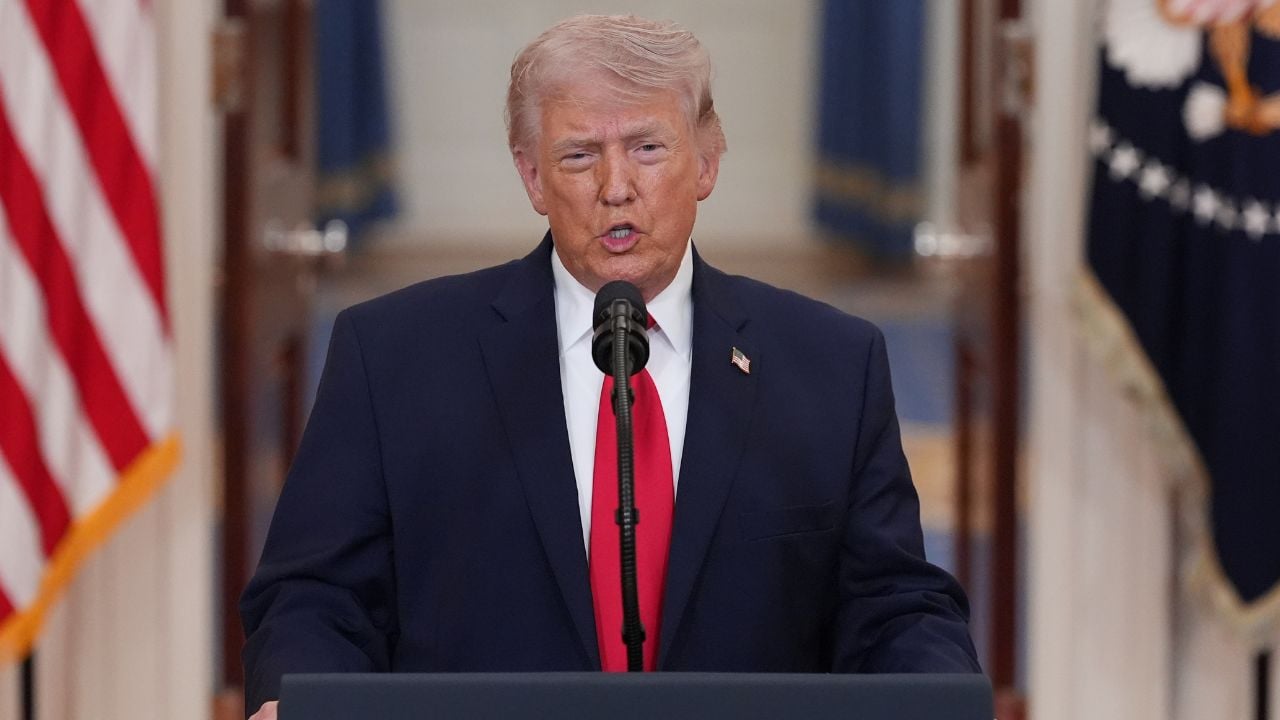
Donald Trump recently suggested that the phone ringing in Tehran didn’t have a Washington area code. It was a call from Beijing.
According to reports, the former President believes that China played the decisive role in pushing Iran toward the negotiating table. To the casual observer, this might seem like a standard political soundbite. To anyone who has watched the geopolitical map of the world slowly change colors over the last ten years, it feels like the snapping of a dry branch. It is the sound of the center of gravity shifting East.
Think about a small merchant in a bazaar in Isfahan. For generations, his life has been dictated by the value of the Rial against the Dollar, a currency he might never hold but whose ghost haunts every transaction. He knows that when the Americans tighten the screws, his children eat less meat. But lately, there is a new shadow over the bazaar. It is the shadow of the dragon. China doesn't talk about human rights or democratic reforms during trade negotiations. They talk about oil. They talk about infrastructure. They talk about the next fifty years while the West struggles to plan for the next five.
The leverage is simple, brutal, and effective. Iran’s economy has been under a suffocating weight for years. They are a nation looking for a lung. China, with its insatiable thirst for energy and its "Belt and Road" ambition, offered a pipeline of oxygen. But that oxygen comes with a price tag that isn't just measured in Yuan. It is measured in stability.
If you are the leadership in Beijing, you don't want your primary energy supplier to be a pariah state forever. You want them predictable. You want them integrated into a system where you hold the keys. Trump’s assertion isn't just about credit; it’s about recognizing that the era of the "unipolar moment" hasn't just ended—it has been replaced by a quiet, calculated pragmatism that doesn't need a Navy to enforce its will when a bank account will do.
Consider the mechanics of a negotiation. In the old world, the U.S. would offer a carrot and a stick. The stick was usually a carrier strike group or a new round of sanctions. The carrot was a seat at the table of "civilized nations." But for Iran, that carrot often tasted like ash. Why negotiate with a power that might change its entire foreign policy every four or eight years?
Beijing offers something different. They offer permanence.
When Trump claims China "got them to negotiate," he is highlighting a terrifyingly efficient piece of diplomacy. If China tells Iran that their future economic survival depends on cooling the regional jets, Iran listens. They listen because China is the only door left open. It is the ultimate leverage: the power of the only friend in the room.
We often mistake silence for inactivity. While the West was loud—debating the nuances of nuclear enrichment levels and centrifugal speeds—China was silent. They were buying. They were building. They were signing twenty-five-year strategic pacts that made the Iranian economy a subsidiary of the Chinese growth machine. By the time the world looked up, the "negotiation" wasn't a choice for Tehran. It was a requirement for survival dictated by their most important customer.
This isn't just about a nuclear deal or a trade agreement. It is about the fundamental way the world is ordered. For eighty years, the Mediterranean and the Persian Gulf were Western lakes. We decided who was in and who was out. But now, when a deal is struck, the handshake might be happening in a room where English isn't the primary language.
Trump’s observation strips away the veneer of American exceptionalism. It suggests that the "Art of the Deal" has found a new practitioner, one who plays a much longer game.
Imagine the frustration of a career diplomat at the State Department. You have spent years studying the intricacies of Farsi rhetoric. You have tracked every shipment of dual-use technology. You have built a coalition of European allies. Then, you realize the person who actually moved the needle wasn't even at your meeting. They were in a boardroom in Beijing, looking at a spreadsheet of energy requirements for the 2030s.
The stakes are invisible until they aren't. We see the headline and think of it as "news," but it is actually the final chapter of a very long book. The "invisible stakes" are the loss of the ability to dictate the terms of peace. If China is the one who can bring Iran to the table, then China is the one who decides what that table looks like. They decide the menu. They decide who gets to sit down next.
There is a certain irony in Trump, the man who walked away from the original nuclear deal, pointing to China as the broker of a new reality. It is an admission that the tools we used to rely on—the sanctions, the rhetoric, the isolation—created a vacuum. And in physics, as in politics, nature abhors a vacuum. China didn't just walk into the room; they bought the building and started charging rent.
The human element here isn't found in the politicians. It’s found in the millions of people in the Middle East who are waking up to a world where the West is no longer the only North Star. It’s the engineer in Tehran who now learns Mandarin instead of English. It’s the shipping clerk in Shanghai who sees the Persian Gulf not as a conflict zone, but as a gas station.
We are watching a transition that is as quiet as a tide and just as unstoppable. The "negotiation" Trump speaks of isn't a victory for Western diplomacy. it is a realization. It is the moment we realize that the Dragon hasn't just arrived at the gates; it has been invited inside to settle the accounts.
The wind is blowing from the East, and it smells of desert sand and industrial smoke. It is a reminder that in the grand theater of history, the person holding the microphone isn't always the one directing the play. Sometimes, the most important lines are whispered from the wings.
The table is set. The chairs are filled. But the person at the head of the table isn't who we thought it would be.