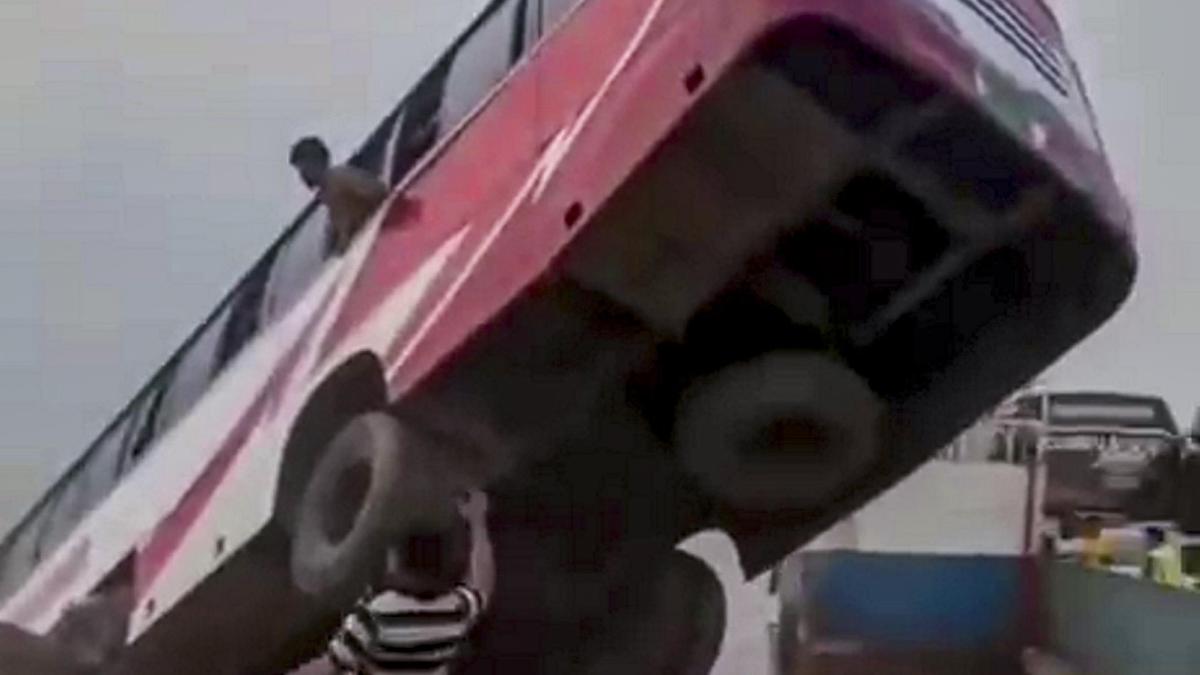
On a stretch of road that has seen more blood than asphalt in recent years, a bus carrying dozens of passengers veered off a bridge and plunged into a river in central Bangladesh. The immediate toll stands at 16 dead, but the numbers rarely tell the full story in a country where "accidental" is often a polite word for "avoidable." Divers and rescue teams continue to scour the murky waters for the missing, yet the search for accountability remains stalled at the shoreline.
This isn't an isolated tragedy. It is the predictable outcome of a transport system that prioritizes speed and profit over the basic mechanics of safety. When a vehicle of that size clears a guardrail and hits the water, it isn't just a failure of the driver’s reflexes. It is a failure of engineering, a failure of regulation, and a failure of the oversight bodies that allow "killer buses" to remain on the road long after they should have been scrapped. You might also find this similar coverage useful: Strategic Asymmetry and the Kinetic Deconstruction of Iranian Integrated Air Defense.
The Anatomy of a Plunge
The physics of a bus crash into water are brutal and unforgiving. Unlike a collision on land where crumple zones and air bags might offer a slim margin of survival, a water entry transforms a transport vehicle into a sealed trap. The weight of the engine usually pulls the front of the bus down first. Within seconds, the pressure of the surrounding water makes opening doors or windows nearly impossible from the inside.
Survival in these cases often depends on the structural integrity of the bridge and the height of the fall. In this latest incident, the bus reportedly hit the railing at a high velocity, suggesting either a mechanical failure of the brakes or a complete loss of control by an exhausted driver. Bangladesh’s highway network is a patchwork of narrow lanes and high-speed corridors where heavy long-haul trucks compete for space with overloaded passenger coaches. As discussed in recent coverage by NBC News, the implications are widespread.
The immediate aftermath is always a chaotic scramble. Local villagers are usually the first on the scene, diving into the current with little more than ropes and courage. By the time the professional dive teams arrive, the "golden hour" for life-saving intervention has almost always passed. We are left with the grim task of recovery rather than rescue.
The Ghost Fleet of the Highways
If you look at the registration papers of the buses involved in these frequent disasters, a pattern emerges. Many of these vehicles are "zombie" buses. They have either expired fitness certificates or were never built to carry passengers in the first place. It is common practice to take a truck chassis, bolt a flimsy metal shell onto it, and call it a bus. These franken-vehicles have a high center of gravity and unstable handling, making them prone to tipping during sharp turns or sudden braking.
The Bangladesh Road Transport Authority (BRTA) is technically responsible for ensuring these machines stay off the road. However, the gap between the law and the tarmac is wide. Enforcement is sporadic. Checkpoints are often bypassed through a system of "tokens" or informal payments that allow dangerous vehicles to continue their routes. This creates a culture of impunity where owners feel no pressure to invest in maintenance. Why spend money on new tires or brake pads when the cost of a fine—or a bribe—is significantly lower?
Human Fatigue as a Hidden Variable
We often blame the "reckless driver," but we rarely look at the conditions that produce that recklessness. The men behind the wheel of these long-distance coaches often work eighteen-hour shifts. They are fueled by cheap tea and the pressure of meeting tight turnaround times set by fleet owners. If a driver doesn't make the trip in the allotted time, his pay is docked.
This environment turns every journey into a race against the clock. When you combine a sleep-deprived human with a mechanically unsound vehicle on a road with no lighting and poor signage, the result isn't an accident. It’s a mathematical certainty. The plunge into the river is simply the final, tragic step in a long chain of systemic neglect.
The Failure of the Guardrails
A bridge should be a fortress. In many developed infrastructure projects, guardrails are designed to deflect a vehicle back onto the roadway or at least absorb enough energy to prevent a breakthrough. In many parts of rural Bangladesh, the railings are decorative at best. They are thin steel pipes or concrete balusters that offer no resistance to a 10-ton bus traveling at 80 kilometers per hour.
Replacing these railings with modern, crash-rated barriers would save hundreds of lives every year. Yet, infrastructure budgets are often funneled into high-profile mega-projects while the basic safety features of existing bridges are left to rot. It is a choice of optics over lives.
The Economic Weight of Grief
Beyond the immediate loss of life, there is an economic devastation that ripples through the community. Many of those who died in this latest crash were the primary breadwinners for their families. In Bangladesh, there is no robust social safety net to catch the orphans and widows left behind by the transport industry’s negligence. The "compensation" offered by the government or the bus owners' associations is usually a pittance, barely enough to cover funeral costs, let alone a lifetime of lost income.
This creates a cycle of poverty. A family loses a father, the children are pulled out of school to work, and the next generation is trapped in the same low-wage, high-risk labor pool. The true cost of the crash into the river is measured in decades, not just the number of bodies recovered in a single afternoon.
Corruption in the Inspection Lane
To fix this, the inspection process must be removed from the hands of those who benefit from the status quo. Digitalizing the fitness certification process and using independent third-party inspectors would be a start. If a bus doesn't have functioning ABS brakes and a reinforced frame, it should be impounded and crushed. There can be no middle ground when the stakes are measured in human lives.
We also need to look at the licensing of drivers. The industry is rife with "contract drivers" who hold forged licenses or have never undergone formal training for heavy vehicles. A national database linked to biometric identification could eliminate the ability of banned drivers to simply move to a different district and start over.
The Silence of the Authorities
Every time a bus hits the water, there is a flurry of activity. Committees are formed. Promises are made. "Thorough investigations" are launched with the gravity of a state funeral. But as the headlines fade, so does the political will to enact change. The transport lobby in Bangladesh is incredibly powerful, with many high-ranking officials having direct or indirect stakes in the very bus companies that are killing people.
This conflict of interest is the primary reason why meaningful reform never gains traction. You cannot expect the wolves to guard the sheep, and you cannot expect a transport ministry staffed by bus owners to regulate the transport industry with any level of rigor.
The Path to Real Safety
If we want to stop the body count from rising, we have to stop treating these events as acts of God. They are acts of man. Specifically, they are acts of greedy men and indifferent bureaucrats.
- Mandatory Speed Governors: Every long-distance bus must be fitted with a device that physically prevents it from exceeding a safe speed.
- Standardized Bridge Safety: Every bridge over a major waterway must be retrofitted with high-tension cable barriers or reinforced concrete walls.
- Strict Hour Limits: Drivers must be tracked via GPS to ensure they are not exceeding eight hours of driving time in a twenty-four-hour period.
- End the "Token" System: Direct, public accountability for police and BRTA officials who allow unfit vehicles to pass through checkpoints.
Until these steps are taken, the rivers of Bangladesh will continue to be a graveyard for the poor and the working class. The 16 people who died this week weren't just passengers on a bus; they were victims of a system that decided their lives were worth less than the cost of a new set of brake pads.
Demand that the authorities release the full maintenance history of the bus involved and the driving record of the man at the wheel.