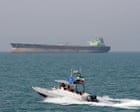
The sea has a memory, but the men who sail it today are focused only on the horizon. If you stand on the deck of a VLCC—a Very Large Crude Carrier—as it approaches the Strait of Hormuz, the world feels deceptively quiet. The air is thick with humidity and the smell of salt mixed with something heavier, something industrial. Underneath your feet, two million barrels of oil thrum with a low-frequency vibration that you feel in your teeth. This is the jugular of the global economy. One-fifth of the world’s oil passes through this thin strip of blue water.
It is only twenty-one miles wide at its narrowest point.
When the news breaks that tensions between Israel and Iran have escalated into a direct exchange of fire, the quiet on the deck evaporates. It is replaced by a cold, calculating anxiety that ripples from the bridge of the ship to the trading floors of Manhattan and the gas pumps of suburban Ohio. We treat geopolitics like a chess game played by giants, but for the crew on that ship and the families waiting for their paychecks, it is a matter of physics and friction.
The Invisible Architecture of the Strait
To understand why a few missiles in the desert can change the price of bread in London, you have to look at the map. The Strait of Hormuz is not just a waterway; it is a bottleneck designed by geography to be a leverage point. On one side lies the Arabian Peninsula; on the other, the rugged, mountainous coastline of Iran.
Ships don't just wander through. They follow a Traffic Separation Scheme, a set of invisible lanes barely two miles wide, separated by a two-mile buffer. It is a tightrope walk for vessels the size of skyscrapers. When Iran suggests it might restrict access to this passage, or when rhetoric from leaders like Donald Trump highlights Iran’s "poor job" of allowing oil flow, the markets don't just react to the words. They react to the physical reality that this narrow corridor is the only exit for the lifeblood of modern civilization.
Consider a hypothetical captain named Elias. He is responsible for a crew of twenty-four and a cargo worth hundreds of millions of dollars. As the headlines flash, Elias isn't thinking about grand strategy. He is looking at his insurance premiums. The moment a region is declared a "high-risk area," the cost to sail through it triples. That cost is never absorbed by the shipping company. It is passed down, cent by cent, until it reaches the person filling up a sedan in the rain.
The struggle between Israel and Iran is often framed as a "shadow war," but shadows don't sink tankers. Real steel does. The drone strikes and the targeted assassinations are the sparks, but the Strait is the tinderbox. If the flow of oil stops, or even slows by ten percent, the global supply chain doesn't just bend. It snaps.
The Rhetoric of the Barrel
During a recent campaign stop, Donald Trump leveled a critique that felt more like a business review than a diplomatic cable. He claimed Iran was doing a "very poor job" of allowing oil through. It’s a fascinating choice of words. It frames a sovereign nation’s strategic posture as a service failure. But beneath the bluster is a hard truth: the world expects the Middle East to function as a seamless utility, even as the region burns.
Iran knows this. They understand that their greatest weapon isn't necessarily a nuclear warhead, but the ability to create uncertainty. In the world of high-stakes finance, uncertainty is more expensive than actual conflict. When a missile is fired, you can calculate the damage. When a threat is made against the Strait, you have to price in the infinite possibilities of what might happen.
The tension between Israel and Iran has moved out of the shadows. For years, they fought through proxies—Hezbollah in Lebanon, militias in Iraq, cyberattacks on infrastructure. Now, they are trading blows directly. This shift changes the math for every energy company on the planet. If Israel strikes Iranian oil refineries, Iran has a singular, devastating counter-move: they can make the Strait of Hormuz impassable.
The Human Cost of a Cent
We talk about "market volatility" as if it’s a weather pattern. It isn't. It is the collective heartbeat of billions of people experiencing fear.
Think about a logistics manager in a small manufacturing town. She’s trying to figure out if she can afford to keep her shipping fleet running through the next quarter. If oil prices jump twenty dollars a barrel because of a skirmish in the Gulf, her margins vanish. She has to tell her staff there won't be bonuses. She might have to let people go.
The "macro" is always built of "micros." The geopolitical maneuvers in Tehran and Tel Aviv are felt in the grocery aisles. When energy costs rise, the cost of fertilizer rises. When fertilizer costs rise, the price of corn and wheat follows. A drone strike in Isfahan can, quite literally, result in a mother in a different hemisphere deciding she can’t afford the "good" milk this week.
It is a terrifying realization. Our modern, high-speed, interconnected life is built upon a foundation of stability in one of the most unstable places on Earth. We have spent decades trying to diversify energy sources, moving toward renewables and domestic fracking, yet the ghost of the 1973 oil crisis still haunts the halls of power. We are more dependent on the "Status Quo" of the Strait than we care to admit.
The Strategy of Chaos
Israel’s objective is clear: neutralize the threat of a nuclear Iran and dismantle the "Ring of Fire" that surrounds its borders. Iran’s objective is equally clear: ensure its survival by making the cost of an attack on its soil too high for the world to bear.
This is why the Strait is always the final chapter of any escalation.
If you are Iran, you don't need to win a naval battle against the United States Fifth Fleet. You just need to sink one or two large ships in the right place or sow enough mines to make the insurance companies refuse to cover any vessel entering the Gulf. If no ship is insured, no ship sails.
The "poor job" Trump mentioned isn't an accident. It is a deliberate calibration of pressure. By making the passage of oil feel precarious, Iran reminds the West that their internal comfort is tied to Iranian stability. It is a hostage situation where the hostage is the global economy.
Beyond the Headlines
The news cycle moves fast. We see the videos of orange glows in the night sky and the satellite imagery of charred hangars. We hear the fiery speeches at the United Nations. But the real story is written in the ledgers of the world’s central banks.
There is a psychological exhaustion that sets in when a conflict lingers in this "almost-war" state. Investors become twitchy. Governments start to hoard reserves. The invisible stakes are the erosion of trust in the global systems we take for granted. We assume that when we turn the key in the ignition, the fuel will be there. We assume that when we click "buy" on an app, the product will arrive from overseas.
But the Strait of Hormuz is a reminder that the world is much smaller and much more fragile than it appears. It is a twenty-one-mile gap between peace and a global depression.
The Weight of the Silence
Back on the deck of the tanker, the sun begins to set, casting a long, golden shadow across the water. For now, the ship moves forward. The crew eats dinner. The engines continue their rhythmic pulse.
But every man on that bridge is listening to the radio. They are waiting for a word, a coordinate, or a warning that the "poor job" of keeping the lanes open has finally ceased altogether. They are the frontline of a war that is fought with barrels and bourses as much as with bullets.
The tragedy of the modern era is that we have become experts at measuring the cost of everything while losing our sense of the value of stability. We watch the "Live Updates" like a spectator sport, forgetting that we are all on that ship. We are all navigating the narrow lanes. We are all one miscalculation away from a world that looks very different tomorrow morning.
The sea doesn't care about politics. It only cares about the weight of what it carries. Right now, it is carrying the anxiety of eight billion people through a twenty-one-mile gap.
The silence in the Strait is the loudest thing in the world.