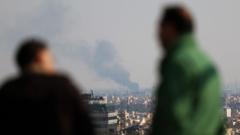
The sound of a ringing phone in Tehran doesn't carry the same casual weight it did five weeks ago. Now, it is a sharp, jagged edge. It cuts through the thick, smog-choked air of the capital, demanding an answer to a question no one wants to ask: Are you still there? Farrah doesn't answer the phone until the third ring. Her hands, usually steady from years of threading needles in a small tailoring shop, are mapped with fine tremors. She hasn't slept—truly slept—in four days. To sleep is to surrender vigilance. To sleep is to miss the low, guttural hum of a drone or the distant, earth-shaking thud that signals another neighborhood has been reduced to gray dust and rebar.
She sits in a kitchen that smells of cardamom and stale anxiety. The war is thirty days old, but for Farrah and millions like her, time has stopped behaving like a linear progression. It has become a recurring loop of sirens, bread lines, and the frantic refreshing of news feeds that offer more rumors than hope.
The Architecture of Exhaustion
When a country enters its second month of active conflict, the adrenaline that fueled the initial shock begins to evaporate. What remains is a bone-deep, psychic fatigue. It is a physiological state where the nervous system is permanently "on," scanning for threats that are often invisible until the moment of impact.
Medical professionals call this hypervigilance. In Iran, they just call it Tuesday.
The statistics are easy to find if you look at the cold data: currency devaluation hitting record lows, supply chain disruptions, and the skyrocketing cost of basic grains. But numbers are poor storytellers. They don't capture the way a father looks at his children when the lights flicker, wondering if he should move them to the hallway or if the hallway is just a more confined place to die.
Consider the "Hypothetical of the Suitcase." Every family in Farrah’s apartment block has one. It sits by the door, packed with deeds to property, gold jewelry, a change of clothes, and medicine. That suitcase is a physical manifestation of a psychological break. It says: I am prepared to lose everything I cannot carry. When you live with that suitcase for thirty days, you stop being a citizen. You become a ghost in waiting.
The economy isn't just "failing"; it is dissolving. Inflation in a war zone isn't a graph on a screen; it is the butcher telling you the price of lamb rose between the time you walked into the shop and the time you reached the counter. It is the realization that your life savings can now barely buy a week’s worth of eggs. This creates a specific kind of desperation—a frantic, quiet scramble that erodes the social fabric faster than any missile.
The Silence of the Streets
Walk through the Grand Bazaar today and you won’t hear the usual rhythmic clink of metalworkers or the boisterous haggling of spice merchants. The silence is heavy. It’s the silence of a people who have run out of things to say to one another because every conversation ends in the same place.
"Did you hear?"
"Yes."
"Is it true?"
"Probably."
Social media, once a vibrant, chaotic space for dissent and connection, has become a digital graveyard of frantic check-ins and black-and-white photos of the missing. The government’s grip on the internet tightens as the external pressure increases, creating a double-enclosure. The people are trapped by the borders of a war they didn't choose and the digital walls of a state that fears their internal whispers as much as the external bombs.
Farrah’s son, Arash, used to spend his evenings playing football in the local park. Now, he sits in the corner of the living room, staring at a screen that flickers with the glow of unverified Telegram videos. He is fifteen. He should be worried about exams or the girl in his history class. Instead, he can identify the difference between a subsonic cruise missile and an interceptor by the way the windows rattle.
This is the hidden cost of the thirty-day mark. It is the theft of a generation's normalcy. When a child learns to navigate the physics of ballistics before the physics of a playground, the damage is likely permanent.
The Illusion of Choice
There is a myth that in times of war, people become their most heroic selves. While there are flashes of bravery—the neighbors sharing a single generator, the underground clinics treating the wounded—there is also a darker, more grinding reality. Desperation breeds a transactional existence.
In the southern districts, where the poverty was already biting before the first explosion, the war has turned the hunt for food into a battlefield of its own. Reports emerge of people selling their organs just to fund a flight out of the country, or to pay the smugglers who promise a treacherous trek through the mountains toward the Turkish border.
Is it a choice if the alternative is a slow starvation under a sky that rains fire?
The invisible stakes are not just about who wins the territory. They are about the survival of the Iranian middle class—the teachers, the engineers, the tailors like Farrah. These are the people who hold the country's culture together. When they are pushed into "mounting desperation," the very soul of the nation begins to fray. They are the ones who have the most to lose and the least power to stop the loss.
The Anatomy of a Night
Midnight in Tehran is the hardest hour.
The city is under a partial blackout to make it a harder target for aerial reconnaissance. In the darkness, the senses sharpen. Every car backfiring is a gunshot. Every gust of wind is a whistle of an incoming round.
Farrah lies on her back, staring at the ceiling. A thin crack runs across the plaster, a souvenir from a blast two weeks ago that shattered the neighbor’s windows. She watches that crack, convinced that if she looks away, it will widen. If she keeps her eyes fixed on it, she can hold the house together by sheer will.
This is the state of millions. A collective, waking nightmare where the primary emotion isn't fear—it's resentment. Resentment at being a pawn in a geopolitical game where the players are safe in bunkers or foreign capitals, while Farrah’s only defense is a prayer and a suitcase by the door.
The world watches the news cycles. They see the maps with red arrows and the "expert" panels discussing strategic depths and regional proxies. They see the "standard" reports of mounting desperation. But they don't see the way Farrah’s hands shake when she tries to thread a needle the next morning. They don't feel the weight of the silence in the bazaar. They don't understand that after thirty days, you don't just fear the war. You become it.
The war is no longer something happening to them. It is a part of their blood, their breath, and their broken sleep. It is the permanent tilt of the floor and the constant, rhythmic shaking of a ceiling that refuses to stay still.
Farrah finally closes her eyes for a second, but a low rumble starts in the distance.
She is awake again before the sound even registers in her conscious mind. Her hand reaches out in the dark, feeling for the handle of the suitcase. It is still there. She is still there. For now.