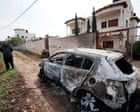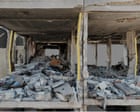
The scent of turpentine usually signals the beginning of something. For Chafic Abboud, it was the smell of life, of a Lebanese morning, of color bleeding into the fabric of a nation’s memory. But when the dust settled over a small village in South Lebanon, the only scent left was the metallic tang of spent munitions and the scorched earth of a home that no longer existed.
War is often documented in spreadsheets. We read about casualty counts, strategic coordinates, and the surgical precision of modern weaponry. We see numbers on a screen and, for a moment, our hearts dip before the scroll continues. But for an artist, the world isn't made of data. It is made of faces. It is made of the specific way a mother leans into the light or how a father’s hands look when he rests them on a wooden table.
When a strike claimed the lives of those parents, it didn't just end two lives. It tore a hole in the cultural fabric of a family and a community. Now, that grief has traveled from the rubble of Lebanon to the polished parquet floors of a Paris courtroom.
The Weight of a Name
Imagine a man whose entire existence is dedicated to the act of seeing. An artist’s eye is trained to find the nuance in the shadow. So, when the shadow of a drone or a jet passes over a home, the artist sees more than a tactical maneuver. They see the impending erasure of history.
This isn't just a legal filing. It is a scream codified into the language of international law. By filing a war crime case in Paris, the artist is attempting something radical: forcing the world to look at the individual through the lens of the universal.
The legal system is built on logic, cold and unyielding. It demands evidence. It asks for dates, times, and proof of intent. But how do you provide evidence for the loss of a lullaby? How do you quantify the disappearance of the person who taught you how to see the world in the first place?
The strike in Lebanon wasn't an isolated incident in the mind of the survivor. It was the end of a world. By bringing this case to France, the artist leverages the principle of universal jurisdiction. It is a bold, desperate gamble that the law can occasionally behave like art—that it can find a truth that transcends borders.
The Geometry of Destruction
To understand the stakes, we must look at the mechanics of the event. A strike is an exercise in geometry. A missile follows a trajectory. It hits a point on a map. In the debriefing rooms, this is called a successful engagement.
In the artist’s studio, it is a shattered perspective.
South Lebanon has long been a landscape defined by its proximity to the edge. For those living there, the sky is not just a source of weather; it is a source of surveillance. The constant hum of unmanned aerial vehicles becomes a background noise, a sinister soundtrack to the mundane acts of making coffee or hanging laundry.
When the strike occurred, it targeted a residence. The legal argument being shaped in Paris hinges on the distinction between a military objective and a civilian sanctuary. If a home is no longer a home, what is left of our shared humanity?
The case argues that the parents were not collateral. They were the point. Or, at the very least, their lives were deemed a negligible cost in the pursuit of a different target. This is where the narrative of "surgical strikes" begins to bleed out. If the surgery kills the family in the next room, the precision is a haunting, hollow boast.
The Paper Trail of Pain
Lawyers in Paris are now sifting through the remains. They are looking at satellite imagery, ballistics reports, and witness statements. They are trying to reconstruct the final moments of two people who likely never saw the end coming.
Consider the contrast. On one side, you have the high-tech machinery of modern warfare—sensors, algorithms, and remote-controlled death. On the other, you have a set of legal documents filed in a city famous for its commitment to the rights of man.
The artist is not seeking a payday. There is no amount of Euro or Lebanese Pounds that can reconstitute a human being from the ash. The goal is recognition. It is the demand that the state responsible for the trigger-pull acknowledges that a line was crossed.
In many ways, the courtroom is just another type of gallery. The artist is hanging their grief on the wall for the world to inspect. They are saying, "Look at this. Do not turn away."
The legal hurdles are massive. Sovereign immunity and political alliances often act as a shield, thicker than any tank armor. Most cases like this wither in the preliminary stages. They are dismissed as "politically motivated" or "outside the jurisdiction." But the filing itself is an act of resistance. It creates a record. It ensures that when the history of this conflict is written, it won't just be a list of territorial gains and losses. It will include the names of the parents who were sitting in their living room when the sky fell in.
The Invisible Borders of Justice
Why Paris? France has a complex relationship with Lebanon, a history layered with Mandate-era ties and modern diplomacy. But more importantly, France’s legal system allows for the prosecution of grave crimes committed abroad if there is a link to the country or if the crimes are so heinous they demand a global response.
The artist is tapping into a tradition of French intellectuals and jurists who believe that justice should not be stopped by a customs gate.
But the reality on the ground in Lebanon is far removed from the cafes of the Left Bank. In the villages of the south, justice feels like a fairy tale. When your house is gone, and your parents are buried, a legal filing in a distant capital can seem like an exercise in futility.
Yet, this is how the needle moves. It moves through the persistence of those who refuse to let their loss be categorized as an unavoidable accident.
The strike that killed the parents is part of a broader pattern of escalation. Each blast recalibrates what we are willing to accept as "normal." The artist’s case is an attempt to reset that scale. It is a reminder that every "target" has a name, a favorite meal, and a child who will spend the rest of their life trying to paint over the black void left behind.
The Silence After the Verdict
Even if the case succeeds, it won't bring peace to the border. It won't stop the next drone from taking flight. But it might make the person behind the screen pause. It might introduce a flicker of doubt into the cold calculus of the kill chain.
The artist continues to work. They paint, perhaps with more ferocity now, or perhaps with a devastating quietness. The colors on the canvas are no longer just aesthetic choices; they are a testimony.
We often think of war as something that happens to "them"—people in far-off places with different lives. But the artist shows us that the human experience is terrifyingly fragile. A home in Lebanon is not so different from a home in Paris or New York. It is a place of safety that can be evaporated in a millisecond by a decision made hundreds of miles away.
The legal battle will drag on for years. There will be motions, appeals, and political pressure to let the matter drop. The news cycle will move on to the next crisis, the next strike, the next tragedy.
But in a small studio, or perhaps in a quiet corner of a Parisian law office, the files remain open. The artist stands before a blank surface, or a judge, and refuses to be silent. They are holding up a mirror to a world that prefers to look at maps instead of faces.
The paint is drying. The court is in session. The story of two parents in a Lebanese village has become a question that the rest of the world has to answer.
What is the price of a life when it is caught in the crosshairs of a ghost?
The answer isn't in the verdict. It’s in the fact that we are finally forced to ask the question.