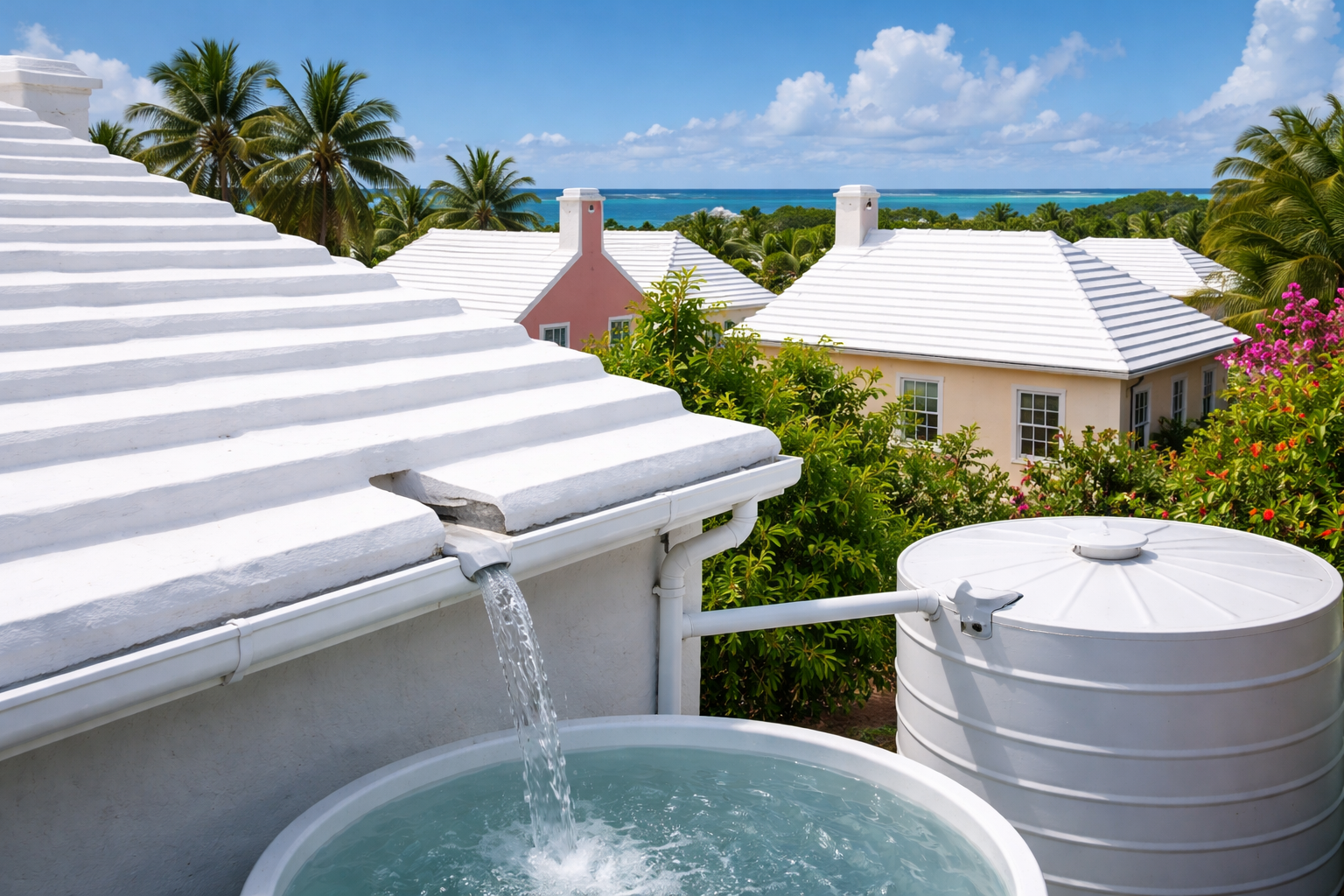
The architectural world has a collective crush on Bermuda’s white stepped roofs. For four centuries, we have been told the same romanticized story: a resource-poor island outsmarted nature by turning every house into a private reservoir. Design magazines call it "sustainable brilliance." Urban planners call it "pre-modern genius."
They are wrong.
What the world views as a masterclass in self-sufficiency is actually a high-maintenance, fragile, and increasingly dangerous workaround for a failure in large-scale infrastructure. The "Bermuda Method" isn't a blueprint for the future of the planet; it’s a cautionary tale about what happens when you are forced to rely on a literal bucket of sky-water to survive a drought.
The Myth of the Free Lunch from the Clouds
The standard narrative suggests that Bermuda solved the water crisis 400 years ago. The logic is simple: lime-washed limestone steps slow down the rain, filter it through a bit of gravel, and store it in a dark tank under the house. No pipes, no pumps, no problem.
Except the problem is massive.
In a modern world, the individual cistern system is a biological gamble. The "stepped" design that everyone finds so charming? It is a giant collector for everything that falls from the sky—and I don't just mean H2O. Bird droppings, salt spray, decaying vegetation, and heavy metals from atmospheric pollution all settle on those pristine white steps.
While the lime wash supposedly "purifies" the water by increasing its alkalinity, it’s a crude chemical band-aid. Relying on a coat of paint to keep your drinking water safe from Salmonella or E. coli is a risk no modern municipality would ever dream of taking. I have seen homeowners spend thousands on UV filtration and reverse osmosis systems just to make their "ancestral" water supply remotely potable.
The system doesn't work because it's clever. It works because, for 400 years, Bermudians had no other choice. That isn't innovation. It’s survivalism.
The Scalability Lie
Every time a "green" architect suggests we should adopt the Bermuda model in dry climates like California or the Mediterranean, they ignore the math.
Bermuda receives an average of 55 inches of rain per year, spread relatively evenly across twelve months. The system only functions because the input is consistent. Try applying this to a region with a "wet season" and a "dry season."
$V = A \times R$
The volume of water ($V$) you can collect is strictly limited by your roof area ($A$) and the rainfall ($R$). In a modern suburban setting, the roof-to-occupant ratio is a disaster. If you have a family of four in a two-story home with a small footprint, your roof cannot possibly collect enough water to sustain modern hygiene standards, dishwashers, and high-efficiency toilets.
Bermuda makes it mandatory by law to have 80% of your roof area dedicated to collection, with a tank capacity of 100 gallons per square foot of roof. This is a massive hidden "tax" on construction. It forces every single homeowner to be their own utility manager. Imagine if every time you turned on the tap, you had to worry about whether your "infrastructure" had a crack in the seal or a dead frog in the intake.
The Hidden Carbon Footprint of "Natural" Water
We love to hate on massive desalination plants and central reservoirs because they look industrial. They aren't "aesthetic."
But let’s look at the cold reality of decentralized water. When a Bermuda tank runs dry—which happens during any significant dry spell—the homeowner has to call a "water truck." These are heavy, diesel-burning vehicles that haul thousands of gallons of water from central lenses or desalination plants to individual homes.
Think about the sheer inefficiency of that logistics chain. Instead of moving water through a pressurized, underground pipe system using gravity and efficient industrial pumps, you are putting it on a six-wheeled truck and driving it up a narrow hill.
The "400-year-old system" is actually propped up by a fleet of carbon-spewing trucks. The "self-sufficiency" is a facade. Without the government-operated desalination plants and the private trucking industry, the "traditional" Bermuda house would be uninhabitable within two weeks of a heatwave.
Why Architects Love This (and Why They Are Wrong)
Architects love the Bermuda roof because it provides a "visual identity." It’s an easy way to signal "environmental consciousness" without actually doing the hard work of engineering.
I’ve seen developers try to "leverage" this aesthetic in luxury villas across the Caribbean. They build the white roof, they put in the cistern, and then they realize that the occupants—who are paying $2,000 a night—expect a 20-minute high-pressure shower. The cistern drains in three days. The "sustainable" house ends up hooked into a massive, hidden, energy-intensive backup system.
The "Bermuda Method" is a manual process in a digital age.
- Maintenance: You must paint the roof with specialized non-toxic paint every 2-3 years.
- Inspection: You have to physically enter the "tank" (a dark, damp cavern under your living room) to check for cracks.
- Contamination: A single hairline crack in the limestone can allow brackish groundwater or sewage to seep in.
This isn't a "set it and forget it" solution. It is a high-risk, labor-intensive chore that the rest of the developed world moved past the moment we figured out how to build a proper water main.
The True Cost of Distributed Infrastructure
The global obsession with "decentralization" is often a mask for the erosion of public services. When we celebrate Bermuda’s water system, we are essentially celebrating a society where the government doesn't have to provide a basic human necessity.
In Bermuda, if your pump breaks on a Sunday, you don't have water. If your tank develops a leak and you don't notice, you lose your entire year's supply.
We should be moving toward more centralized, high-efficiency water management, not less. We need large-scale water recycling, massive industrial-grade filtration, and smart grids that can detect leaks in real-time. Giving everyone their own little bucket and telling them to "manage it" is a regression, not an evolution.
Stop Fetishizing the Past
Bermuda is a beautiful island with a unique history. Its people are resilient because they had to be. But let’s stop pretending that a white-painted rock is the answer to the global water crisis.
The "People Also Ask" section of the internet wants to know if they can build a Bermuda roof in Texas or Australia. The answer is yes, you can. But you will spend more on maintenance, risk more in terms of health, and likely run out of water exactly when you need it most.
The "status quo" in water management—centralized treatment and distribution—is the greatest public health achievement of the last two centuries. It reduced cholera, ended the tyranny of the well, and allowed cities to grow.
Bermuda’s roof is a stunning piece of history, but it is a terrible piece of modern technology. It is a monument to a time when we were at the mercy of the weather. We shouldn't be looking to replicate it; we should be grateful we have the technology to move beyond it.
If you want to solve the water crisis, stop looking at the roof. Look at the grid.
Go ahead and build a white roof if you like the look. Just don't try to drink the rain that hits it unless you’re prepared to deal with the consequences of 17th-century plumbing in a 21st-century world.