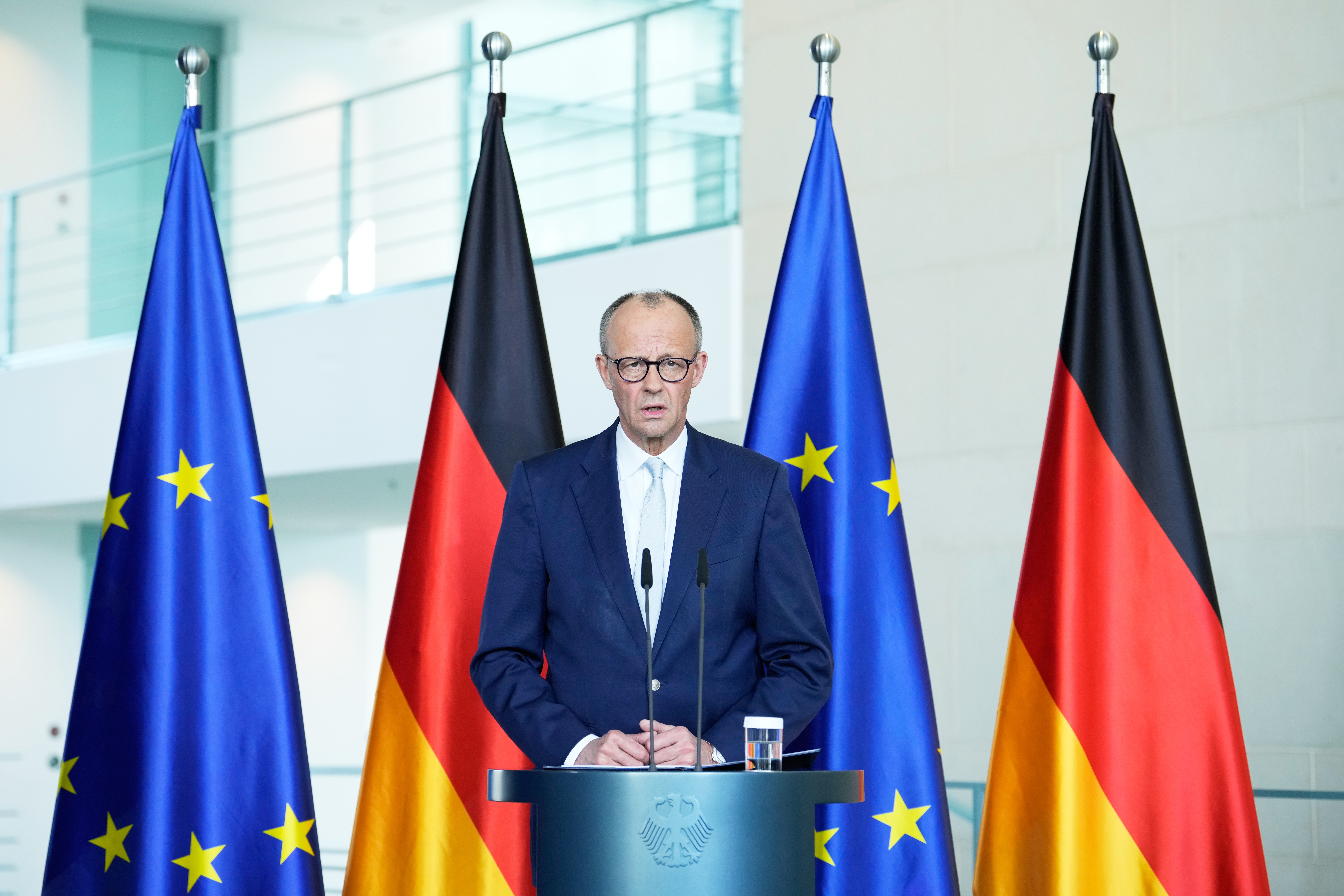
The Chancellery in Berlin is currently operating under a quiet but pervasive dread. While public statements focus on de-escalation, the private reality is a desperate scramble to prevent the North Atlantic Treaty Organization from fracturing under the weight of a potential U.S.-Iran conflict. Germany finds itself trapped between its foundational security reliance on Washington and a deep-seated European fear that an American-led war in the Middle East would effectively bankrupt the political capital holding the alliance together.
German leadership has made it clear that NATO cannot afford to become a secondary casualty of tensions in the Persian Gulf. This is not merely about avoiding military involvement. It is an existential calculation. For Berlin, the math is simple: if the United States triggers a regional war that forces European allies to choose between unconditional loyalty to the Pentagon or their own domestic stability, the alliance might not survive the resulting friction.
The Friction of Unequal Interests
The core of the problem lies in the diverging priorities between Washington and its European counterparts. For the United States, Iran is often viewed through the lens of regional hegemony and non-proliferation. For Germany and the broader EU, Iran is a neighbor of a neighbor. Any significant military escalation doesn't just stay in the Middle East. It spills over into Europe in the form of massive migration waves, disrupted energy markets, and heightened domestic security threats.
Berlin has observed how previous interventions in the region—specifically the 2003 invasion of Iraq—strained the alliance to its breaking point. The current government is acutely aware that the German public has zero appetite for another "coalition of the willing." By signaling early that NATO should remain distant from any U.S.-Iran kinetic exchange, the Chancellor is attempting to build a firewall. This is a preemptive strike against the possibility of a formal Article 5 request or, more likely, a heavy-handed "with us or against us" demand from the State Department.
The Logistics of a Split
If a conflict erupts, the first point of failure won't be in the halls of Brussels, but in the logistics of the American military presence on German soil. Ramstein Air Base serves as the indispensable nerve center for U.S. operations in the Middle East and Africa. Should the U.S. launch strikes from German territory against Iranian targets, Germany becomes a de facto participant in the eyes of Tehran.
This creates a legal and diplomatic nightmare for Berlin.
- The Sovereignty Trap: Germany could be forced to restrict U.S. use of its bases to avoid being pulled into a war it didn't vote for.
- The Intelligence Gap: European intelligence agencies often see the "imminent threats" cited by Washington with a significant degree of skepticism, leading to a breakdown in information sharing.
- The Public Backlash: A German government that allows its soil to be used for an unpopular war risks a total collapse of domestic support, potentially empowering far-right and far-left factions that have long advocated for a pivot away from the Atlanticist model.
Defense Spending as a Shield
There is a subtle irony in the current German position. Under Chancellor Friedrich Merz, Germany has finally begun to move toward the 2% GDP defense spending target that Washington has demanded for decades. Yet, this newfound commitment to "Zeitenwende" or a turning point in security policy is intended to strengthen Europe's hand within NATO, not to provide more boots for American expeditions.
Berlin is playing a sophisticated game of compliance and resistance. By modernizing the Bundeswehr, Germany argues it is doing its part for European defense—specifically against threats on the eastern flank. This allows the government to deflect pressure to participate in Middle Eastern theaters. The logic is that Germany is "too busy" securing the continent to be distracted by a war in the Levant. This strategy, however, assumes that the U.S. will accept a "division of labor" where Europe handles the backyard and America handles the globe. Historical evidence suggests Washington rarely accepts such boundaries when the shooting starts.
The Middle East Shadow over the Eastern Flank
The greatest fear in the Chancellery is that a U.S.-Iran war would drain American resources away from the defense of Europe. If the U.S. military becomes bogged down in a multi-year conflict with a sophisticated adversary like Iran, the "security umbrella" over the Baltics and Poland begins to look increasingly flimsy.
For the German leadership, the stability of NATO is tethered to American focus. A distracted America is a dangerous America for European interests. This is why the Chancellor's rhetoric emphasizes the "unity of the alliance" above all else. It is a coded plea for the U.S. to recognize that its actions in the Middle East have a direct, corrosive effect on its most important military partnership in Europe.
The Economic Reality of Escalation
Beyond the military maneuvers, the economic fallout of a U.S.-Iran conflict would hit Germany harder than almost any other G7 nation. The German industrial model, already reeling from the loss of cheap Russian energy, cannot withstand another price shock. A closure of the Strait of Hormuz would send oil and gas prices to levels that would trigger a deindustrialization crisis in the Rhine-Ruhr valley.
When the Chancellor speaks of NATO stability, he is also speaking of the economic floor required to keep a military alliance funded. A bankrupt Europe cannot be a strong NATO partner. Berlin views the U.S. "maximum pressure" or military options as a direct threat to the economic solvency of the European Union. This creates a situation where Germany isn't just a reluctant ally; it becomes a fundamental obstacle to American foreign policy goals.
Redefining the Partnership
The tension we are seeing today is the result of a decades-long evolution in German foreign policy. The era of "chequebook diplomacy," where Germany simply paid for the costs of others' wars to avoid participating, is over. Berlin now wants a seat at the table where the decisions to start those wars are made.
The current stance is an assertion of a "European-first" NATO. It suggests that the alliance's primary purpose is the defense of the treaty area, not global policing. If Washington continues to view NATO as a toolbox for its interests in the Middle East, it may find the tools increasingly blunt or simply unavailable when the time comes to use them.
The Fragility of the Status Quo
There is no easy fix for this divergence. The U.S. expects its junior partners to follow its lead in exchange for the security guarantee it provides. Germany, meanwhile, believes that the security guarantee is a mutual benefit that shouldn't be held hostage by American adventurism in the Middle East. This is a fundamental disagreement on the very nature of the North Atlantic Treaty.
Wait-and-see is no longer a viable strategy for Berlin. The German government is now actively coordinating with Paris and Warsaw to create a unified European "bloc of restraint." The goal is to present the U.S. with a fait accompli: a Europe that will support the U.S. against traditional threats but will remain strictly neutral in a conflict with Iran.
This plan, however, relies on a level of European unity that has proven elusive in the past. If the U.S. manages to peel off individual allies—perhaps by offering specific defense perks to Poland or the UK—the German "firewall" will crumble. The Chancellor is betting that the shared fear of a regional conflagration is stronger than the individual desire for American favor.
The real threat to NATO isn't a direct attack by a foreign power. It is the slow, grinding realization that the interests of its two most important members—the United States and Germany—may no longer be compatible in a world where the Middle East remains a constant flashpoint. Every time Berlin has to distance itself from a potential U.S. war, the foundation of the alliance thins. Eventually, it may become so thin that it can no longer support the weight of the collective defense it was built to provide.
The Chancellor's warnings are not just diplomatic noise; they are a klaxon for an alliance that is running out of common ground. Germany is telling the world that it will not sacrifice its domestic stability or the security of the European continent for a war it considers a strategic error of the highest order. Whether Washington is listening is another matter entirely. The answer will determine if NATO celebrates its next decade as a unified force or a historical footnote.
Strategic autonomy is no longer a French academic concept; it is a German survival mechanism.


