The crash of a tour helicopter on the island of Kauai, resulting in five injuries, serves as a high-velocity case study in the intersection of micro-climate volatility, mechanical redundancy, and pilot decision-making frameworks. When a rotorcraft transitions from controlled flight to an uncontrolled descent in complex terrain, the survival rate is dictated by a specific set of physics-based variables: the energy dissipation of the airframe, the velocity of the vertical impact, and the efficacy of emergency response in isolated geography. This incident highlights a systemic vulnerability in the high-density aerial tour industry where the margin for error is compressed by the unique topographical constraints of the Napali Coast.
The Triad of Operational Failure in Island Aviation
To understand why this specific incident occurred, we must categorize the risks into three distinct causal pillars.
1. The Micro-Climate Pressure Gradient
Kauai represents one of the most challenging meteorological environments for civil aviation. The interaction between trade winds and the steep elevation of Mount Waialeale creates localized pressure differentials and sudden orographic lifting.
- Mechanical Turbulence: Wind shear occurring at low altitudes can exceed the cyclic control limits of light-utility helicopters.
- Visibility Compression: Rapid cloud formation (clogging) can trap a pilot in Instrument Meteorological Conditions (IMC) while they are flying under Visual Flight Rules (VFR).
2. Kinetic Energy Management and Airframe Integrity
The severity of the five injuries reported suggests a failure in "energy management" during the descent. In a standard autorotation—the process where a pilot uses the upward flow of air to keep the rotors spinning after an engine failure—the goal is to convert potential energy into kinetic energy, then "flare" the aircraft to bleed off horizontal and vertical speed just before impact.
- Vertical Velocity ($V_v$): If the descent rate exceeds the shock-absorption capacity of the landing gear (skids), the force is transferred directly to the airframe and the occupants’ spinal columns.
- Structural Deformation: Modern tour helicopters are designed with "crumple zones" in the seat structures. The fact that all five survived indicates the impact, while severe, likely occurred within the survivable envelope of the aircraft’s structural design.
3. The Geographic Isolation Lag
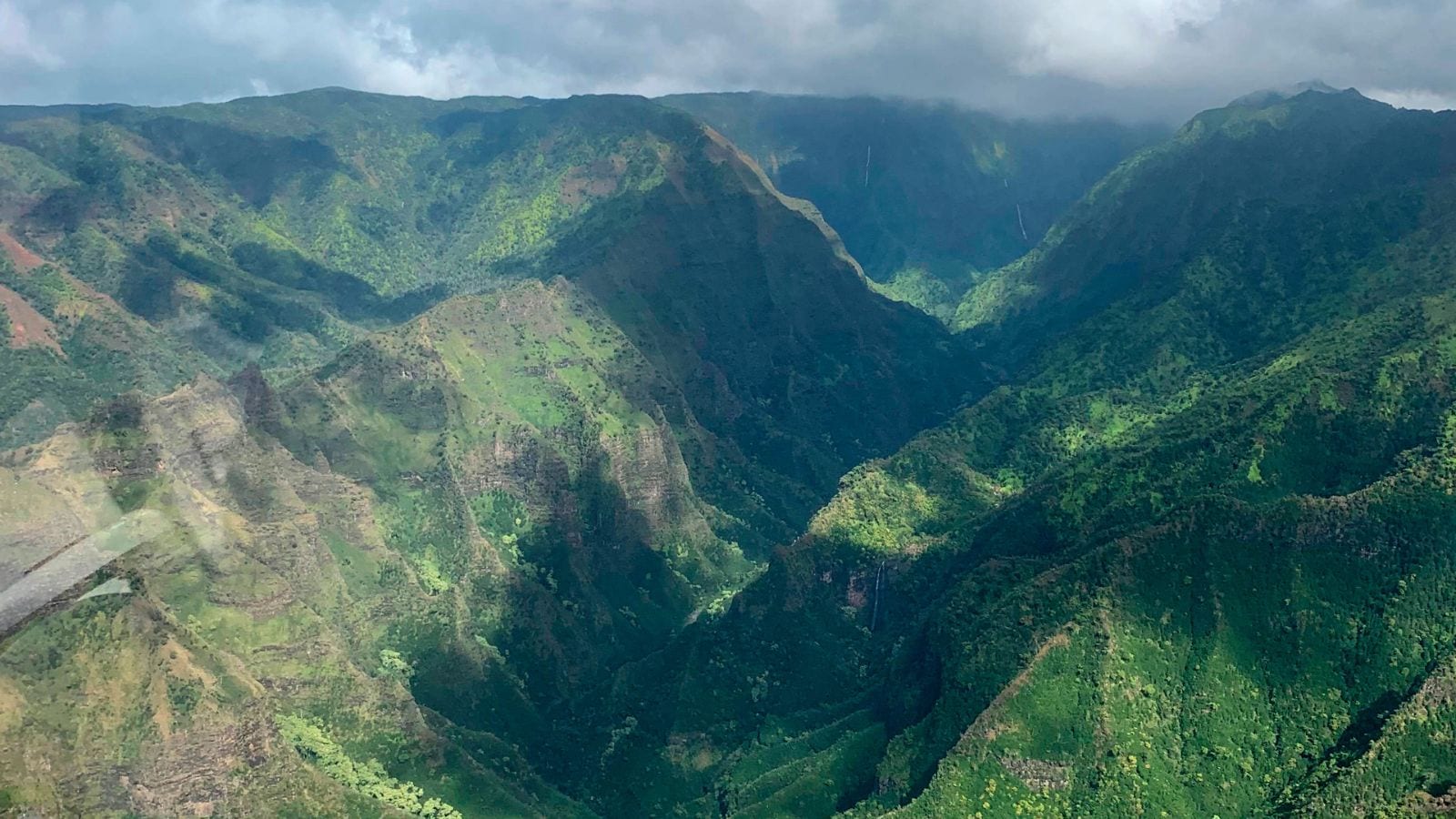
The Napali Coast and the interior canyons of Kauai are inaccessible by ground vehicles. This creates a "Golden Hour" bottleneck. In trauma medicine, the first sixty minutes post-impact are the most critical for preventing mortality.
- Extraction Physics: Rescue operations in these zones require specialized Short-Haul or Hoist capabilities.
- Communication Shadows: Rugged basalt cliffs interfere with VHF radio and GPS signals, often delaying the exact localization of the "ELT" (Emergency Locator Transmitter) signal.
The Mechanics of the "NTSB Probable Cause" Framework
While a formal investigation by the National Transportation Safety Board (NTSB) typically spans 12 to 24 months, the investigative logic follows a rigid hierarchy of evidence. Analysts will first examine the Powerplant and Drive System. They look for "witness marks" on the engine components—internal scarring that indicates whether the engine was producing power at the moment of impact. If no such marks exist, the investigation shifts toward fuel starvation or mechanical shearing.
The second layer of analysis involves the Pilot’s High-Stakes Decision Matrix. In tour operations, there is an inherent conflict between the "mission" (providing the tour) and "safety" (turning back due to weather). This "get-there-itis" is a documented cognitive bias where the proximity to the goal overrides the perception of mounting risk. The investigation will reconstruct the flight path using ADSB (Automatic Dependent Surveillance-Broadcast) data to determine if the pilot attempted to outrun a weather front or if the descent was instantaneous.
Quantifying Tour Industry Risk Profiles
The Kauai tour market operates on a high-frequency, low-margin model. This necessitates high airframe utilization. To evaluate the safety of these operations, one must look at the Accident Rate per 100,000 Flight Hours rather than total crash counts.
- Maintenance Cycles: Turbine engines require meticulous inspections at 100-hour and 300-hour intervals. Any deviation in the logging of these cycles represents a catastrophic risk point.
- Pilot Fatigue: High-frequency tour routes involve repetitive "shuttle" legs. The cognitive load of navigating the same canyons six times a day can lead to "automation complacency," where the pilot relies too heavily on the aircraft's stability systems and fails to detect subtle changes in engine torque or vibration.
Structural Vulnerabilities in Light Turbine Helicopters
Most tour operators on Kauai utilize aircraft like the Airbus H125 (AStar) or the Bell 407. These are single-engine turbines. While highly reliable, they lack the engine redundancy of twin-engine aircraft.
- The Single Point of Failure: In a single-engine configuration, a "flameout" or a catastrophic compressor stall leaves the pilot with only one option: autorotation.
- The Dead Man’s Curve: Every helicopter has a Height-Velocity Diagram. If an engine fails while the aircraft is in a specific "shaded" region—usually low altitude and low airspeed—a successful autorotation is physically impossible because there is insufficient altitude to trade for rotor RPM.
Strategic Imperatives for Aerial Tourism Regulation
The recurrence of incidents in the Hawaiian archipelago suggests that current FAA Part 135 regulations—which govern on-demand charters and tours—may be insufficiently calibrated for the specific density and climate of Kauai.
Mandatory Multi-Engine Transition
The most direct method to reduce "Loss of Power" accidents is a transition to twin-engine airframes. This creates a redundant safety buffer where the failure of one engine allows the aircraft to maintain level flight or, at the very least, a controlled descent to a safe landing zone. The primary barrier here is the 30% to 50% increase in hourly operating costs, which would fundamentally restructure the pricing of the Kauai tourism market.
Real-Time Weather Telemetry
Currently, pilots rely on "pilot reports" (PIREPs) and general area forecasts. A more robust framework would involve the installation of automated weather stations (AWOS) at key "choke points" along the Napali Coast. This would provide pilots with real-time data on wind shear and ceiling heights, removing the subjective "eyes-on" assessment that currently dominates VFR flight.
Terrain Awareness and Warning Systems (TAWS)
While many modern helicopters are equipped with H-TAWS (Helicopter Terrain Awareness and Warning Systems), these systems are often configured with "nuisance" alerts that pilots may desensitize themselves to in the tight confines of a canyon. The logic of these systems must be refined to account for the intentional close-proximity flying inherent in sightseeing while still providing an unmistakable warning of an impending Controlled Flight into Terrain (CFIT).
Immediate Risk Mitigation for the Aviation Consumer
For those engaging with the aerial tour industry, safety is not a binary state but a spectrum of probability. Due diligence must move beyond surface-level reviews and focus on operational transparency.
- Request the Safety Management System (SMS) Profile: Reputable operators maintain an SMS that tracks near-misses and internal safety audits. An operator's willingness to share their safety culture is a leading indicator of risk.
- Verify Pilot "Time in Type": Total flight hours are less relevant than hours flown in the specific aircraft model and the specific geography of Kauai. A pilot with 5,000 hours in the flatlands of the Midwest is less prepared for Kauai than a pilot with 1,000 hours exclusively in island canyons.
- Weight and Balance Sensitivity: Small helicopters are hypersensitive to Center of Gravity (CG). Operators that do not strictly weigh passengers and cargo before flight are bypassing a fundamental law of aerodynamics ($L = W$).
The Kauai crash is not an isolated anomaly; it is the predictable output of a complex system operating at the edge of its environmental and mechanical limits. The survival of the five individuals is a testament to the crashworthiness of modern aerospace engineering, but the occurrence itself points to a failure in the predictive modeling of island flight operations. Operators must now pivot from reactive safety measures to a predictive "high-reliability organization" (HRO) model, where the detection of "weak signals"—a slight uptick in wind speed, a minor vibration in the tail rotor—triggers an immediate cessation of flight operations regardless of the commercial implications.
Audit your chosen operator's tail number against the NTSB's Aviation Accident Database to identify patterns of mechanical failure or pilot error before booking transit into high-risk topographies.