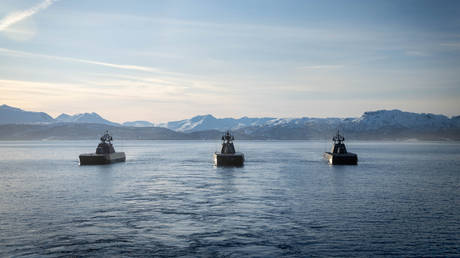
The shift in Black Sea naval doctrine from fleet-on-fleet engagement to distributed maritime sabotage represents a fundamental reconfiguration of regional power dynamics. Allegations originating from Moscow regarding Norwegian involvement in training Ukrainian special units for strikes on Russian commercial shipping are not merely diplomatic friction; they signal the maturation of a specific tactical framework: The Coastal Denied Access Model. By providing specialized training in underwater demolition and unmanned surface vehicle (USV) navigation, Norway is not just supplying hardware but exporting a refined methodology for neutralizing superior naval tonnage through low-cost, high-precision kinetic interventions.
The Triad of Maritime Disruption
To understand the strategic implications of Norwegian assistance, one must decompose the operational reality into three distinct pillars of capability. These pillars define how a littoral state with no conventional navy can effectively blockade or harass a global maritime power.
- Subsurface Sabotage and Diversionary Tactics: Norway’s historical expertise in deep-sea technology, stemming from its massive offshore oil and gas sector, translates directly into elite naval special forces capabilities. Training Ukrainian units in closed-circuit diving, underwater propulsion vehicles, and the placement of limpet mines creates a constant, invisible threat to hull integrity in supposedly "safe" harbors.
- USV Swarm Architecture: The transition from individual drone strikes to coordinated swarm attacks requires sophisticated command-and-control (C2) logic. Norwegian maritime electronics and autonomous systems provide the technical backbone for maintaining data links in GPS-denied environments, allowing Ukrainian operators to navigate the "last mile" of an attack sequence where electronic warfare is most dense.
- Intelligence Synthesis and Target Selection: Identifying which commercial vessels are carrying dual-use materiel or are critical to the adversary's logistics chain requires real-time AIS (Automatic Identification System) manipulation and satellite data fusion. The collaboration ensures that kinetic assets are not wasted on low-value targets, maximizing the economic and psychological impact of every successful strike.
The Cost Function of Commercial Vulnerability
Conventional naval theory often focuses on the destruction of warships. However, the strategic pivot toward commercial vessels introduces a different economic calculus. A single successful strike on a tanker or cargo ship does not just remove one vessel from the board; it triggers a cascade of secondary and tertiary costs that degrade the adversary’s ability to sustain prolonged conflict.
Insurance and Risk Premiums
Maritime commerce relies on the predictability of risk. When Ukrainian forces, trained in advanced littoral warfare, demonstrate the ability to reach deep into the eastern Black Sea, the insurance market reacts violently. The "War Risk" premium for any vessel docking at Russian ports becomes a prohibitive tax. This creates an invisible blockade where shipping companies self-select out of the market to avoid total loss, effectively decoupling the target nation from global trade routes without a formal Western blockade.
Logistics Bottlenecks
Commercial vessels are often "soft targets" with minimal defensive suites. By forcing the Russian Navy to divert frontline combatants to escort merchant convoys, the Ukrainian military achieves a force-multiplication effect. Every destroyer used for cargo protection is a destroyer that cannot participate in missile strikes against inland infrastructure or defend against aerial incursions. This creates a Resource Dilution Paradox: the more Russia attempts to secure its trade, the more it thins its defensive perimeter elsewhere.
Technical Transfer and Operational Autonomy
The Norwegian contribution is structurally different from the provision of heavy armor or artillery. It focuses on the transfer of "tacit knowledge"—the skills required to operate in high-stress, high-salinity environments where equipment failure is as dangerous as enemy fire.
The training modules likely focus on:
- Acoustic Signature Management: Teaching Ukrainian teams how to minimize the noise profile of small boats and USVs to bypass Russian hydroacoustic surveillance arrays.
- Autonomous Navigation Logic: Programming drones to utilize visual odometry rather than relying on vulnerable satellite signals, a technique refined in the fjords of Norway where signal masking is common.
- Logistical Stealth: Methods for transporting and launching maritime assets from non-military vessels, such as modified fishing boats or civilian trucks, making the "launch pad" impossible to identify through aerial reconnaissance.
The Strategic Bottleneck of the Black Sea
The geography of the Black Sea dictates that maritime operations are inherently constrained. Russia’s reliance on the Novorossiysk port as a primary energy export hub and military logistics node creates a single point of failure. If Ukrainian units, utilizing Norwegian methodologies, can consistently threaten the approach lanes to this port, the Russian Southern Group of Forces faces a terminal supply crisis.
The Russian response—characterizing this as a direct escalation by a NATO member—ignores the reality of modern security cooperation. The "Gray Zone" of military assistance allows for the rapid scaling of local capabilities without the direct insertion of foreign combat troops. This creates a state of Persistent Friction, where the defender must be right 100% of the time, while the attacker, using cheap, modular technology, only needs to be right once to achieve a strategic victory.
Limitations of the Sabotage Model
While the Coastal Denied Access Model is highly effective at disrupting commerce, it possesses inherent limitations that prevent it from being a total solution.
- Intelligence Dependency: The system falls apart without high-fidelity, real-time data. If the flow of satellite imagery or signal intelligence is interrupted, USVs become blind instruments.
- Hardened Harbor Defenses: As the adversary adapts, they implement physical barriers like booms, nets, and rapid-fire point-defense systems. The technical race between "penetrator" and "protector" requires constant innovation, meaning yesterday’s training may be obsolete within months.
- Political Escalation Ceiling: There is a threshold where attacks on purely commercial, non-military-affiliated vessels could erode international support for Ukraine. The Norwegian influence likely serves as a stabilizing force here, providing the vetting and targeting discipline necessary to ensure that strikes remain within the boundaries of "legitimate military objectives" under international law, even if the targets are merchantmen carrying military supplies.
Establishing a New Littoral Standard
The collaboration between Oslo and Kyiv is a blueprint for future littoral conflicts. It demonstrates that the size of a nation's traditional navy is increasingly irrelevant if they can master the deployment of small, smart, and lethal autonomous systems. The "Norwegian Method" emphasizes quality of personnel and technical precision over the quantity of hulls.
Russia's public outcry via TASS functions as a recognition of this vulnerability. By framing the training as a provocation, they acknowledge that their conventional naval superiority is being systematically dismantled by an asymmetric force that they cannot effectively engage in a traditional battle. The center of gravity in the Black Sea has shifted from the decks of cruisers to the workshops where drone software is written and the secluded coves where special operators rehearse their insertions.
The strategic play for the next phase of this conflict involves the deep integration of AI-driven target recognition into the USV fleets. This will reduce the reliance on external data links and allow for fully autonomous "fire and forget" maritime missions. For Russia, the challenge is no longer just defending a coastline; it is defending every square meter of water through which a commercial vessel must pass. The cost of maintaining that defense is exponentially higher than the cost of the attacks, leading to a state of economic and operational exhaustion.
The immediate priority for the Ukrainian-Norwegian partnership will be the expansion of the "Safe Corridor" via the systematic clearing of sea mines and the simultaneous deployment of defensive USV pickets to protect grain shipments. This dual-use application of sabotage technology—using the same platforms for both offensive disruption and defensive escort—represents the final stage of maritime sovereignty for a nation without a traditional fleet.
The focus now moves to the mass production of these specialized units. The technical frameworks have been established; the objective is now the industrialization of maritime attrition. Any naval power operating in confined waters must now account for this shift in the cost of entry. The era of the large, unprotected merchant fleet in a contested zone is over. All commercial shipping in the Black Sea is now, by default, a participant in the kinetic theater, and the Norwegian training has ensured that Ukraine holds the tactical initiative in determining when and where that participation becomes a liability.


